Ingress Nginx
Описание
Платформа включает модуль ingress-nginx который обеспечивает балансировку на уровнях L4 L7, он обеспечивает взаимодействие внешнего пользователя с приложениями внутри Bootsman кластера.
Модуль по-умолчанию включен, но обязателен только для управляющего кластера
Поддерживаемые протоколы и сценарии балансировки
Ingress-nginx обеспечивает балансировку на уровнях L4-L7.
HTTP/HTTPS и TLS
Контроллер принимает как нешифрованный HTTP-трафик на порту 80, так и шифрованный HTTPS-трафик на порту 443. TLS терминируется на уровне Ingress. Для настройки шифрования и установки дефолтного сертификата см. раздел: Установка default сертификата для ingress.
HTTP/2
HTTP/2 поддерживается нативно и включён по умолчанию. Дополнительных настроек не требуется.
TCP и UDP
Проброс TCP и UDP сервисов настраивается через значения tcp и udp в конфигурации модуля.
Каждое значение — это маппинг внешнего порта на сервис внутри кластера в формате namespace/service-name:port:
apiVersion: addon.bootsman.tech/v1alpha1
kind: Config
  metadata:
    name: CLUSTER_NAME-ingress-nginx
    namespace: CLUSTER_NAMESPACE
spec:
  enabled: true
  values:
    controller:
      # основные настройки контроллера
    tcp:
      "8080": "default/my-tcp-service:9000"
    udp:
      "123": "default/my-udp-ntp:123"
gRPC
gRPC работает поверх HTTP/2, который поддерживается нативно.
На Ingress-ресурсе приложения указывается аннотация backend-protocol: GRPC, TLS обязателен:
apiVersion: networking.k8s.io/v1
kind: Ingress
metadata:
  name: my-grpc-service
  annotations:
    nginx.ingress.kubernetes.io/backend-protocol: "GRPC"
spec:
  ingressClassName: nginx
  tls:
    - hosts:
        - grpc.example.com
      secretName: grpc-tls
  rules:
    - host: grpc.example.com
      http:
        paths:
          - path: /
            pathType: Prefix
            backend:
              service:
                name: my-grpc-service
                port:
                  number: 50051
WebSocket
WebSocket поддерживается нативно без дополнительных аннотаций.
При длительных соединениях рекомендуется увеличить таймауты через config контроллера:
apiVersion: addon.bootsman.tech/v1alpha1
kind: Config
  metadata:
    name: CLUSTER_NAME-ingress-nginx
    namespace: CLUSTER_NAMESPACE
spec:
  enabled: true
  values:
    controller:
      # основные настройки контроллера
      config:
        proxy-read-timeout: "3600"
        proxy-send-timeout: "3600"
DNS
DNS-трафик (TCP/UDP порт 53) пробрасывается через механизм TCP/UDP:
apiVersion: addon.bootsman.tech/v1alpha1
kind: Config
  metadata:
    name: CLUSTER_NAME-ingress-nginx
    namespace: CLUSTER_NAMESPACE
spec:
  enabled: true
  values:
    controller:
      # основные настройки контроллера
    udp:
      "53": "kube-system/kube-dns:53"
    tcp:
      "53": "kube-system/kube-dns:53"
mTLS
Mutual TLS настраивается через config контроллера.
Клиентский сертификат проверяется на уровне ingress:
apiVersion: addon.bootsman.tech/v1alpha1
kind: Config
  metadata:
    name: CLUSTER_NAME-ingress-nginx
    namespace: CLUSTER_NAMESPACE
spec:
  enabled: true
  values:
    controller:
      # основные настройки контроллера
      config:
        ssl-verify-client: "on"
        ssl-client-certificate: "nginx-ingress/ca-secret"
CA-сертификат размещается как Secret:
PROXY Protocol
PROXY Protocol позволяет сохранить реальный IP-адрес клиента при прохождении трафика через L4-балансировщик (например, облачный LoadBalancer).
Включается через config контроллера:
apiVersion: addon.bootsman.tech/v1alpha1
kind: Config
  metadata:
    name: CLUSTER_NAME-ingress-nginx
    namespace: CLUSTER_NAMESPACE
spec:
  enabled: true
  values:
    controller:
      # основные настройки контроллера
      config:
        use-proxy-protocol: "true"
Важно
Включать только если вышестоящий балансировщик действительно передаёт PROXY Protocol заголовок.
При несоответствии конфигураций соединения будут отклоняться.
SSL Passthrough
SSL Passthrough позволяет пробросить TLS-соединение напрямую к бэкенду без терминации на уровне ingress.
Используется когда приложение само управляет TLS-сертификатом (например, базы данных, кастомные TLS-сервисы).
Функция включается на уровне аргументов контроллера:
apiVersion: addon.bootsman.tech/v1alpha1
kind: Config
  metadata:
    name: CLUSTER_NAME-ingress-nginx
    namespace: CLUSTER_NAMESPACE
spec:
  enabled: true
  values:
    controller:
      # основные настройки контроллера
      extraArgs:
        enable-ssl-passthrough: "true"
На Ingress-ресурсе приложения указывается аннотация ssl-passthrough:
apiVersion: networking.k8s.io/v1
kind: Ingress
metadata:
  name: my-passthrough-service
  annotations:
    nginx.ingress.kubernetes.io/ssl-passthrough: "true"
spec:
  ingressClassName: nginx
  rules:
    - host: myapp.example.com
      http:
        paths:
          - path: /
            pathType: Prefix
            backend:
              service:
                name: my-tls-service
                port:
                  number: 443
Важно
При использовании SSL Passthrough аннотации на уровне Ingress, требующие анализа HTTP-заголовков (например, rewrite, auth, rate-limit), работать не будут — nginx не расшифровывает трафик.
Upstream HTTPS (проксирование на HTTPS-бэкенд)
По умолчанию ingress-nginx проксирует трафик на бэкенды по HTTP. Если бэкенд принимает только HTTPS, настраивается через аннотацию backend-protocol: HTTPS:
apiVersion: networking.k8s.io/v1
kind: Ingress
metadata:
  name: my-https-backend
  annotations:
    nginx.ingress.kubernetes.io/backend-protocol: "HTTPS"
spec:
  ingressClassName: nginx
  tls:
    - hosts:
        - myapp.example.com
      secretName: frontend-tls
  rules:
    - host: myapp.example.com
      http:
        paths:
          - path: /
            pathType: Prefix
            backend:
              service:
                name: my-https-service
                port:
                  number: 8443
По умолчанию сертификат бэкенда не проверяется.
Для включения проверки необходимо добавить CA-сертификат бэкенда через аннотацию proxy-ssl-secret в Ingress-ресурс приложения (в пример выше):
annotations:
  nginx.ingress.kubernetes.io/backend-protocol: "HTTPS"
  nginx.ingress.kubernetes.io/proxy-ssl-secret: "default/backend-ca-secret"
  nginx.ingress.kubernetes.io/proxy-ssl-verify: "on"
Безопасность
Модуль поддерживает TLS версии 1.2 и 1.3.
Заметка
По-умолчанию используется 1.3.
Версии TLS 1.0 и 1.1 отключены так как считаются устаревшими, но при необходимости их можно активировать в конфигурации модуля.
Подключение модуля ingress nginx
Описание Yaml
apiVersion: addon.bootsman.tech/v1alpha1
kind: Config
metadata:
  name: CLUSTER_NAME-ingress-nginx
  namespace: CLUSTER_NAMESPACE
spec:
  enabled: true
  values:
    controller:
      image:
        registry: harbor.bootsman.host/bootsman-nimbus/common-artifacts
        image: ingress-nginx-controller
        tag: "v1.11.5"
        digest: ""
      opentelemetry:
        image:
          registry: harbor.bootsman.host/bootsman-nimbus/common-artifacts
          image: ingress-nginx-opentelemetry
          tag: "v20240813-b933310d"
          digest: ""
      admissionWebhooks:
        patch:
          image:
            registry: harbor.bootsman.host/bootsman-nimbus/common-artifacts
            image: kube-webhook-certgen
            tag: v1.5.2
            digest: ""
      resources:
        limits:
          cpu: 300m
          memory: 1000Mi
        requests:
          cpu: 10m
          memory: 150Mi
      metrics:
        enabled: true
        serviceMonitor:
          enabled: true
      kind: DaemonSet
      service:
        type: ClusterIP
      hostPort:
        enabled: true
        ports:
          http: 80
          https: 443
      ingressClassResource:
        default: true
      publishService:
        enabled: true
      watchIngressWithoutClass: true
    rbac:
      create: true
apiVersion: addon.bootsman.tech/v1alpha1
kind: Config
metadata:
  name: CLUSTER_NAME-ingress-nginx
  namespace: CLUSTER_NAMESPACE
spec:
  enabled: true
  values:
    controller:
      image:
        registry: harbor.bootsman.host/bootsman-nimbus/common-artifacts
        image: ingress-nginx-controller
        tag: "v1.11.5"
        digest: ""
      opentelemetry:
        image:
          registry: harbor.bootsman.host/bootsman-nimbus/common-artifacts
          image: ingress-nginx-opentelemetry
          tag: "v20240813-b933310d"
          digest: ""
      admissionWebhooks:
        patch:
          image:
            registry: harbor.bootsman.host/bootsman-nimbus/common-artifacts
            image: kube-webhook-certgen
            tag: v1.5.2
            digest: ""
      resources:
        limits:
          cpu: 300m
          memory: 1000Mi
        requests:
          cpu: 10m
          memory: 150Mi
      metrics:
        enabled: true
        serviceMonitor:
          enabled: true
      kind: DaemonSet
      service:
        type: LoadBalancer
        externalTrafficPolicy: Local
      ingressClassResource:
        default: true
      publishService:
        enabled: true
      watchIngressWithoutClass: true
    rbac:
      create: true
Настройка в UI
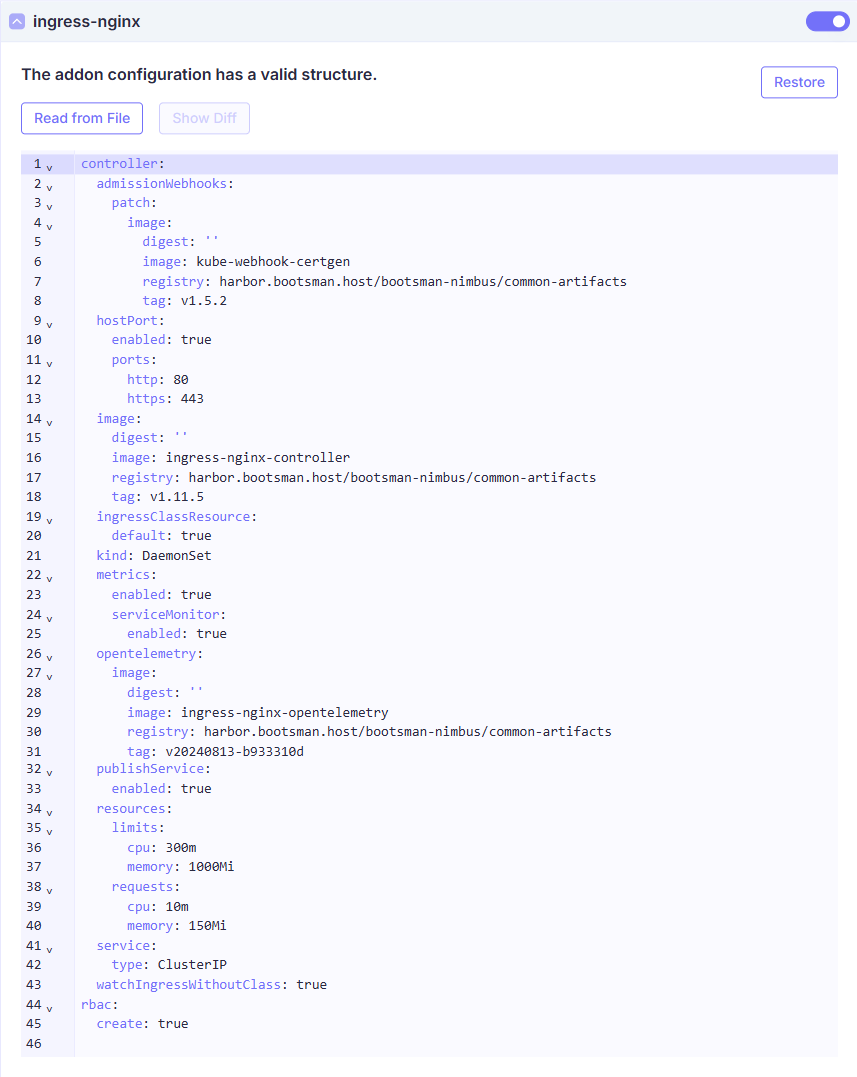
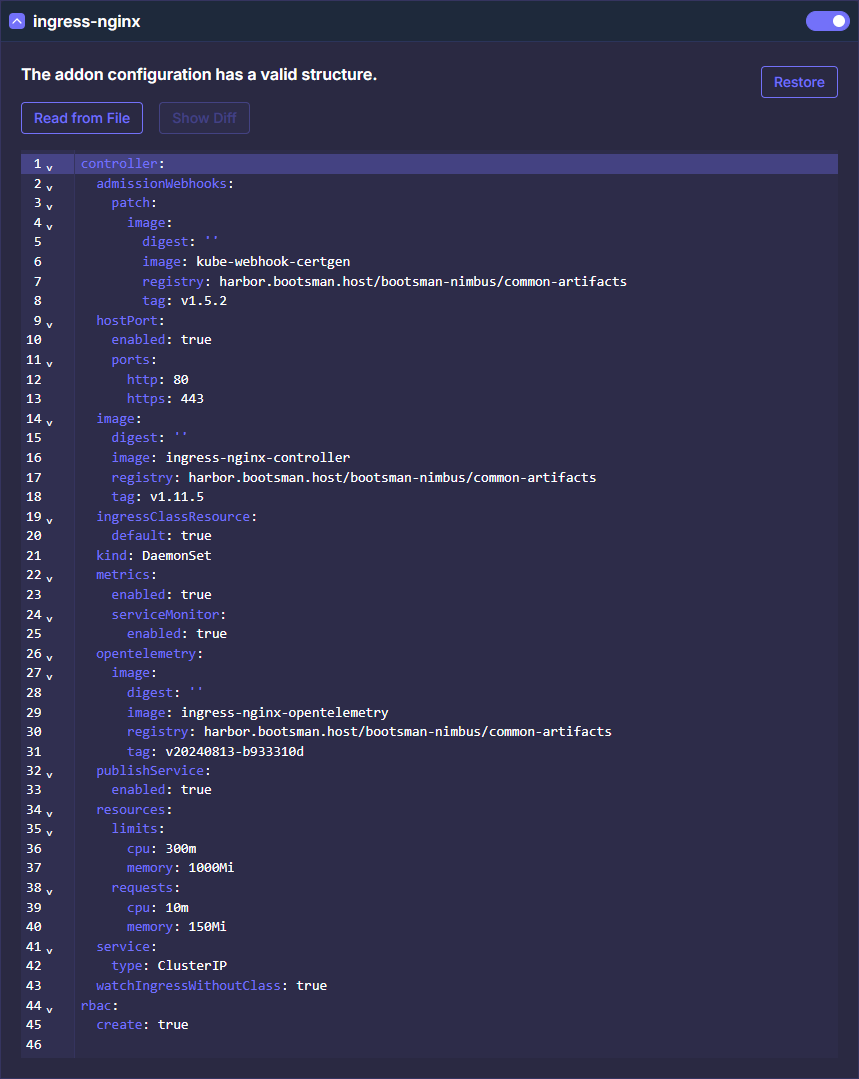
Все Values
Продвинутые настройки
Ниже представлены тонкие настройки модуля.
Используйте их для расширения конфигурации модуля, если потребуется.
Документация
Более полная документация по модулю:
Nginx Ingress Docs
Nginx Ingress Chart
ingress-nginx Values
values:
## nginx configuration
## Ref: https://github.com/kubernetes/ingress-nginx/blob/main/docs/user-guide/nginx-configuration/index.md
##
## Overrides for generated resource names
# See templates/_helpers.tpl
# nameOverride:
# fullnameOverride:
# -- Override the deployment namespace; defaults to .Release.Namespace
namespaceOverride: ""
## Labels to apply to all resources
##
commonLabels: {}
# scmhash: abc123
# myLabel: aakkmd
controller:
name: controller
enableAnnotationValidations: false
image:
## Keep false as default for now!
chroot: false
registry: harbor.bootsman.host/bootsman-nimbus/common-artifacts
image: ingress-nginx-controller
## for backwards compatibility consider setting the full image url via the repository value below
## use *either* current default registry/image or repository format or installing chart by providing the values.yaml will fail
## repository:
tag: "v1.11.5"
digest: ''
digestChroot: sha256:ec9df3eb6b06563a079ee46045da94cbf750f7dbb16fdbcb9e3265b551ed72ad
pullPolicy: IfNotPresent
runAsNonRoot: true
# www-data -> uid 101
runAsUser: 101
allowPrivilegeEscalation: false
seccompProfile:
type: RuntimeDefault
readOnlyRootFilesystem: false
# -- Use an existing PSP instead of creating one
existingPsp: ""
# -- Configures the controller container name
containerName: controller
# -- Configures the ports that the nginx-controller listens on
containerPort:
http: 80
https: 443
# -- Global configuration passed to the ConfigMap consumed by the controller. Values may contain Helm templates.
# Ref.: https://kubernetes.github.io/ingress-nginx/user-guide/nginx-configuration/configmap/
config: {}
# -- Annotations to be added to the controller config configuration configmap.
configAnnotations: {}
# -- Will add custom headers before sending traffic to backends according to https://github.com/kubernetes/ingress-nginx/tree/main/docs/examples/customization/custom-headers
proxySetHeaders: {}
# -- Will add custom headers before sending response traffic to the client according to: https://kubernetes.github.io/ingress-nginx/user-guide/nginx-configuration/configmap/#add-headers
addHeaders: {}
# -- Optionally customize the pod dnsConfig.
dnsConfig: {}
# -- Optionally customize the pod hostAliases.
hostAliases: []
# - ip: 127.0.0.1
# hostnames:
# - foo.local
# - bar.local
# - ip: 10.1.2.3
# hostnames:
# - foo.remote
# - bar.remote
# -- Optionally customize the pod hostname.
hostname: {}
# -- Optionally change this to ClusterFirstWithHostNet in case you have 'hostNetwork: true'.
# By default, while using host network, name resolution uses the host's DNS. If you wish nginx-controller
# to keep resolving names inside the k8s network, use ClusterFirstWithHostNet.
dnsPolicy: ClusterFirst
# -- Bare-metal considerations via the host network https://kubernetes.github.io/ingress-nginx/deploy/baremetal/#via-the-host-network
# Ingress status was blank because there is no Service exposing the Ingress-Nginx Controller in a configuration using the host network, the default --publish-service flag used in standard cloud setups does not apply
reportNodeInternalIp: false
# -- Process Ingress objects without ingressClass annotation/ingressClassName field
# Overrides value for --watch-ingress-without-class flag of the controller binary
# Defaults to false
watchIngressWithoutClass: true
# -- Process IngressClass per name (additionally as per spec.controller).
ingressClassByName: false
# -- This configuration enables Topology Aware Routing feature, used together with service annotation service.kubernetes.io/topology-mode="auto"
# Defaults to false
enableTopologyAwareRouting: false
# -- This configuration disable Nginx Controller Leader Election
disableLeaderElection: false
# -- Duration a leader election is valid before it's getting re-elected, e.g. `15s`, `10m` or `1h`. (Default: 30s)
electionTTL: ""
# -- This configuration defines if Ingress Controller should allow users to set
# their own *-snippet annotations, otherwise this is forbidden / dropped
# when users add those annotations.
# Global snippets in ConfigMap are still respected
allowSnippetAnnotations: false
# -- Required for use with CNI based kubernetes installations (such as ones set up by kubeadm),
# since CNI and hostport don't mix yet. Can be deprecated once https://github.com/kubernetes/kubernetes/issues/23920
# is merged
hostNetwork: false
## Use host ports 80 and 443
## Disabled by default
hostPort:
# -- Enable 'hostPort' or not
enabled: true
ports:
# -- 'hostPort' http port
http: 80
# -- 'hostPort' https port
https: 443
# NetworkPolicy for controller component.
networkPolicy:
# -- Enable 'networkPolicy' or not
enabled: false
# -- Election ID to use for status update, by default it uses the controller name combined with a suffix of 'leader'
electionID: ""
# -- This section refers to the creation of the IngressClass resource.
# IngressClasses are immutable and cannot be changed after creation.
# We do not support namespaced IngressClasses, yet, so a ClusterRole and a ClusterRoleBinding is required.
ingressClassResource:
# -- Name of the IngressClass
name: nginx
# -- Create the IngressClass or not
enabled: true
# -- If true, Ingresses without `ingressClassName` get assigned to this IngressClass on creation.
# Ingress creation gets rejected if there are multiple default IngressClasses.
# Ref: https://kubernetes.io/docs/concepts/services-networking/ingress/#default-ingress-class
default: true
# -- Annotations to be added to the IngressClass resource.
annotations: {}
# -- Controller of the IngressClass. An Ingress Controller looks for IngressClasses it should reconcile by this value.
# This value is also being set as the `--controller-class` argument of this Ingress Controller.
# Ref: https://kubernetes.io/docs/concepts/services-networking/ingress/#ingress-class
controllerValue: k8s.io/ingress-nginx
# -- Aliases of this IngressClass. Creates copies with identical settings but the respective alias as name.
# Useful for development environments with only one Ingress Controller but production-like Ingress resources.
# `default` gets enabled on the original IngressClass only.
aliases: []
# aliases:
# - nginx-alias-1
# - nginx-alias-2
# -- A link to a custom resource containing additional configuration for the controller.
# This is optional if the controller consuming this IngressClass does not require additional parameters.
# Ref: https://kubernetes.io/docs/concepts/services-networking/ingress/#ingress-class
parameters: {}
# parameters:
# apiGroup: k8s.example.com
# kind: IngressParameters
# name: external-lb
# -- For backwards compatibility with ingress.class annotation, use ingressClass.
# Algorithm is as follows, first ingressClassName is considered, if not present, controller looks for ingress.class annotation
ingressClass: nginx
# -- Labels to add to the pod container metadata
podLabels: {}
# key: value
# -- Security context for controller pods
podSecurityContext: {}
# -- sysctls for controller pods
## Ref: https://kubernetes.io/docs/tasks/administer-cluster/sysctl-cluster/
sysctls: {}
# sysctls:
# "net.core.somaxconn": "8192"
# -- Security context for controller containers
containerSecurityContext: {}
# -- Allows customization of the source of the IP address or FQDN to report
# in the ingress status field. By default, it reads the information provided
# by the service. If disable, the status field reports the IP address of the
# node or nodes where an ingress controller pod is running.
publishService:
# -- Enable 'publishService' or not
enabled: true
# -- Allows overriding of the publish service to bind to
# Must be <namespace>/<service_name>
pathOverride: ""
# Limit the scope of the controller to a specific namespace
scope:
# -- Enable 'scope' or not
enabled: false
# -- Namespace to limit the controller to; defaults to $(POD_NAMESPACE)
namespace: ""
# -- When scope.enabled == false, instead of watching all namespaces, we watching namespaces whose labels
# only match with namespaceSelector. Format like foo=bar. Defaults to empty, means watching all namespaces.
namespaceSelector: ""
# -- Allows customization of the configmap / nginx-configmap namespace; defaults to $(POD_NAMESPACE)
configMapNamespace: ""
tcp:
# -- Allows customization of the tcp-services-configmap; defaults to $(POD_NAMESPACE)
configMapNamespace: ""
# -- Annotations to be added to the tcp config configmap
annotations: {}
udp:
# -- Allows customization of the udp-services-configmap; defaults to $(POD_NAMESPACE)
configMapNamespace: ""
# -- Annotations to be added to the udp config configmap
annotations: {}
# -- Maxmind license key to download GeoLite2 Databases.
## https://blog.maxmind.com/2019/12/significant-changes-to-accessing-and-using-geolite2-databases/
maxmindLicenseKey: ""
# -- Additional command line arguments to pass to Ingress-Nginx Controller
# E.g. to specify the default SSL certificate you can use
extraArgs: {}
## extraArgs:
## default-ssl-certificate: "<namespace>/<secret_name>"
## time-buckets: "0.005,0.01,0.025,0.05,0.1,0.25,0.5,1,2.5,5,10"
## length-buckets: "10,20,30,40,50,60,70,80,90,100"
## size-buckets: "10,100,1000,10000,100000,1e+06,1e+07"
# -- Additional environment variables to set
extraEnvs: []
# extraEnvs:
# - name: FOO
# valueFrom:
# secretKeyRef:
# key: FOO
# name: secret-resource
# -- Use a `DaemonSet` or `Deployment`
kind: DaemonSet
# -- Annotations to be added to the controller Deployment or DaemonSet
##
annotations: {}
# keel.sh/pollSchedule: "@every 60m"
# -- Labels to be added to the controller Deployment or DaemonSet and other resources that do not have option to specify labels
##
labels: {}
# keel.sh/policy: patch
# keel.sh/trigger: poll
# -- The update strategy to apply to the Deployment or DaemonSet
##
updateStrategy: {}
# rollingUpdate:
# maxUnavailable: 1
# type: RollingUpdate
# -- `minReadySeconds` to avoid killing pods before we are ready
##
minReadySeconds: 0
# -- Node tolerations for server scheduling to nodes with taints
## Ref: https://kubernetes.io/docs/concepts/configuration/assign-pod-node/
##
tolerations:
- effect: NoSchedule
key: node-role.kubernetes.io/bootsman-ingress
operator: Exists
- effect: NoExecute
key: node-role.kubernetes.io/bootsman-ingress
operator: Exists
- effect: NoSchedule
key: node-role.kubernetes.io/bootsman-storage
operator: Exists
- effect: NoExecute
key: node-role.kubernetes.io/bootsman-storage
operator: Exists
- effect: NoSchedule
key: node-role.kubernetes.io/bootsman-gpu
operator: Exists
- effect: NoExecute
key: node-role.kubernetes.io/bootsman-gpu
operator: Exists
# - key: "key"
# operator: "Equal|Exists"
# value: "value"
# effect: "NoSchedule|PreferNoSchedule|NoExecute(1.6 only)"
# -- Affinity and anti-affinity rules for server scheduling to nodes
## Ref: https://kubernetes.io/docs/concepts/configuration/assign-pod-node/#affinity-and-anti-affinity
##
affinity: {}
# -- Topology spread constraints rely on node labels to identify the topology domain(s) that each Node is in.
## Ref: https://kubernetes.io/docs/concepts/workloads/pods/pod-topology-spread-constraints/
##
topologySpreadConstraints: []
# -- `terminationGracePeriodSeconds` to avoid killing pods before we are ready
## wait up to five minutes for the drain of connections
##
terminationGracePeriodSeconds: 300
# -- Node labels for controller pod assignment
## Ref: https://kubernetes.io/docs/concepts/scheduling-eviction/assign-pod-node/
##
nodeSelector:
kubernetes.io/os: linux
## Liveness and readiness probe values
## Ref: https://kubernetes.io/docs/concepts/workloads/pods/pod-lifecycle/#container-probes
##
## startupProbe:
## httpGet:
## # should match container.healthCheckPath
## path: "/healthz"
## port: 10254
## scheme: HTTP
## initialDelaySeconds: 5
## periodSeconds: 5
## timeoutSeconds: 2
## successThreshold: 1
## failureThreshold: 5
livenessProbe:
httpGet:
# should match container.healthCheckPath
path: "/healthz"
port: 10254
scheme: HTTP
initialDelaySeconds: 10
periodSeconds: 10
timeoutSeconds: 1
successThreshold: 1
failureThreshold: 5
readinessProbe:
httpGet:
# should match container.healthCheckPath
path: "/healthz"
port: 10254
scheme: HTTP
initialDelaySeconds: 10
periodSeconds: 10
timeoutSeconds: 1
successThreshold: 1
failureThreshold: 3
# -- Path of the health check endpoint. All requests received on the port defined by
# the healthz-port parameter are forwarded internally to this path.
healthCheckPath: "/healthz"
# -- Address to bind the health check endpoint.
# It is better to set this option to the internal node address
# if the Ingress-Nginx Controller is running in the `hostNetwork: true` mode.
healthCheckHost: ""
# -- Annotations to be added to controller pods
##
podAnnotations: {}
replicaCount: 1
# -- Minimum available pods set in PodDisruptionBudget.
# Define either 'minAvailable' or 'maxUnavailable', never both.
minAvailable: 1
# -- Maximum unavailable pods set in PodDisruptionBudget. If set, 'minAvailable' is ignored.
# maxUnavailable: 1
## Define requests resources to avoid probe issues due to CPU utilization in busy nodes
## ref: https://github.com/kubernetes/ingress-nginx/issues/4735#issuecomment-551204903
## Ideally, there should be no limits.
## https://engineering.indeedblog.com/blog/2019/12/cpu-throttling-regression-fix/
resources:
limits:
cpu: 300m
memory: 1000Mi
requests:
cpu: 10m
memory: 150Mi
# Mutually exclusive with keda autoscaling
autoscaling:
enabled: false
annotations: {}
minReplicas: 1
maxReplicas: 11
targetCPUUtilizationPercentage: 50
targetMemoryUtilizationPercentage: 50
behavior: {}
# scaleDown:
# stabilizationWindowSeconds: 300
# policies:
# - type: Pods
# value: 1
# periodSeconds: 180
# scaleUp:
# stabilizationWindowSeconds: 300
# policies:
# - type: Pods
# value: 2
# periodSeconds: 60
autoscalingTemplate: []
# Custom or additional autoscaling metrics
# ref: https://kubernetes.io/docs/tasks/run-application/horizontal-pod-autoscale/#support-for-custom-metrics
# - type: Pods
# pods:
# metric:
# name: nginx_ingress_controller_nginx_process_requests_total
# target:
# type: AverageValue
# averageValue: 10000m
# Mutually exclusive with hpa autoscaling
keda:
apiVersion: "keda.sh/v1alpha1"
## apiVersion changes with keda 1.x vs 2.x
## 2.x = keda.sh/v1alpha1
## 1.x = keda.k8s.io/v1alpha1
enabled: false
minReplicas: 1
maxReplicas: 11
pollingInterval: 30
cooldownPeriod: 300
# fallback:
# failureThreshold: 3
# replicas: 11
restoreToOriginalReplicaCount: false
scaledObject:
annotations: {}
# Custom annotations for ScaledObject resource
# annotations:
# key: value
triggers: []
# - type: prometheus
# metadata:
# serverAddress: http://<prometheus-host>:9090
# metricName: http_requests_total
# threshold: '100'
# query: sum(rate(http_requests_total{deployment="my-deployment"}[2m]))
behavior: {}
# scaleDown:
# stabilizationWindowSeconds: 300
# policies:
# - type: Pods
# value: 1
# periodSeconds: 180
# scaleUp:
# stabilizationWindowSeconds: 300
# policies:
# - type: Pods
# value: 2
# periodSeconds: 60
# -- Enable mimalloc as a drop-in replacement for malloc.
## ref: https://github.com/microsoft/mimalloc
##
enableMimalloc: true
## Override NGINX template
customTemplate:
configMapName: ""
configMapKey: ""
service:
# -- Enable controller services or not. This does not influence the creation of either the admission webhook or the metrics service.
enabled: true
external:
# -- Enable the external controller service or not. Useful for internal-only deployments.
enabled: true
# -- Annotations to be added to the external controller service. See `controller.service.internal.annotations` for annotations to be added to the internal controller service.
annotations: {}
# -- Labels to be added to both controller services.
labels: {}
# -- Type of the external controller service.
# Ref: https://kubernetes.io/docs/concepts/services-networking/service/#publishing-services-service-types
type: LoadBalancer
# -- Pre-defined cluster internal IP address of the external controller service. Take care of collisions with existing services.
# This value is immutable. Set once, it can not be changed without deleting and re-creating the service.
# Ref: https://kubernetes.io/docs/concepts/services-networking/service/#choosing-your-own-ip-address
clusterIP: ""
# -- List of node IP addresses at which the external controller service is available.
# Ref: https://kubernetes.io/docs/concepts/services-networking/service/#external-ips
externalIPs: []
# -- Deprecated: Pre-defined IP address of the external controller service. Used by cloud providers to connect the resulting load balancer service to a pre-existing static IP.
# Ref: https://kubernetes.io/docs/concepts/services-networking/service/#loadbalancer
loadBalancerIP: ""
# -- Restrict access to the external controller service. Values must be CIDRs. Allows any source address by default.
loadBalancerSourceRanges: []
# -- Load balancer class of the external controller service. Used by cloud providers to select a load balancer implementation other than the cloud provider default.
# Ref: https://kubernetes.io/docs/concepts/services-networking/service/#load-balancer-class
loadBalancerClass: ""
# -- Enable node port allocation for the external controller service or not. Applies to type `LoadBalancer` only.
# Ref: https://kubernetes.io/docs/concepts/services-networking/service/#load-balancer-nodeport-allocation
# allocateLoadBalancerNodePorts: true
# -- External traffic policy of the external controller service. Set to "Local" to preserve source IP on providers supporting it.
# Ref: https://kubernetes.io/docs/tasks/access-application-cluster/create-external-load-balancer/#preserving-the-client-source-ip
externalTrafficPolicy: ""
# -- Session affinity of the external controller service. Must be either "None" or "ClientIP" if set. Defaults to "None".
# Ref: https://kubernetes.io/docs/reference/networking/virtual-ips/#session-affinity
sessionAffinity: ""
# -- Specifies the health check node port (numeric port number) for the external controller service.
# If not specified, the service controller allocates a port from your cluster's node port range.
# Ref: https://kubernetes.io/docs/tasks/access-application-cluster/create-external-load-balancer/#preserving-the-client-source-ip
# healthCheckNodePort: 0
# -- Represents the dual-stack capabilities of the external controller service. Possible values are SingleStack, PreferDualStack or RequireDualStack.
# Fields `ipFamilies` and `clusterIP` depend on the value of this field.
# Ref: https://kubernetes.io/docs/concepts/services-networking/dual-stack/#services
ipFamilyPolicy: SingleStack
# -- List of IP families (e.g. IPv4, IPv6) assigned to the external controller service. This field is usually assigned automatically based on cluster configuration and the `ipFamilyPolicy` field.
# Ref: https://kubernetes.io/docs/concepts/services-networking/dual-stack/#services
ipFamilies:
- IPv4
# -- Enable the HTTP listener on both controller services or not.
enableHttp: true
# -- Enable the HTTPS listener on both controller services or not.
enableHttps: true
ports:
# -- Port the external HTTP listener is published with.
http: 80
# -- Port the external HTTPS listener is published with.
https: 443
targetPorts:
# -- Port of the ingress controller the external HTTP listener is mapped to.
http: http
# -- Port of the ingress controller the external HTTPS listener is mapped to.
https: https
# -- Declare the app protocol of the external HTTP and HTTPS listeners or not. Supersedes provider-specific annotations for declaring the backend protocol.
# Ref: https://kubernetes.io/docs/concepts/services-networking/service/#application-protocol
appProtocol: true
nodePorts:
# -- Node port allocated for the external HTTP listener. If left empty, the service controller allocates one from the configured node port range.
http: ""
# -- Node port allocated for the external HTTPS listener. If left empty, the service controller allocates one from the configured node port range.
https: ""
# -- Node port mapping for external TCP listeners. If left empty, the service controller allocates them from the configured node port range.
# Example:
# tcp:
# 8080: 30080
tcp: {}
# -- Node port mapping for external UDP listeners. If left empty, the service controller allocates them from the configured node port range.
# Example:
# udp:
# 53: 30053
udp: {}
internal:
# -- Enable the internal controller service or not. Remember to configure `controller.service.internal.annotations` when enabling this.
enabled: false
# -- Annotations to be added to the internal controller service. Mandatory for the internal controller service to be created. Varies with the cloud service.
# Ref: https://kubernetes.io/docs/concepts/services-networking/service/#internal-load-balancer
annotations: {}
# -- Type of the internal controller service.
# Defaults to the value of `controller.service.type`.
# Ref: https://kubernetes.io/docs/concepts/services-networking/service/#publishing-services-service-types
type: ""
# -- Pre-defined cluster internal IP address of the internal controller service. Take care of collisions with existing services.
# This value is immutable. Set once, it can not be changed without deleting and re-creating the service.
# Ref: https://kubernetes.io/docs/concepts/services-networking/service/#choosing-your-own-ip-address
clusterIP: ""
# -- List of node IP addresses at which the internal controller service is available.
# Ref: https://kubernetes.io/docs/concepts/services-networking/service/#external-ips
externalIPs: []
# -- Deprecated: Pre-defined IP address of the internal controller service. Used by cloud providers to connect the resulting load balancer service to a pre-existing static IP.
# Ref: https://kubernetes.io/docs/concepts/services-networking/service/#loadbalancer
loadBalancerIP: ""
# -- Restrict access to the internal controller service. Values must be CIDRs. Allows any source address by default.
loadBalancerSourceRanges: []
# -- Load balancer class of the internal controller service. Used by cloud providers to select a load balancer implementation other than the cloud provider default.
# Ref: https://kubernetes.io/docs/concepts/services-networking/service/#load-balancer-class
loadBalancerClass: ""
# -- Enable node port allocation for the internal controller service or not. Applies to type `LoadBalancer` only.
# Ref: https://kubernetes.io/docs/concepts/services-networking/service/#load-balancer-nodeport-allocation
# allocateLoadBalancerNodePorts: true
# -- External traffic policy of the internal controller service. Set to "Local" to preserve source IP on providers supporting it.
# Ref: https://kubernetes.io/docs/tasks/access-application-cluster/create-external-load-balancer/#preserving-the-client-source-ip
externalTrafficPolicy: ""
# -- Session affinity of the internal controller service. Must be either "None" or "ClientIP" if set. Defaults to "None".
# Ref: https://kubernetes.io/docs/reference/networking/virtual-ips/#session-affinity
sessionAffinity: ""
# -- Specifies the health check node port (numeric port number) for the internal controller service.
# If not specified, the service controller allocates a port from your cluster's node port range.
# Ref: https://kubernetes.io/docs/tasks/access-application-cluster/create-external-load-balancer/#preserving-the-client-source-ip
# healthCheckNodePort: 0
# -- Represents the dual-stack capabilities of the internal controller service. Possible values are SingleStack, PreferDualStack or RequireDualStack.
# Fields `ipFamilies` and `clusterIP` depend on the value of this field.
# Ref: https://kubernetes.io/docs/concepts/services-networking/dual-stack/#services
ipFamilyPolicy: SingleStack
# -- List of IP families (e.g. IPv4, IPv6) assigned to the internal controller service. This field is usually assigned automatically based on cluster configuration and the `ipFamilyPolicy` field.
# Ref: https://kubernetes.io/docs/concepts/services-networking/dual-stack/#services
ipFamilies:
- IPv4
ports: {}
# -- Port the internal HTTP listener is published with.
# Defaults to the value of `controller.service.ports.http`.
# http: 80
# -- Port the internal HTTPS listener is published with.
# Defaults to the value of `controller.service.ports.https`.
# https: 443
targetPorts: {}
# -- Port of the ingress controller the internal HTTP listener is mapped to.
# Defaults to the value of `controller.service.targetPorts.http`.
# http: http
# -- Port of the ingress controller the internal HTTPS listener is mapped to.
# Defaults to the value of `controller.service.targetPorts.https`.
# https: https
# -- Declare the app protocol of the internal HTTP and HTTPS listeners or not. Supersedes provider-specific annotations for declaring the backend protocol.
# Ref: https://kubernetes.io/docs/concepts/services-networking/service/#application-protocol
appProtocol: true
nodePorts:
# -- Node port allocated for the internal HTTP listener. If left empty, the service controller allocates one from the configured node port range.
http: ""
# -- Node port allocated for the internal HTTPS listener. If left empty, the service controller allocates one from the configured node port range.
https: ""
# -- Node port mapping for internal TCP listeners. If left empty, the service controller allocates them from the configured node port range.
# Example:
# tcp:
# 8080: 30080
tcp: {}
# -- Node port mapping for internal UDP listeners. If left empty, the service controller allocates them from the configured node port range.
# Example:
# udp:
# 53: 30053
udp: {}
# shareProcessNamespace enables process namespace sharing within the pod.
# This can be used for example to signal log rotation using `kill -USR1` from a sidecar.
shareProcessNamespace: false
# -- Additional containers to be added to the controller pod.
# See https://github.com/lemonldap-ng-controller/lemonldap-ng-controller as example.
extraContainers: []
# - name: my-sidecar
# image: nginx:latest
# - name: lemonldap-ng-controller
# image: lemonldapng/lemonldap-ng-controller:0.2.0
# args:
# - /lemonldap-ng-controller
# - --alsologtostderr
# - --configmap=$(POD_NAMESPACE)/lemonldap-ng-configuration
# env:
# - name: POD_NAME
# valueFrom:
# fieldRef:
# fieldPath: metadata.name
# - name: POD_NAMESPACE
# valueFrom:
# fieldRef:
# fieldPath: metadata.namespace
# volumeMounts:
# - name: copy-portal-skins
# mountPath: /srv/var/lib/lemonldap-ng/portal/skins
# -- Additional volumeMounts to the controller main container.
extraVolumeMounts: []
# - name: copy-portal-skins
# mountPath: /var/lib/lemonldap-ng/portal/skins
# -- Additional volumes to the controller pod.
extraVolumes: []
# - name: copy-portal-skins
# emptyDir: {}
# -- Containers, which are run before the app containers are started.
extraInitContainers: []
# - name: init-myservice
# image: busybox
# command: ['sh', '-c', 'until nslookup myservice; do echo waiting for myservice; sleep 2; done;']
# -- Modules, which are mounted into the core nginx image. See values.yaml for a sample to add opentelemetry module
extraModules: []
# - name: mytestmodule
# image:
# registry: harbor.bootsman.host/bootsman-nimbus/common-artifacts
# image: ingress-nginx/mytestmodule
# ## for backwards compatibility consider setting the full image url via the repository value below
# ## use *either* current default registry/image or repository format or installing chart by providing the values.yaml will fail
# ## repository:
# tag: "v1.0.0"
# digest: ""
# distroless: false
# containerSecurityContext:
# runAsNonRoot: true
# runAsUser: <user-id>
# allowPrivilegeEscalation: false
# seccompProfile:
# type: RuntimeDefault
# capabilities:
# drop:
# - ALL
# readOnlyRootFilesystem: true
# resources: {}
#
# The image must contain a `/usr/local/bin/init_module.sh` executable, which
# will be executed as initContainers, to move its config files within the
# mounted volume.
opentelemetry:
enabled: false
name: opentelemetry
image:
registry: harbor.bootsman.host/bootsman-nimbus/common-artifacts
image: ingress-nginx/opentelemetry-1.25.3
## for backwards compatibility consider setting the full image url via the repository value below
## use *either* current default registry/image or repository format or installing chart by providing the values.yaml will fail
## repository:
tag: v20240813-b933310d
digest: sha256:f7604ac0547ed64d79b98d92133234e66c2c8aade3c1f4809fed5eec1fb7f922
distroless: true
containerSecurityContext:
runAsNonRoot: true
# -- The image's default user, inherited from its base image `cgr.dev/chainguard/static`.
runAsUser: 65532
allowPrivilegeEscalation: false
seccompProfile:
type: RuntimeDefault
capabilities:
drop:
- ALL
readOnlyRootFilesystem: true
resources: {}
admissionWebhooks:
name: admission
annotations: {}
# ignore-check.kube-linter.io/no-read-only-rootfs: "This deployment needs write access to root filesystem".
## Additional annotations to the admission webhooks.
## These annotations will be added to the ValidatingWebhookConfiguration and
## the Jobs Spec of the admission webhooks.
enabled: true
# -- Additional environment variables to set
extraEnvs: []
# extraEnvs:
# - name: FOO
# valueFrom:
# secretKeyRef:
# key: FOO
# name: secret-resource
# -- Admission Webhook failure policy to use
failurePolicy: Fail
# timeoutSeconds: 10
port: 8443
certificate: "/usr/local/certificates/cert"
key: "/usr/local/certificates/key"
namespaceSelector: {}
objectSelector: {}
# -- Labels to be added to admission webhooks
labels: {}
# -- Use an existing PSP instead of creating one
existingPsp: ""
service:
annotations: {}
# clusterIP: ""
externalIPs: []
# loadBalancerIP: ""
loadBalancerSourceRanges: []
servicePort: 443
type: ClusterIP
createSecretJob:
name: create
# -- Security context for secret creation containers
securityContext:
runAsNonRoot: true
runAsUser: 65532
allowPrivilegeEscalation: false
seccompProfile:
type: RuntimeDefault
capabilities:
drop:
- ALL
readOnlyRootFilesystem: true
resources: {}
# limits:
# cpu: 10m
# memory: 20Mi
# requests:
# cpu: 10m
# memory: 20Mi
patchWebhookJob:
name: patch
# -- Security context for webhook patch containers
securityContext:
runAsNonRoot: true
runAsUser: 65532
allowPrivilegeEscalation: false
seccompProfile:
type: RuntimeDefault
capabilities:
drop:
- ALL
readOnlyRootFilesystem: true
resources: {}
patch:
enabled: true
image:
registry: harbor.bootsman.host/bootsman-nimbus/common-artifacts
image: kube-webhook-certgen
## for backwards compatibility consider setting the full image url via the repository value below
## use *either* current default registry/image or repository format or installing chart by providing the values.yaml will fail
## repository:
tag: v1.5.2
digest: ''
pullPolicy: IfNotPresent
# -- Provide a priority class name to the webhook patching job
##
priorityClassName: ""
podAnnotations: {}
# NetworkPolicy for webhook patch
networkPolicy:
# -- Enable 'networkPolicy' or not
enabled: false
nodeSelector:
kubernetes.io/os: linux
tolerations:
- effect: NoSchedule
key: node-role.kubernetes.io/bootsman-ingress
operator: Exists
- effect: NoExecute
key: node-role.kubernetes.io/bootsman-ingress
operator: Exists
- effect: NoSchedule
key: node-role.kubernetes.io/bootsman-storage
operator: Exists
- effect: NoExecute
key: node-role.kubernetes.io/bootsman-storage
operator: Exists
- effect: NoSchedule
key: node-role.kubernetes.io/bootsman-gpu
operator: Exists
- effect: NoExecute
key: node-role.kubernetes.io/bootsman-gpu
operator: Exists
# -- Labels to be added to patch job resources
labels: {}
# -- Security context for secret creation & webhook patch pods
securityContext: {}
# -- Admission webhook patch job RBAC
rbac:
# -- Create RBAC or not
create: true
# -- Admission webhook patch job service account
serviceAccount:
# -- Create a service account or not
create: true
# -- Custom service account name
name: ""
# -- Auto-mount service account token or not
automountServiceAccountToken: true
# Use certmanager to generate webhook certs
certManager:
enabled: false
# self-signed root certificate
rootCert:
# default to be 5y
duration: ""
admissionCert:
# default to be 1y
duration: ""
# issuerRef:
# name: "issuer"
# kind: "ClusterIssuer"
metrics:
port: 10254
portName: metrics
# if this port is changed, change healthz-port: in extraArgs: accordingly
enabled: true
service:
annotations: {}
# prometheus.io/scrape: "true"
# prometheus.io/port: "10254"
# -- Labels to be added to the metrics service resource
labels: {}
# clusterIP: ""
# -- List of IP addresses at which the stats-exporter service is available
## Ref: https://kubernetes.io/docs/concepts/services-networking/service/#external-ips
##
externalIPs: []
# loadBalancerIP: ""
loadBalancerSourceRanges: []
servicePort: 10254
type: ClusterIP
# externalTrafficPolicy: ""
# nodePort: ""
serviceMonitor:
enabled: true
additionalLabels: {}
# -- Annotations to be added to the ServiceMonitor.
annotations: {}
## The label to use to retrieve the job name from.
## jobLabel: "app.kubernetes.io/name"
namespace: ""
namespaceSelector: {}
## Default: scrape .Release.Namespace or namespaceOverride only
## To scrape all, use the following:
## namespaceSelector:
## any: true
scrapeInterval: 30s
# honorLabels: true
targetLabels: []
relabelings: []
metricRelabelings: []
prometheusRule:
enabled: false
additionalLabels: {}
# namespace: ""
rules: []
# # These are just examples rules, please adapt them to your needs
# - alert: NGINXConfigFailed
# expr: count(nginx_ingress_controller_config_last_reload_successful == 0) > 0
# for: 1s
# labels:
# severity: critical
# annotations:
# description: bad ingress config - nginx config test failed
# summary: uninstall the latest ingress changes to allow config reloads to resume
# # By default a fake self-signed certificate is generated as default and
# # it is fine if it expires. If `--default-ssl-certificate` flag is used
# # and a valid certificate passed please do not filter for `host` label!
# # (i.e. delete `{host!="_"}` so also the default SSL certificate is
# # checked for expiration)
# - alert: NGINXCertificateExpiry
# expr: (avg(nginx_ingress_controller_ssl_expire_time_seconds{host!="_"}) by (host) - time()) < 604800
# for: 1s
# labels:
# severity: critical
# annotations:
# description: ssl certificate(s) will expire in less then a week
# summary: renew expiring certificates to avoid downtime
# - alert: NGINXTooMany500s
# expr: 100 * ( sum( nginx_ingress_controller_requests{status=~"5.+"} ) / sum(nginx_ingress_controller_requests) ) > 5
# for: 1m
# labels:
# severity: warning
# annotations:
# description: Too many 5XXs
# summary: More than 5% of all requests returned 5XX, this requires your attention
# - alert: NGINXTooMany400s
# expr: 100 * ( sum( nginx_ingress_controller_requests{status=~"4.+"} ) / sum(nginx_ingress_controller_requests) ) > 5
# for: 1m
# labels:
# severity: warning
# annotations:
# description: Too many 4XXs
# summary: More than 5% of all requests returned 4XX, this requires your attention
# -- Improve connection draining when ingress controller pod is deleted using a lifecycle hook:
# With this new hook, we increased the default terminationGracePeriodSeconds from 30 seconds
# to 300, allowing the draining of connections up to five minutes.
# If the active connections end before that, the pod will terminate gracefully at that time.
# To effectively take advantage of this feature, the Configmap feature
# worker-shutdown-timeout new value is 240s instead of 10s.
##
lifecycle:
preStop:
exec:
command:
- /wait-shutdown
priorityClassName: ""
# -- Rollback limit
##
revisionHistoryLimit: 10
## Default 404 backend
##
defaultBackend:
##
enabled: false
name: defaultbackend
image:
registry: harbor.bootsman.host/bootsman-nimbus/common-artifacts
image: defaultbackend-amd64
## for backwards compatibility consider setting the full image url via the repository value below
## use *either* current default registry/image or repository format or installing chart by providing the values.yaml will fail
## repository:
tag: "1.5"
pullPolicy: IfNotPresent
runAsNonRoot: true
# nobody user -> uid 65534
runAsUser: 65534
allowPrivilegeEscalation: false
seccompProfile:
type: RuntimeDefault
readOnlyRootFilesystem: true
# -- Use an existing PSP instead of creating one
existingPsp: ""
extraArgs: {}
serviceAccount:
create: true
name: ""
automountServiceAccountToken: true
# -- Additional environment variables to set for defaultBackend pods
extraEnvs: []
port: 8080
## Readiness and liveness probes for default backend
## Ref: https://kubernetes.io/docs/tasks/configure-pod-container/configure-liveness-readiness-probes/
##
livenessProbe:
failureThreshold: 3
initialDelaySeconds: 30
periodSeconds: 10
successThreshold: 1
timeoutSeconds: 5
readinessProbe:
failureThreshold: 6
initialDelaySeconds: 0
periodSeconds: 5
successThreshold: 1
timeoutSeconds: 5
# -- The update strategy to apply to the Deployment or DaemonSet
##
updateStrategy: {}
# rollingUpdate:
# maxUnavailable: 1
# type: RollingUpdate
# -- `minReadySeconds` to avoid killing pods before we are ready
##
minReadySeconds: 0
# -- Node tolerations for server scheduling to nodes with taints
## Ref: https://kubernetes.io/docs/concepts/configuration/assign-pod-node/
##
tolerations:
- effect: NoSchedule
key: node-role.kubernetes.io/bootsman-ingress
operator: Exists
- effect: NoExecute
key: node-role.kubernetes.io/bootsman-ingress
operator: Exists
- effect: NoSchedule
key: node-role.kubernetes.io/bootsman-storage
operator: Exists
- effect: NoExecute
key: node-role.kubernetes.io/bootsman-storage
operator: Exists
- effect: NoSchedule
key: node-role.kubernetes.io/bootsman-gpu
operator: Exists
- effect: NoExecute
key: node-role.kubernetes.io/bootsman-gpu
operator: Exists
# - key: "key"
# operator: "Equal|Exists"
# value: "value"
# effect: "NoSchedule|PreferNoSchedule|NoExecute(1.6 only)"
# -- Affinity and anti-affinity rules for server scheduling to nodes
## Ref: https://kubernetes.io/docs/concepts/configuration/assign-pod-node/#affinity-and-anti-affinity
affinity: {}
# -- Topology spread constraints rely on node labels to identify the topology domain(s) that each Node is in.
# Ref.: https://kubernetes.io/docs/concepts/workloads/pods/pod-topology-spread-constraints/
topologySpreadConstraints: []
# -- Security context for default backend pods
podSecurityContext: {}
# -- Security context for default backend containers
containerSecurityContext: {}
# -- Labels to add to the pod container metadata
podLabels: {}
# key: value
# -- Node labels for default backend pod assignment
## Ref: https://kubernetes.io/docs/concepts/scheduling-eviction/assign-pod-node/
##
nodeSelector:
kubernetes.io/os: linux
# -- Annotations to be added to default backend pods
##
podAnnotations: {}
replicaCount: 1
# -- Minimum available pods set in PodDisruptionBudget.
minAvailable: 1
resources: {}
# limits:
# cpu: 10m
# memory: 20Mi
# requests:
# cpu: 10m
# memory: 20Mi
extraVolumeMounts: []
## Additional volumeMounts to the default backend container.
# - name: copy-portal-skins
# mountPath: /var/lib/lemonldap-ng/portal/skins
extraVolumes: []
## Additional volumes to the default backend pod.
# - name: copy-portal-skins
# emptyDir: {}
extraConfigMaps: []
## Additional configmaps to the default backend pod.
# - name: my-extra-configmap-1
# labels:
# type: config-1
# data:
# extra_file_1.html: |
# <!-- Extra HTML content for ConfigMap 1 -->
# - name: my-extra-configmap-2
# labels:
# type: config-2
# data:
# extra_file_2.html: |
# <!-- Extra HTML content for ConfigMap 2 -->
autoscaling:
annotations: {}
enabled: false
minReplicas: 1
maxReplicas: 2
targetCPUUtilizationPercentage: 50
targetMemoryUtilizationPercentage: 50
# NetworkPolicy for default backend component.
networkPolicy:
# -- Enable 'networkPolicy' or not
enabled: false
service:
annotations: {}
# clusterIP: ""
# -- List of IP addresses at which the default backend service is available
## Ref: https://kubernetes.io/docs/concepts/services-networking/service/#external-ips
##
externalIPs: []
# loadBalancerIP: ""
loadBalancerSourceRanges: []
servicePort: 80
type: ClusterIP
priorityClassName: ""
# -- Labels to be added to the default backend resources
labels: {}
## Enable RBAC as per https://github.com/kubernetes/ingress-nginx/blob/main/docs/deploy/rbac.md and https://github.com/kubernetes/ingress-nginx/issues/266
rbac:
create: true
scope: false
## If true, create & use Pod Security Policy resources
## https://kubernetes.io/docs/concepts/policy/pod-security-policy/
podSecurityPolicy:
enabled: false
serviceAccount:
create: true
name: ""
automountServiceAccountToken: true
# -- Annotations for the controller service account
annotations: {}
# -- Optional array of imagePullSecrets containing private registry credentials
## Ref: https://kubernetes.io/docs/tasks/configure-pod-container/pull-image-private-registry/
imagePullSecrets: []
# - name: secretName
# -- TCP service key-value pairs
## Ref: https://github.com/kubernetes/ingress-nginx/blob/main/docs/user-guide/exposing-tcp-udp-services.md
##
tcp: {}
# "8080": "default/example-tcp-svc:9000"
# -- UDP service key-value pairs
## Ref: https://github.com/kubernetes/ingress-nginx/blob/main/docs/user-guide/exposing-tcp-udp-services.md
##
udp: {}
# "53": "kube-system/kube-dns:53"
# -- Prefix for TCP and UDP ports names in ingress controller service
## Some cloud providers, like Yandex Cloud may have a requirements for a port name regex to support cloud load balancer integration
portNamePrefix: ""
# -- (string) A base64-encoded Diffie-Hellman parameter.
# This can be generated with: `openssl dhparam 4096 2> /dev/null | base64`
## Ref: https://github.com/kubernetes/ingress-nginx/tree/main/docs/examples/customization/ssl-dh-param
dhParam: ""
Настройка модуля в соответствии с ролью Bootsman-ingress
apiVersion: addon.bootsman.tech/v1alpha1
kind: Config
metadata:
  name: CLUSTER_NAME-ingress-nginx
  namespace: CLUSTER_NAMESPACE
spec:
  enabled: true
  values:
    controller:
      affinity:
        nodeAffinity:
          requiredDuringSchedulingIgnoredDuringExecution:
            nodeSelectorTerms:
              - matchExpressions:
                  - key: node-role.kubernetes.io/ingress
                    operator: Exists
      image:
        registry: harbor.bootsman.host/bootsman-nimbus/common-artifacts
        image: ingress-nginx-controller
        tag: "v1.11.5"
        digest: ""
      opentelemetry:
        image:
          registry: harbor.bootsman.host/bootsman-nimbus/common-artifacts
          image: ingress-nginx-opentelemetry
          tag: "v20240813-b933310d"
          digest: ""
      admissionWebhooks:
        patch:
          image:
            registry: harbor.bootsman.host/bootsman-nimbus/common-artifacts
            image: kube-webhook-certgen
            tag: v1.5.2
            digest: ""
      resources:
        limits:
          cpu: 300m
          memory: 1000Mi
        requests:
          cpu: 10m
          memory: 150Mi
      metrics:
        enabled: true
        serviceMonitor:
          enabled: true
      kind: DaemonSet
      service:
        type: ClusterIP
      hostPort:
        enabled: true
        ports:
          http: 80
          https: 443
      ingressClassResource:
        default: true
      publishService:
        enabled: true
      watchIngressWithoutClass: true
    rbac:
      create: true
apiVersion: addon.bootsman.tech/v1alpha1
kind: Config
metadata:
  name: CLUSTER_NAME-ingress-nginx
  namespace: CLUSTER_NAMESPACE
spec:
  enabled: true
  values:
    controller:
      affinity:
        nodeAffinity:
          requiredDuringSchedulingIgnoredDuringExecution:
            nodeSelectorTerms:
              - matchExpressions:
                  - key: node-role.kubernetes.io/ingress
                    operator: Exists
      image:
        registry: harbor.bootsman.host/bootsman-nimbus/common-artifacts
        image: ingress-nginx-controller
        tag: "v1.11.5"
        digest: ""
      opentelemetry:
        image:
          registry: harbor.bootsman.host/bootsman-nimbus/common-artifacts
          image: ingress-nginx-opentelemetry
          tag: "v20240813-b933310d"
          digest: ""
      admissionWebhooks:
        patch:
          image:
            registry: harbor.bootsman.host/bootsman-nimbus/common-artifacts
            image: kube-webhook-certgen
            tag: v1.5.2
            digest: ""
      resources:
        limits:
          cpu: 300m
          memory: 1000Mi
        requests:
          cpu: 10m
          memory: 150Mi
      metrics:
        enabled: true
        serviceMonitor:
          enabled: true
      kind: DaemonSet
      service:
        type: LoadBalancer
        externalTrafficPolicy: Local
      ingressClassResource:
        default: true
      publishService:
        enabled: true
      watchIngressWithoutClass: true
    rbac:
      create: true
Установка default сертификата для ingress
Заметка
Установку поддерживает любой кластер Bootsman как управляющий, так и подчиненный. Для этого нужен установленный модуль ingress-nginx
Размещение сертификата на кластере
Создайте секрет, содержащий в себе сертификат и ключ. Например, с помощью kubectl
- default-cert - имя секрета, в котором будет хранится сертификат
./tls.key - путь и имя ключа сертификата на машине, на которой выполняется kubectl
./tls.crt - путь и имя сертификата на машине, на которой выполняется kubectl
Изменение конфигурации модуля
Для внесения изменений можно использовать Web панель или kubectl.
Требуется отредактировать объект Config.addon.bootsman.tech
Задайте имя управляющего кластера для будущих команд