Cilium Tetragon
Описание
Модуль Cilium Tetragon обеспечивает мониторинг выполнения процессов, сетевой активности и файловых операций, применяя политики безопасности непосредственно на ядре.
Подключение модуля Cilium Tetragon
Описание Yaml
apiVersion: addon.bootsman.tech/v1alpha1
kind: Config
metadata:
  name: CLUSTER_NAME-tetragon
  namespace: CLUSTER_NAMESPACE
spec:
  enabled: true (1)
  values:
    tetragon:
      image:
        repository: harbor.bootsman.host/bootsman-nimbus/common-artifacts/tetragon
    tetragonOperator:
      image:
        repository: harbor.bootsman.host/bootsman-nimbus/common-artifacts/tetragon-operator
    export:
      stdout:
        image:
          repository: harbor.bootsman.host/bootsman-nimbus/common-artifacts/hubble-export-stdout
    rthooks:
      image:
        repository: harbor.bootsman.host/bootsman-nimbus/common-artifacts/tetragon-rthooks
- True - включено.
False - выключено
Настройка в UI
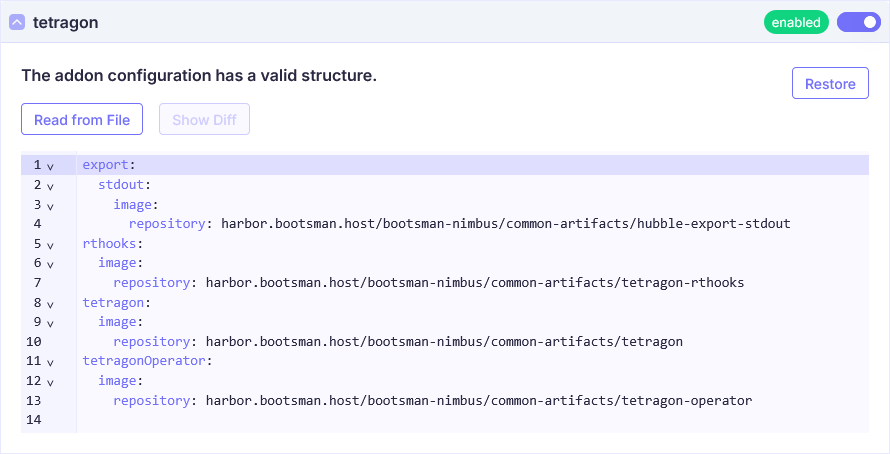
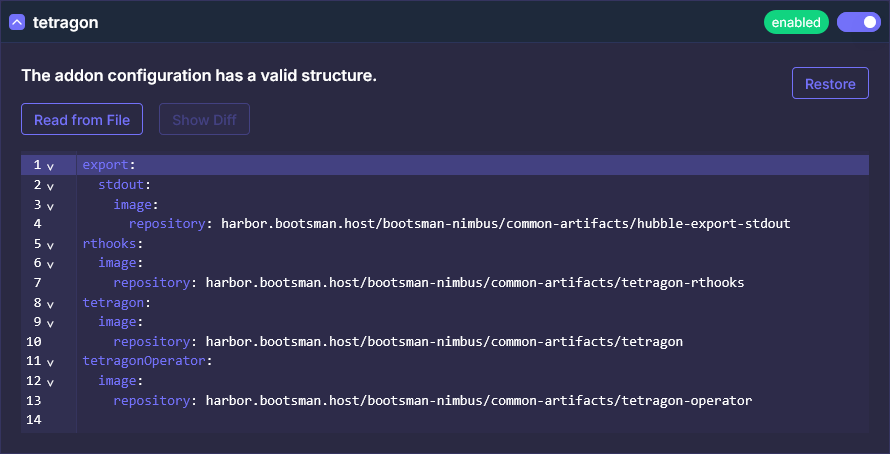
Все Values
Продвинутые настройки
Ниже представлены тонкие настройки модуля.
Используйте их для расширения конфигурации модуля, если потребуется.
Документация
Более полная документация по модулю:
Cilium Tetragon Docs
Cilium Tetragon Values
# Global settings
enabled: true
imagePullSecrets: []
# Tetragon agent settings
priorityClassName: ""
imagePullPolicy: IfNotPresent
serviceAccount:
  create: true
  annotations: {}
  name: ""
podAnnotations: {}
podSecurityContext: {}
nodeSelector: {}
tolerations:
  - operator: Exists
affinity: {}
extraHostPathMounts: []
extraConfigmapMounts: []
daemonSetAnnotations: {}
extraVolumes: []
updateStrategy: {}
podLabels: {}
daemonSetLabelsOverride: {}
selectorLabelsOverride: {}
podLabelsOverride: {}
serviceLabelsOverride: {}
# -- DNS policy for Tetragon pods.
#
# https://kubernetes.io/docs/concepts/services-networking/dns-pod-service/#pod-s-dns-policy
dnsPolicy: Default
# -- Directory to put Tetragon JSON export files.
exportDirectory: "/var/run/cilium/tetragon"
# -- Configures whether Tetragon pods run on the host network.
#
# IMPORTANT: Tetragon must be on the host network for the process visibility to
# function properly.
hostNetwork: true
tetragon:
  enabled: true
  nameOverride: ""
  image:
    override: ~
    repository: harbor.bootsman.host/bootsman-nimbus/common-artifacts/tetragon
    tag: v1.6.0
  resources: {}
  extraArgs: {}
  extraEnv: []
  # extraEnv:
  #   - name: foo
  #     value: bar
  podAnnotations:
    enabled: false
  extraVolumeMounts: []
  securityContext:
    privileged: true
  # -- Overrides the default livenessProbe for the tetragon container.
  livenessProbe: {}
  #  grpc:
  #    port: 54321

  # -- Tetragon puts processes in an LRU cache. The cache is used to find ancestors
  # for subsequently exec'ed processes.
  processCacheSize: 65536
  # -- If you want to run Tetragon in debug mode change this value to true
  debug: false
  # -- JSON export filename. Set it to an empty string to disable JSON export altogether.
  exportFilename: tetragon.log
  # -- JSON export file permissions as a string. Typically it's either "600" (to restrict access to
  # owner) or "640"/"644" (to allow read access by logs collector or another agent).
  exportFilePerm: "600"
  # -- Size in megabytes at which to rotate JSON export files.
  exportFileMaxSizeMB: 10
  # -- Number of rotated files to retain.
  exportFileMaxBackups: 5
  # -- Compress rotated JSON export files.
  exportFileCompress: false
  # -- Rate-limit event export (events per minute), Set to -1 to export all events.
  exportRateLimit: -1
  # -- Allowlist for JSON export. For example, to export only process_connect events from
  # the default namespace:
  #
  # exportAllowList: |
  #   {"namespace":["default"],"event_set":["PROCESS_EXEC"]}
  exportAllowList: |-
    {"event_set":["PROCESS_EXEC", "PROCESS_EXIT", "PROCESS_KPROBE", "PROCESS_UPROBE", "PROCESS_TRACEPOINT", "PROCESS_LSM"]}
  # -- Denylist for JSON export **(for file sinks only; does not filter gRPC output)**. For example, to exclude exec events that look similar to
  # Kubernetes health checks and all the events from kube-system namespace and the host:
  #
  # exportDenyList: |
  #   {"health_check":true}
  #   {"namespace":["kube-system",""]}
  #
  exportDenyList: |-
    {"health_check":true}
    {"namespace":["", "cilium", "kube-system"]}
  # -- Filters to include or exclude fields from Tetragon events. Without any filters, all
  # fields are included by default. The presence of at least one inclusion filter implies
  # default-exclude (i.e. any fields that don't match an inclusion filter will be
  # excluded). Field paths are expressed using dot notation like "a.b.c" and multiple
  # field paths can be separated by commas like "a.b.c,d,e.f". An optional "event_set" may
  # be specified to apply the field filter to a specific set of events.
  #
  # For example, to exclude the "parent" field from all events and include the "process"
  # field in PROCESS_KPROBE events while excluding all others:
  #
  # fieldFilters: |
  #   {"fields": "parent", "action": "EXCLUDE"}
  #   {"event_set": ["PROCESS_KPROBE"], "fields": "process", "action": "INCLUDE"}
  #
  fieldFilters: ""
  # -- Filters to redact secrets from the args fields in Tetragon events. To perform
  # redactions, redaction filters define RE2 regular expressions in the `redact`
  # field. Any capture groups in these RE2 regular expressions are redacted and
  # replaced with "*****".
  #
  # For more control, you can select which binary or binaries should have their
  # arguments redacted with the `binary_regex` field.
  #
  # NOTE: This feature uses RE2 as its regular expression library. Make sure that you follow
  # RE2 regular expression guidelines as you may observe unexpected results otherwise.
  # More information on RE2 syntax can be found [here](https://github.com/google/re2/wiki/Syntax).
  #
  # NOTE: When writing regular expressions in JSON, it is important to escape
  # backslash characters. For instance `\Wpasswd\W?` would be written as
  # `{"redact": "\\Wpasswd\\W?"}`.
  #
  # As a concrete example, the following will redact all passwords passed to
  # processes with the "--password" argument:
  #
  #   {"redact": ["--password(?:\\s+|=)(\\S*)"]}
  #
  # Now, an event which contains the string "--password=foo" would have that
  # string replaced with "--password=*****".
  #
  # Suppose we also see some passwords passed via the -p shorthand for a specific binary, foo.
  # We can also redact these as follows:
  #
  #   {"binary_regex": ["(?:^|/)foo$"], "redact": ["-p(?:\\s+|=)(\\S*)"]}
  #
  # With both of the above redaction filters in place, we are now redacting all
  # password arguments.
  redactionFilters: ""
  # -- Name of the cluster where Tetragon is installed. Tetragon uses this value
  # to set the cluster_name field in GetEventsResponse messages.
  clusterName: ""
  # -- Access Kubernetes API to associate Tetragon events with Kubernetes pods.
  enableK8sAPI: true
  # -- Enable Capabilities visibility in exec and kprobe events.
  enableProcessCred: false
  # -- Enable Namespaces visibility in exec and kprobe events.
  enableProcessNs: false
  processAncestors:
    # -- Comma-separated list of process event types to enable ancestors for.
    # Supported event types are: base, kprobe, tracepoint, loader, uprobe, lsm, usdt. Unknown event types will be ignored.
    # Type "base" is required by all other supported event types for correct reference counting.
    # Set it to "" to disable ancestors completely.
    enabled: ""
  # -- Set --btf option to explicitly specify an absolute path to a btf file. For advanced users only.
  btf: ""
  # -- Override the command. For advanced users only.
  commandOverride: []
  # -- Override the arguments. For advanced users only.
  argsOverride: []
  prometheus:
    # -- Whether to enable exposing Tetragon metrics.
    enabled: true
    # -- The address at which to expose metrics. Set it to "" to expose on all available interfaces.
    address: ""
    # -- The port at which to expose metrics.
    port: 2112
    # -- Comma-separated list of enabled metrics labels.
    # The configurable labels are: namespace, workload, pod, binary. Unknown labels will be ignored.
    # Removing some labels from the list might help reduce the metrics cardinality if needed.
    metricsLabelFilter: "namespace,workload,pod,binary"
    serviceMonitor:
      # -- Whether to create a 'ServiceMonitor' resource targeting the tetragon pods.
      enabled: false
      # -- The set of labels to place on the 'ServiceMonitor' resource.
      labelsOverride: {}
      # -- Extra labels to be added on the Tetragon ServiceMonitor.
      extraLabels: {}
      # -- Interval at which metrics should be scraped. If not specified, Prometheus' global scrape interval is used.
      scrapeInterval: 60s
  grpc:
    # -- Whether to enable exposing Tetragon gRPC.
    enabled: true
    # -- The address at which to expose gRPC. Examples: localhost:54321, unix:///var/run/cilum/tetragon/tetragon.sock
    address: "localhost:54321"
  gops:
    # -- Whether to enable exposing gops server.
    enabled: true
    # -- The address at which to expose gops.
    address: "localhost"
    # -- The port at which to expose gops.
    port: 8118
  pprof:
    # -- Whether to enable exposing pprof server.
    enabled: false
    # -- The address at which to expose pprof.
    address: "localhost"
    # -- The port at which to expose pprof.
    port: 6060
  # -- Enable policy filter. This is required for K8s namespace and pod-label filtering.
  enablePolicyFilter: True
  # -- Enable policy filter cgroup map.
  enablePolicyFilterCgroupMap: false
  # -- Enable policy filter debug messages.
  enablePolicyFilterDebug: false
  # -- Enable latency monitoring in message handling
  enableMsgHandlingLatency: false
  healthGrpc:
    # -- Whether to enable health gRPC server.
    enabled: true
    # -- The port at which to expose health gRPC.
    port: 6789
    # -- The interval at which to check the health of the agent.
    interval: 10
  # -- Location of the host proc filesystem in the runtime environment. If the runtime runs in the
  # host, the path is /proc. Exceptions to this are environments like kind, where the runtime itself
  # does not run on the host.
  hostProcPath: "/proc"
  # -- Configure the number of retries in tetragon's event cache.
  eventCacheRetries: 15
  # -- Configure the delay (in seconds) between retires in tetragon's event cache.
  eventCacheRetryDelay: 2
  # -- Persistent enforcement to allow the enforcement policy to continue running even when its Tetragon process is gone.
  enableKeepSensorsOnExit: false
  # -- Configure the interval (suffixed with s for seconds, m for minutes, etc) for the process cache garbage collector.
  processCacheGCInterval: 30s
  # -- Configure tetragon pod so that it can contact the CRI running on the host
  cri:
    enabled: false
    # -- path of the CRI socket on the host. This will typically be
    # "/run/containerd/containerd.sock" for containerd or "/var/run/crio/crio.sock"  for crio.
    socketHostPath: ""
  # -- Enabling cgidmap instructs the Tetragon agent to use cgroup ids (instead of cgroup names) for
  # pod association. This feature depends on cri being enabled.
  cgidmap:
    enabled: false
  usePerfRingBuffer: false
# Tetragon Operator settings
tetragonOperator:
  # -- Enables the Tetragon Operator.
  enabled: true
  # -- The name of the Tetragon Operator deployment.
  nameOverride: ""
  # -- Number of replicas to run for the tetragon-operator deployment
  replicas: 1
  # -- Lease handling for an automated failover when running multiple replicas
  failoverLease:
    # -- Enable lease failover functionality
    enabled: false
    # -- Kubernetes Namespace in which the Lease resource is created. Defaults to the namespace where Tetragon is deployed in, if it's empty.
    namespace: ""
    # -- If a lease is not renewed for X duration, the current leader is considered dead, a new leader is picked
    leaseDuration: 15s
    # -- The interval at which the leader will renew the lease
    leaseRenewDeadline: 5s
    # -- The timeout between retries if renewal fails
    leaseRetryPeriod: 2s
  # -- Annotations for the Tetragon Operator Deployment.
  annotations: {}
  # -- Annotations for the Tetragon Operator Deployment Pods.
  podAnnotations: {}
  # -- Extra labels to be added on the Tetragon Operator Deployment.
  extraLabels: {}
  # -- Extra labels to be added on the Tetragon Operator Deployment Pods.
  extraPodLabels: {}
  # -- priorityClassName for the Tetragon Operator Deployment Pods.
  priorityClassName: ""
  # -- tetragon-operator service account.
  serviceAccount:
    create: true
    annotations: {}
    name: ""
  # -- securityContext for the Tetragon Operator Deployment Pods.
  podSecurityContext: {}
  # -- securityContext for the Tetragon Operator Deployment Pod container.
  containerSecurityContext:
    runAsUser: 65532
    runAsGroup: 65532
    runAsNonRoot: true
    allowPrivilegeEscalation: false
    capabilities:
      drop:
        - "ALL"
  # -- securityContext for the Tetragon Operator Deployment Pod container. (DEPRECATED: Use containerSecurityContext instead. TODO: Remove in v1.6.0)
  securityContext: {}
  # -- resources for the Tetragon Operator Deployment Pod container.
  resources:
    limits:
      cpu: 500m
      memory: 128Mi
    requests:
      cpu: 10m
      memory: 64Mi
  # -- resources for the Tetragon Operator Deployment update strategy
  strategy:
    type: RollingUpdate
    rollingUpdate:
      maxSurge: 1
      maxUnavailable: 0
  # -- Steer the Tetragon Operator Deployment Pod placement via nodeSelector, tolerations and affinity rules.
  nodeSelector: {}
  tolerations: []
  affinity:
    podAntiAffinity:
      preferredDuringSchedulingIgnoredDuringExecution:
        - weight: 100
          podAffinityTerm:
            topologyKey: kubernetes.io/hostname
            labelSelector:
              matchLabels:
                app.kubernetes.io/name: tetragon-operator
  # -- tetragon-operator image.
  image:
    override: ~
    repository: harbor.bootsman.host/bootsman-nimbus/common-artifacts/tetragon-operator
    tag: v1.6.0
    pullPolicy: IfNotPresent
  # -- Extra volumes for the Tetragon Operator Deployment.
  extraVolumes: []
  extraVolumeMounts: []
  forceUpdateCRDs: false
  podInfo:
    # -- Enables the PodInfo CRD and the controller that reconciles PodInfo
    # custom resources.
    enabled: false
  tracingPolicy:
    # -- Enables the TracingPolicy and TracingPolicyNamespaced CRD creation.
    enabled: true
  prometheus:
    # -- Enables the Tetragon Operator metrics.
    enabled: true
    # -- The address at which to expose Tetragon Operator metrics. Set it to "" to expose on all available interfaces.
    address: ""
    # -- The port at which to expose metrics.
    port: 2113
    serviceMonitor:
      # -- Whether to create a 'ServiceMonitor' resource targeting the tetragonOperator pods.
      enabled: false
      # -- The set of labels to place on the 'ServiceMonitor' resource.
      labelsOverride: {}
      # -- Extra labels to be added on the Tetragon Operator ServiceMonitor.
      extraLabels: {}
      # -- Interval at which metrics should be scraped. If not specified, Prometheus' global scrape interval is used.
      scrapeInterval: 60s
# -- Tetragon events export settings
export:
  # "stdout". "" to disable.
  mode: "stdout"
  resources: {}
  securityContext: {}
  # filenames defines list of files for fluentd to tail and export.
  filenames:
    - tetragon.log
  # stdout specific exporter settings
  stdout:
    # -- Extra environment variables to add to the export-stdout container.
    # Example:
    # extraEnv:
    #   - name: FOO
    #     value: bar
    #   - name: SECRET_KEY
    #     valueFrom:
    #       secretKeyRef:
    #         name: my-secret
    #         key: secret-key
    extraEnv: []
    # -- Extra envFrom sources to add to the export-stdout container.
    # This allows adding any type of envFrom source (configMapRef, secretRef, etc.).
    # Example:
    # extraEnvFrom:
    #   - configMapRef:
    #       name: my-config-map
    #   - secretRef:
    #       name: my-secret
    #       optional: true
    extraEnvFrom: []
    # -- A simplified way to add secret references to envFrom.
    # Can be specified either as a string (just the secret name) or as an object with additional parameters.
    # Example:
    # envFromSecrets:
    #   - my-simple-secret
    #   - name: my-optional-secret
    #     optional: true
    envFromSecrets: []
    # * When enabledCommand=true and commandOverride is not set, the command inserted will be hubble-export-stdout.
    #   This supports the default for the current deployment instructions to deploy stdout-export sidecar container.
    # * When enabledCommand=true and commandOverride override is set, the command inserted will be the value of commandOverride.
    #   This is useful for inserting another sidecar container that requires a command override.
    # * When enabledCommand=false, no command will be specified in the manifest and container's default command will take over.
    enabledCommand: true
    # * When enabledArgs=true and argsOverride is not set, the args inserted will be the default ones for export-stdout.
    # * When enabledArgs=true and argsOverride override is set, the args value inserted will be the value of argsOverride.
    #   This is useful for inserting another sidecar container that requires args override.
    # * When enabledArgs=false, no command will be specified in the manifest and container's default args value will take over.
    enabledArgs: true
    # specific manifest command to use
    commandOverride: []
    # specific manifest args to use
    argsOverride: []
    # Extra volume mounts to add to stdout export pod
    extraVolumeMounts: []
    image:
      override: ~
      repository: harbor.bootsman.host/bootsman-nimbus/common-artifacts/hubble-export-stdout
      tag: v1.1.1
crds:
  # -- Method for installing CRDs. Supported values are: "operator", "helm" and "none".
  # The "operator" method allows for fine-grained control over which CRDs are installed and by
  # default doesn't perform CRD downgrades. These can be configured in tetragonOperator section.
  # The "helm" method always installs all CRDs for the chart version.
  installMethod: "operator"
# -- Method for installing Tetagon rthooks (tetragon-rthooks) daemonset
# The tetragon-rthooks daemonset is responsible for installing run-time hooks on the host.
# See: https://tetragon.io/docs/concepts/runtime-hooks
rthooks:
  # -- Enable the Tetragon rthooks daemonset
  enabled: false
  # -- tetragon-rthooks name override
  nameOverride: ""
  # -- Method to use for installing  rthooks. Values:
  #
  #    "oci-hooks":
  #       Add an apppriate file to "/usr/share/containers/oci/hooks.d". Use this with CRI-O.
  #       See https://github.com/containers/common/blob/main/pkg/hooks/docs/oci-hooks.5.md
  #       for more details.
  #       Specific configuration for this interface can be found under "ociHooks".
  #
  #    "nri-hook":
  #      Install the hook via NRI. Use this with containerd. Requires NRI being enabled.
  #      see: https://github.com/containerd/containerd/blob/main/docs/NRI.md.
  #      Specific configuration for this interface can be found under "nriHook".
  #
  interface: ""
  # -- Annotations for the Tetragon rthooks daemonset
  annotations: {}
  # -- Extra labels for the Tetrargon rthooks daemonset
  extraLabels: {}
  # -- Pod annotations for the Tetrargon rthooks pod
  podAnnotations: {}
  # -- priorityClassName for the Tetrargon rthooks pod
  priorityClassName: ""
  # -- security context for the Tetrargon rthooks pod
  podSecurityContext: {}
  # -- installDir is the host location where the tetragon-oci-hook binary will be installed
  installDir: "/opt/tetragon"
  # -- Comma-separated list of namespaces to allow Pod creation for, in case tetragon-oci-hook fails to reach Tetragon agent.
  # The namespace Tetragon is deployed in is always added as an exception and must not be added again.
  failAllowNamespaces: ""
  # -- Extra volume mounts to add to the oci-hook-setup init container
  extraVolumeMounts: []
  # -- resources for the the oci-hook-setup init container
  resources: {}
  # -- extra args to pass to tetragon-oci-hook
  extraHookArgs: {}
  # -- configuration for "oci-hooks" interface
  ociHooks:
    # -- directory to install .json file for running the hook
    hooksPath: "/usr/share/containers/oci/hooks.d"
  # -- configuration for the "nri-hook" interface
  nriHook:
    # -- path to NRI socket
    nriSocket: "/var/run/nri/nri.sock"
  # -- image for the Tetragon rthooks pod
  image:
    override: ~
    repository: harbor.bootsman.host/bootsman-nimbus/common-artifacts/tetragon-rthooks
    tag: v0.8
  # -- rthooks service account.
  serviceAccount:
    name: ""