Ingress Nginx
Описание
Модуль обеспечивает взаимодействие внешнего пользователя с приложениями внутри Bootsman кластера.
Модуль по-умолчанию включен, но обязателен только для управляющего кластера
Подключение модуля ingress nginx
Описание Yaml
apiVersion: addon.bootsman.tech/v1alpha1
kind: Config
metadata:
  name: CLUSTER_NAME-ingress-nginx
  namespace: CLUSTER_NAMESPACE
spec:
  enabled: true
  values:
    controller:
      image:
        registry: harbor.bootsman.host/bootsman-nimbus/common-artifacts
        image: ingress-nginx-controller
        tag: "v1.11.5"
        digest: ""
      opentelemetry:
        image:
          registry: harbor.bootsman.host/bootsman-nimbus/common-artifacts
          image: ingress-nginx-opentelemetry
          tag: "v20240813-b933310d"
          digest: ""
      admissionWebhooks:
        patch:
          image:
            registry: harbor.bootsman.host/bootsman-nimbus/common-artifacts
            image: kube-webhook-certgen
            tag: v1.5.2
            digest: ""
      resources:
        limits:
          cpu: 300m
          memory: 1000Mi
        requests:
          cpu: 10m
          memory: 150Mi
      metrics:
        enabled: true
        serviceMonitor:
          enabled: true
      kind: DaemonSet
      service:
        type: ClusterIP
      hostPort:
        enabled: true
        ports:
          http: 80
          https: 443
      ingressClassResource:
        default: true
      publishService:
        enabled: true
      watchIngressWithoutClass: true
    rbac:
      create: true
apiVersion: addon.bootsman.tech/v1alpha1
kind: Config
metadata:
  name: CLUSTER_NAME-ingress-nginx
  namespace: CLUSTER_NAMESPACE
spec:
  enabled: true
  values:
    controller:
      image:
        registry: harbor.bootsman.host/bootsman-nimbus/common-artifacts
        image: ingress-nginx-controller
        tag: "v1.11.5"
        digest: ""
      opentelemetry:
        image:
          registry: harbor.bootsman.host/bootsman-nimbus/common-artifacts
          image: ingress-nginx-opentelemetry
          tag: "v20240813-b933310d"
          digest: ""
      admissionWebhooks:
        patch:
          image:
            registry: harbor.bootsman.host/bootsman-nimbus/common-artifacts
            image: kube-webhook-certgen
            tag: v1.5.2
            digest: ""
      resources:
        limits:
          cpu: 300m
          memory: 1000Mi
        requests:
          cpu: 10m
          memory: 150Mi
      metrics:
        enabled: true
        serviceMonitor:
          enabled: true
      kind: DaemonSet
      service:
        type: LoadBalancer
        externalTrafficPolicy: Local
      ingressClassResource:
        default: true
      publishService:
        enabled: true
      watchIngressWithoutClass: true
    rbac:
      create: true
Настройка в UI
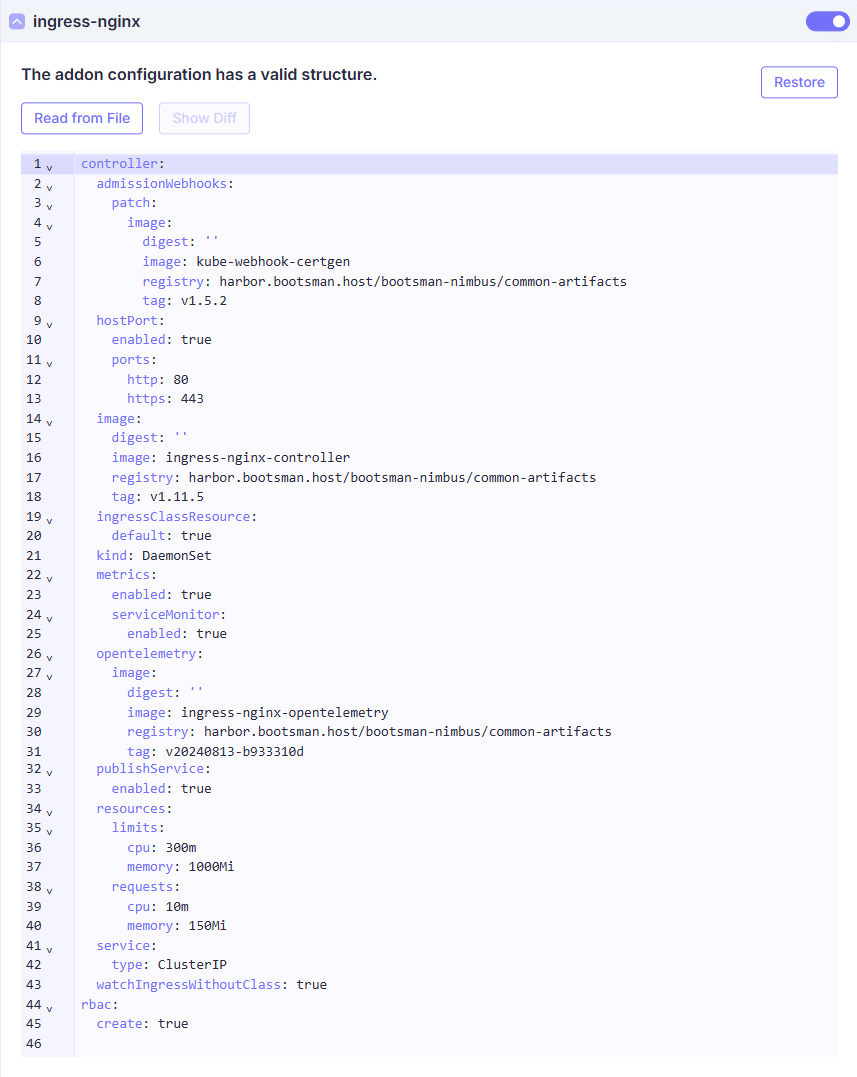
Все Values
Продвинутые настройки
Ниже представлены тонкие настройки модуля.
Используйте их для расширения конфигурации модуля, если потребуется.
Документация
Более полная документация по модулю:
Nginx Ingress Docs
Nginx Ingress Chart
ingress-nginx Values
values:
## nginx configuration
## Ref: https://github.com/kubernetes/ingress-nginx/blob/main/docs/user-guide/nginx-configuration/index.md
##
## Overrides for generated resource names
# See templates/_helpers.tpl
# nameOverride:
# fullnameOverride:
# -- Override the deployment namespace; defaults to .Release.Namespace
namespaceOverride: ""
## Labels to apply to all resources
##
commonLabels: {}
# scmhash: abc123
# myLabel: aakkmd
controller:
name: controller
enableAnnotationValidations: false
image:
## Keep false as default for now!
chroot: false
registry: harbor.bootsman.host/bootsman-nimbus/common-artifacts
image: ingress-nginx-controller
## for backwards compatibility consider setting the full image url via the repository value below
## use *either* current default registry/image or repository format or installing chart by providing the values.yaml will fail
## repository:
tag: "v1.11.5"
digest: ''
digestChroot: sha256:ec9df3eb6b06563a079ee46045da94cbf750f7dbb16fdbcb9e3265b551ed72ad
pullPolicy: IfNotPresent
runAsNonRoot: true
# www-data -> uid 101
runAsUser: 101
allowPrivilegeEscalation: false
seccompProfile:
type: RuntimeDefault
readOnlyRootFilesystem: false
# -- Use an existing PSP instead of creating one
existingPsp: ""
# -- Configures the controller container name
containerName: controller
# -- Configures the ports that the nginx-controller listens on
containerPort:
http: 80
https: 443
# -- Global configuration passed to the ConfigMap consumed by the controller. Values may contain Helm templates.
# Ref.: https://kubernetes.github.io/ingress-nginx/user-guide/nginx-configuration/configmap/
config: {}
# -- Annotations to be added to the controller config configuration configmap.
configAnnotations: {}
# -- Will add custom headers before sending traffic to backends according to https://github.com/kubernetes/ingress-nginx/tree/main/docs/examples/customization/custom-headers
proxySetHeaders: {}
# -- Will add custom headers before sending response traffic to the client according to: https://kubernetes.github.io/ingress-nginx/user-guide/nginx-configuration/configmap/#add-headers
addHeaders: {}
# -- Optionally customize the pod dnsConfig.
dnsConfig: {}
# -- Optionally customize the pod hostAliases.
hostAliases: []
# - ip: 127.0.0.1
# hostnames:
# - foo.local
# - bar.local
# - ip: 10.1.2.3
# hostnames:
# - foo.remote
# - bar.remote
# -- Optionally customize the pod hostname.
hostname: {}
# -- Optionally change this to ClusterFirstWithHostNet in case you have 'hostNetwork: true'.
# By default, while using host network, name resolution uses the host's DNS. If you wish nginx-controller
# to keep resolving names inside the k8s network, use ClusterFirstWithHostNet.
dnsPolicy: ClusterFirst
# -- Bare-metal considerations via the host network https://kubernetes.github.io/ingress-nginx/deploy/baremetal/#via-the-host-network
# Ingress status was blank because there is no Service exposing the Ingress-Nginx Controller in a configuration using the host network, the default --publish-service flag used in standard cloud setups does not apply
reportNodeInternalIp: false
# -- Process Ingress objects without ingressClass annotation/ingressClassName field
# Overrides value for --watch-ingress-without-class flag of the controller binary
# Defaults to false
watchIngressWithoutClass: true
# -- Process IngressClass per name (additionally as per spec.controller).
ingressClassByName: false
# -- This configuration enables Topology Aware Routing feature, used together with service annotation service.kubernetes.io/topology-mode="auto"
# Defaults to false
enableTopologyAwareRouting: false
# -- This configuration disable Nginx Controller Leader Election
disableLeaderElection: false
# -- Duration a leader election is valid before it's getting re-elected, e.g. `15s`, `10m` or `1h`. (Default: 30s)
electionTTL: ""
# -- This configuration defines if Ingress Controller should allow users to set
# their own *-snippet annotations, otherwise this is forbidden / dropped
# when users add those annotations.
# Global snippets in ConfigMap are still respected
allowSnippetAnnotations: false
# -- Required for use with CNI based kubernetes installations (such as ones set up by kubeadm),
# since CNI and hostport don't mix yet. Can be deprecated once https://github.com/kubernetes/kubernetes/issues/23920
# is merged
hostNetwork: false
## Use host ports 80 and 443
## Disabled by default
hostPort:
# -- Enable 'hostPort' or not
enabled: true
ports:
# -- 'hostPort' http port
http: 80
# -- 'hostPort' https port
https: 443
# NetworkPolicy for controller component.
networkPolicy:
# -- Enable 'networkPolicy' or not
enabled: false
# -- Election ID to use for status update, by default it uses the controller name combined with a suffix of 'leader'
electionID: ""
# -- This section refers to the creation of the IngressClass resource.
# IngressClasses are immutable and cannot be changed after creation.
# We do not support namespaced IngressClasses, yet, so a ClusterRole and a ClusterRoleBinding is required.
ingressClassResource:
# -- Name of the IngressClass
name: nginx
# -- Create the IngressClass or not
enabled: true
# -- If true, Ingresses without `ingressClassName` get assigned to this IngressClass on creation.
# Ingress creation gets rejected if there are multiple default IngressClasses.
# Ref: https://kubernetes.io/docs/concepts/services-networking/ingress/#default-ingress-class
default: true
# -- Annotations to be added to the IngressClass resource.
annotations: {}
# -- Controller of the IngressClass. An Ingress Controller looks for IngressClasses it should reconcile by this value.
# This value is also being set as the `--controller-class` argument of this Ingress Controller.
# Ref: https://kubernetes.io/docs/concepts/services-networking/ingress/#ingress-class
controllerValue: k8s.io/ingress-nginx
# -- Aliases of this IngressClass. Creates copies with identical settings but the respective alias as name.
# Useful for development environments with only one Ingress Controller but production-like Ingress resources.
# `default` gets enabled on the original IngressClass only.
aliases: []
# aliases:
# - nginx-alias-1
# - nginx-alias-2
# -- A link to a custom resource containing additional configuration for the controller.
# This is optional if the controller consuming this IngressClass does not require additional parameters.
# Ref: https://kubernetes.io/docs/concepts/services-networking/ingress/#ingress-class
parameters: {}
# parameters:
# apiGroup: k8s.example.com
# kind: IngressParameters
# name: external-lb
# -- For backwards compatibility with ingress.class annotation, use ingressClass.
# Algorithm is as follows, first ingressClassName is considered, if not present, controller looks for ingress.class annotation
ingressClass: nginx
# -- Labels to add to the pod container metadata
podLabels: {}
# key: value
# -- Security context for controller pods
podSecurityContext: {}
# -- sysctls for controller pods
## Ref: https://kubernetes.io/docs/tasks/administer-cluster/sysctl-cluster/
sysctls: {}
# sysctls:
# "net.core.somaxconn": "8192"
# -- Security context for controller containers
containerSecurityContext: {}
# -- Allows customization of the source of the IP address or FQDN to report
# in the ingress status field. By default, it reads the information provided
# by the service. If disable, the status field reports the IP address of the
# node or nodes where an ingress controller pod is running.
publishService:
# -- Enable 'publishService' or not
enabled: true
# -- Allows overriding of the publish service to bind to
# Must be <namespace>/<service_name>
pathOverride: ""
# Limit the scope of the controller to a specific namespace
scope:
# -- Enable 'scope' or not
enabled: false
# -- Namespace to limit the controller to; defaults to $(POD_NAMESPACE)
namespace: ""
# -- When scope.enabled == false, instead of watching all namespaces, we watching namespaces whose labels
# only match with namespaceSelector. Format like foo=bar. Defaults to empty, means watching all namespaces.
namespaceSelector: ""
# -- Allows customization of the configmap / nginx-configmap namespace; defaults to $(POD_NAMESPACE)
configMapNamespace: ""
tcp:
# -- Allows customization of the tcp-services-configmap; defaults to $(POD_NAMESPACE)
configMapNamespace: ""
# -- Annotations to be added to the tcp config configmap
annotations: {}
udp:
# -- Allows customization of the udp-services-configmap; defaults to $(POD_NAMESPACE)
configMapNamespace: ""
# -- Annotations to be added to the udp config configmap
annotations: {}
# -- Maxmind license key to download GeoLite2 Databases.
## https://blog.maxmind.com/2019/12/significant-changes-to-accessing-and-using-geolite2-databases/
maxmindLicenseKey: ""
# -- Additional command line arguments to pass to Ingress-Nginx Controller
# E.g. to specify the default SSL certificate you can use
extraArgs: {}
## extraArgs:
## default-ssl-certificate: "<namespace>/<secret_name>"
## time-buckets: "0.005,0.01,0.025,0.05,0.1,0.25,0.5,1,2.5,5,10"
## length-buckets: "10,20,30,40,50,60,70,80,90,100"
## size-buckets: "10,100,1000,10000,100000,1e+06,1e+07"
# -- Additional environment variables to set
extraEnvs: []
# extraEnvs:
# - name: FOO
# valueFrom:
# secretKeyRef:
# key: FOO
# name: secret-resource
# -- Use a `DaemonSet` or `Deployment`
kind: DaemonSet
# -- Annotations to be added to the controller Deployment or DaemonSet
##
annotations: {}
# keel.sh/pollSchedule: "@every 60m"
# -- Labels to be added to the controller Deployment or DaemonSet and other resources that do not have option to specify labels
##
labels: {}
# keel.sh/policy: patch
# keel.sh/trigger: poll
# -- The update strategy to apply to the Deployment or DaemonSet
##
updateStrategy: {}
# rollingUpdate:
# maxUnavailable: 1
# type: RollingUpdate
# -- `minReadySeconds` to avoid killing pods before we are ready
##
minReadySeconds: 0
# -- Node tolerations for server scheduling to nodes with taints
## Ref: https://kubernetes.io/docs/concepts/configuration/assign-pod-node/
##
tolerations:
- effect: NoSchedule
key: node-role.kubernetes.io/bootsman-ingress
operator: Exists
- effect: NoExecute
key: node-role.kubernetes.io/bootsman-ingress
operator: Exists
- effect: NoSchedule
key: node-role.kubernetes.io/bootsman-storage
operator: Exists
- effect: NoExecute
key: node-role.kubernetes.io/bootsman-storage
operator: Exists
- effect: NoSchedule
key: node-role.kubernetes.io/bootsman-gpu
operator: Exists
- effect: NoExecute
key: node-role.kubernetes.io/bootsman-gpu
operator: Exists
# - key: "key"
# operator: "Equal|Exists"
# value: "value"
# effect: "NoSchedule|PreferNoSchedule|NoExecute(1.6 only)"
# -- Affinity and anti-affinity rules for server scheduling to nodes
## Ref: https://kubernetes.io/docs/concepts/configuration/assign-pod-node/#affinity-and-anti-affinity
##
affinity: {}
# -- Topology spread constraints rely on node labels to identify the topology domain(s) that each Node is in.
## Ref: https://kubernetes.io/docs/concepts/workloads/pods/pod-topology-spread-constraints/
##
topologySpreadConstraints: []
# -- `terminationGracePeriodSeconds` to avoid killing pods before we are ready
## wait up to five minutes for the drain of connections
##
terminationGracePeriodSeconds: 300
# -- Node labels for controller pod assignment
## Ref: https://kubernetes.io/docs/concepts/scheduling-eviction/assign-pod-node/
##
nodeSelector:
kubernetes.io/os: linux
## Liveness and readiness probe values
## Ref: https://kubernetes.io/docs/concepts/workloads/pods/pod-lifecycle/#container-probes
##
## startupProbe:
## httpGet:
## # should match container.healthCheckPath
## path: "/healthz"
## port: 10254
## scheme: HTTP
## initialDelaySeconds: 5
## periodSeconds: 5
## timeoutSeconds: 2
## successThreshold: 1
## failureThreshold: 5
livenessProbe:
httpGet:
# should match container.healthCheckPath
path: "/healthz"
port: 10254
scheme: HTTP
initialDelaySeconds: 10
periodSeconds: 10
timeoutSeconds: 1
successThreshold: 1
failureThreshold: 5
readinessProbe:
httpGet:
# should match container.healthCheckPath
path: "/healthz"
port: 10254
scheme: HTTP
initialDelaySeconds: 10
periodSeconds: 10
timeoutSeconds: 1
successThreshold: 1
failureThreshold: 3
# -- Path of the health check endpoint. All requests received on the port defined by
# the healthz-port parameter are forwarded internally to this path.
healthCheckPath: "/healthz"
# -- Address to bind the health check endpoint.
# It is better to set this option to the internal node address
# if the Ingress-Nginx Controller is running in the `hostNetwork: true` mode.
healthCheckHost: ""
# -- Annotations to be added to controller pods
##
podAnnotations: {}
replicaCount: 1
# -- Minimum available pods set in PodDisruptionBudget.
# Define either 'minAvailable' or 'maxUnavailable', never both.
minAvailable: 1
# -- Maximum unavailable pods set in PodDisruptionBudget. If set, 'minAvailable' is ignored.
# maxUnavailable: 1
## Define requests resources to avoid probe issues due to CPU utilization in busy nodes
## ref: https://github.com/kubernetes/ingress-nginx/issues/4735#issuecomment-551204903
## Ideally, there should be no limits.
## https://engineering.indeedblog.com/blog/2019/12/cpu-throttling-regression-fix/
resources:
limits:
cpu: 300m
memory: 1000Mi
requests:
cpu: 10m
memory: 150Mi
# Mutually exclusive with keda autoscaling
autoscaling:
enabled: false
annotations: {}
minReplicas: 1
maxReplicas: 11
targetCPUUtilizationPercentage: 50
targetMemoryUtilizationPercentage: 50
behavior: {}
# scaleDown:
# stabilizationWindowSeconds: 300
# policies:
# - type: Pods
# value: 1
# periodSeconds: 180
# scaleUp:
# stabilizationWindowSeconds: 300
# policies:
# - type: Pods
# value: 2
# periodSeconds: 60
autoscalingTemplate: []
# Custom or additional autoscaling metrics
# ref: https://kubernetes.io/docs/tasks/run-application/horizontal-pod-autoscale/#support-for-custom-metrics
# - type: Pods
# pods:
# metric:
# name: nginx_ingress_controller_nginx_process_requests_total
# target:
# type: AverageValue
# averageValue: 10000m
# Mutually exclusive with hpa autoscaling
keda:
apiVersion: "keda.sh/v1alpha1"
## apiVersion changes with keda 1.x vs 2.x
## 2.x = keda.sh/v1alpha1
## 1.x = keda.k8s.io/v1alpha1
enabled: false
minReplicas: 1
maxReplicas: 11
pollingInterval: 30
cooldownPeriod: 300
# fallback:
# failureThreshold: 3
# replicas: 11
restoreToOriginalReplicaCount: false
scaledObject:
annotations: {}
# Custom annotations for ScaledObject resource
# annotations:
# key: value
triggers: []
# - type: prometheus
# metadata:
# serverAddress: http://<prometheus-host>:9090
# metricName: http_requests_total
# threshold: '100'
# query: sum(rate(http_requests_total{deployment="my-deployment"}[2m]))
behavior: {}
# scaleDown:
# stabilizationWindowSeconds: 300
# policies:
# - type: Pods
# value: 1
# periodSeconds: 180
# scaleUp:
# stabilizationWindowSeconds: 300
# policies:
# - type: Pods
# value: 2
# periodSeconds: 60
# -- Enable mimalloc as a drop-in replacement for malloc.
## ref: https://github.com/microsoft/mimalloc
##
enableMimalloc: true
## Override NGINX template
customTemplate:
configMapName: ""
configMapKey: ""
service:
# -- Enable controller services or not. This does not influence the creation of either the admission webhook or the metrics service.
enabled: true
external:
# -- Enable the external controller service or not. Useful for internal-only deployments.
enabled: true
# -- Annotations to be added to the external controller service. See `controller.service.internal.annotations` for annotations to be added to the internal controller service.
annotations: {}
# -- Labels to be added to both controller services.
labels: {}
# -- Type of the external controller service.
# Ref: https://kubernetes.io/docs/concepts/services-networking/service/#publishing-services-service-types
type: LoadBalancer
# -- Pre-defined cluster internal IP address of the external controller service. Take care of collisions with existing services.
# This value is immutable. Set once, it can not be changed without deleting and re-creating the service.
# Ref: https://kubernetes.io/docs/concepts/services-networking/service/#choosing-your-own-ip-address
clusterIP: ""
# -- List of node IP addresses at which the external controller service is available.
# Ref: https://kubernetes.io/docs/concepts/services-networking/service/#external-ips
externalIPs: []
# -- Deprecated: Pre-defined IP address of the external controller service. Used by cloud providers to connect the resulting load balancer service to a pre-existing static IP.
# Ref: https://kubernetes.io/docs/concepts/services-networking/service/#loadbalancer
loadBalancerIP: ""
# -- Restrict access to the external controller service. Values must be CIDRs. Allows any source address by default.
loadBalancerSourceRanges: []
# -- Load balancer class of the external controller service. Used by cloud providers to select a load balancer implementation other than the cloud provider default.
# Ref: https://kubernetes.io/docs/concepts/services-networking/service/#load-balancer-class
loadBalancerClass: ""
# -- Enable node port allocation for the external controller service or not. Applies to type `LoadBalancer` only.
# Ref: https://kubernetes.io/docs/concepts/services-networking/service/#load-balancer-nodeport-allocation
# allocateLoadBalancerNodePorts: true
# -- External traffic policy of the external controller service. Set to "Local" to preserve source IP on providers supporting it.
# Ref: https://kubernetes.io/docs/tasks/access-application-cluster/create-external-load-balancer/#preserving-the-client-source-ip
externalTrafficPolicy: ""
# -- Session affinity of the external controller service. Must be either "None" or "ClientIP" if set. Defaults to "None".
# Ref: https://kubernetes.io/docs/reference/networking/virtual-ips/#session-affinity
sessionAffinity: ""
# -- Specifies the health check node port (numeric port number) for the external controller service.
# If not specified, the service controller allocates a port from your cluster's node port range.
# Ref: https://kubernetes.io/docs/tasks/access-application-cluster/create-external-load-balancer/#preserving-the-client-source-ip
# healthCheckNodePort: 0
# -- Represents the dual-stack capabilities of the external controller service. Possible values are SingleStack, PreferDualStack or RequireDualStack.
# Fields `ipFamilies` and `clusterIP` depend on the value of this field.
# Ref: https://kubernetes.io/docs/concepts/services-networking/dual-stack/#services
ipFamilyPolicy: SingleStack
# -- List of IP families (e.g. IPv4, IPv6) assigned to the external controller service. This field is usually assigned automatically based on cluster configuration and the `ipFamilyPolicy` field.
# Ref: https://kubernetes.io/docs/concepts/services-networking/dual-stack/#services
ipFamilies:
- IPv4
# -- Enable the HTTP listener on both controller services or not.
enableHttp: true
# -- Enable the HTTPS listener on both controller services or not.
enableHttps: true
ports:
# -- Port the external HTTP listener is published with.
http: 80
# -- Port the external HTTPS listener is published with.
https: 443
targetPorts:
# -- Port of the ingress controller the external HTTP listener is mapped to.
http: http
# -- Port of the ingress controller the external HTTPS listener is mapped to.
https: https
# -- Declare the app protocol of the external HTTP and HTTPS listeners or not. Supersedes provider-specific annotations for declaring the backend protocol.
# Ref: https://kubernetes.io/docs/concepts/services-networking/service/#application-protocol
appProtocol: true
nodePorts:
# -- Node port allocated for the external HTTP listener. If left empty, the service controller allocates one from the configured node port range.
http: ""
# -- Node port allocated for the external HTTPS listener. If left empty, the service controller allocates one from the configured node port range.
https: ""
# -- Node port mapping for external TCP listeners. If left empty, the service controller allocates them from the configured node port range.
# Example:
# tcp:
# 8080: 30080
tcp: {}
# -- Node port mapping for external UDP listeners. If left empty, the service controller allocates them from the configured node port range.
# Example:
# udp:
# 53: 30053
udp: {}
internal:
# -- Enable the internal controller service or not. Remember to configure `controller.service.internal.annotations` when enabling this.
enabled: false
# -- Annotations to be added to the internal controller service. Mandatory for the internal controller service to be created. Varies with the cloud service.
# Ref: https://kubernetes.io/docs/concepts/services-networking/service/#internal-load-balancer
annotations: {}
# -- Type of the internal controller service.
# Defaults to the value of `controller.service.type`.
# Ref: https://kubernetes.io/docs/concepts/services-networking/service/#publishing-services-service-types
type: ""
# -- Pre-defined cluster internal IP address of the internal controller service. Take care of collisions with existing services.
# This value is immutable. Set once, it can not be changed without deleting and re-creating the service.
# Ref: https://kubernetes.io/docs/concepts/services-networking/service/#choosing-your-own-ip-address
clusterIP: ""
# -- List of node IP addresses at which the internal controller service is available.
# Ref: https://kubernetes.io/docs/concepts/services-networking/service/#external-ips
externalIPs: []
# -- Deprecated: Pre-defined IP address of the internal controller service. Used by cloud providers to connect the resulting load balancer service to a pre-existing static IP.
# Ref: https://kubernetes.io/docs/concepts/services-networking/service/#loadbalancer
loadBalancerIP: ""
# -- Restrict access to the internal controller service. Values must be CIDRs. Allows any source address by default.
loadBalancerSourceRanges: []
# -- Load balancer class of the internal controller service. Used by cloud providers to select a load balancer implementation other than the cloud provider default.
# Ref: https://kubernetes.io/docs/concepts/services-networking/service/#load-balancer-class
loadBalancerClass: ""
# -- Enable node port allocation for the internal controller service or not. Applies to type `LoadBalancer` only.
# Ref: https://kubernetes.io/docs/concepts/services-networking/service/#load-balancer-nodeport-allocation
# allocateLoadBalancerNodePorts: true
# -- External traffic policy of the internal controller service. Set to "Local" to preserve source IP on providers supporting it.
# Ref: https://kubernetes.io/docs/tasks/access-application-cluster/create-external-load-balancer/#preserving-the-client-source-ip
externalTrafficPolicy: ""
# -- Session affinity of the internal controller service. Must be either "None" or "ClientIP" if set. Defaults to "None".
# Ref: https://kubernetes.io/docs/reference/networking/virtual-ips/#session-affinity
sessionAffinity: ""
# -- Specifies the health check node port (numeric port number) for the internal controller service.
# If not specified, the service controller allocates a port from your cluster's node port range.
# Ref: https://kubernetes.io/docs/tasks/access-application-cluster/create-external-load-balancer/#preserving-the-client-source-ip
# healthCheckNodePort: 0
# -- Represents the dual-stack capabilities of the internal controller service. Possible values are SingleStack, PreferDualStack or RequireDualStack.
# Fields `ipFamilies` and `clusterIP` depend on the value of this field.
# Ref: https://kubernetes.io/docs/concepts/services-networking/dual-stack/#services
ipFamilyPolicy: SingleStack
# -- List of IP families (e.g. IPv4, IPv6) assigned to the internal controller service. This field is usually assigned automatically based on cluster configuration and the `ipFamilyPolicy` field.
# Ref: https://kubernetes.io/docs/concepts/services-networking/dual-stack/#services
ipFamilies:
- IPv4
ports: {}
# -- Port the internal HTTP listener is published with.
# Defaults to the value of `controller.service.ports.http`.
# http: 80
# -- Port the internal HTTPS listener is published with.
# Defaults to the value of `controller.service.ports.https`.
# https: 443
targetPorts: {}
# -- Port of the ingress controller the internal HTTP listener is mapped to.
# Defaults to the value of `controller.service.targetPorts.http`.
# http: http
# -- Port of the ingress controller the internal HTTPS listener is mapped to.
# Defaults to the value of `controller.service.targetPorts.https`.
# https: https
# -- Declare the app protocol of the internal HTTP and HTTPS listeners or not. Supersedes provider-specific annotations for declaring the backend protocol.
# Ref: https://kubernetes.io/docs/concepts/services-networking/service/#application-protocol
appProtocol: true
nodePorts:
# -- Node port allocated for the internal HTTP listener. If left empty, the service controller allocates one from the configured node port range.
http: ""
# -- Node port allocated for the internal HTTPS listener. If left empty, the service controller allocates one from the configured node port range.
https: ""
# -- Node port mapping for internal TCP listeners. If left empty, the service controller allocates them from the configured node port range.
# Example:
# tcp:
# 8080: 30080
tcp: {}
# -- Node port mapping for internal UDP listeners. If left empty, the service controller allocates them from the configured node port range.
# Example:
# udp:
# 53: 30053
udp: {}
# shareProcessNamespace enables process namespace sharing within the pod.
# This can be used for example to signal log rotation using `kill -USR1` from a sidecar.
shareProcessNamespace: false
# -- Additional containers to be added to the controller pod.
# See https://github.com/lemonldap-ng-controller/lemonldap-ng-controller as example.
extraContainers: []
# - name: my-sidecar
# image: nginx:latest
# - name: lemonldap-ng-controller
# image: lemonldapng/lemonldap-ng-controller:0.2.0
# args:
# - /lemonldap-ng-controller
# - --alsologtostderr
# - --configmap=$(POD_NAMESPACE)/lemonldap-ng-configuration
# env:
# - name: POD_NAME
# valueFrom:
# fieldRef:
# fieldPath: metadata.name
# - name: POD_NAMESPACE
# valueFrom:
# fieldRef:
# fieldPath: metadata.namespace
# volumeMounts:
# - name: copy-portal-skins
# mountPath: /srv/var/lib/lemonldap-ng/portal/skins
# -- Additional volumeMounts to the controller main container.
extraVolumeMounts: []
# - name: copy-portal-skins
# mountPath: /var/lib/lemonldap-ng/portal/skins
# -- Additional volumes to the controller pod.
extraVolumes: []
# - name: copy-portal-skins
# emptyDir: {}
# -- Containers, which are run before the app containers are started.
extraInitContainers: []
# - name: init-myservice
# image: busybox
# command: ['sh', '-c', 'until nslookup myservice; do echo waiting for myservice; sleep 2; done;']
# -- Modules, which are mounted into the core nginx image. See values.yaml for a sample to add opentelemetry module
extraModules: []
# - name: mytestmodule
# image:
# registry: harbor.bootsman.host/bootsman-nimbus/common-artifacts
# image: ingress-nginx/mytestmodule
# ## for backwards compatibility consider setting the full image url via the repository value below
# ## use *either* current default registry/image or repository format or installing chart by providing the values.yaml will fail
# ## repository:
# tag: "v1.0.0"
# digest: ""
# distroless: false
# containerSecurityContext:
# runAsNonRoot: true
# runAsUser: <user-id>
# allowPrivilegeEscalation: false
# seccompProfile:
# type: RuntimeDefault
# capabilities:
# drop:
# - ALL
# readOnlyRootFilesystem: true
# resources: {}
#
# The image must contain a `/usr/local/bin/init_module.sh` executable, which
# will be executed as initContainers, to move its config files within the
# mounted volume.
opentelemetry:
enabled: false
name: opentelemetry
image:
registry: harbor.bootsman.host/bootsman-nimbus/common-artifacts
image: ingress-nginx/opentelemetry-1.25.3
## for backwards compatibility consider setting the full image url via the repository value below
## use *either* current default registry/image or repository format or installing chart by providing the values.yaml will fail
## repository:
tag: v20240813-b933310d
digest: sha256:f7604ac0547ed64d79b98d92133234e66c2c8aade3c1f4809fed5eec1fb7f922
distroless: true
containerSecurityContext:
runAsNonRoot: true
# -- The image's default user, inherited from its base image `cgr.dev/chainguard/static`.
runAsUser: 65532
allowPrivilegeEscalation: false
seccompProfile:
type: RuntimeDefault
capabilities:
drop:
- ALL
readOnlyRootFilesystem: true
resources: {}
admissionWebhooks:
name: admission
annotations: {}
# ignore-check.kube-linter.io/no-read-only-rootfs: "This deployment needs write access to root filesystem".
## Additional annotations to the admission webhooks.
## These annotations will be added to the ValidatingWebhookConfiguration and
## the Jobs Spec of the admission webhooks.
enabled: true
# -- Additional environment variables to set
extraEnvs: []
# extraEnvs:
# - name: FOO
# valueFrom:
# secretKeyRef:
# key: FOO
# name: secret-resource
# -- Admission Webhook failure policy to use
failurePolicy: Fail
# timeoutSeconds: 10
port: 8443
certificate: "/usr/local/certificates/cert"
key: "/usr/local/certificates/key"
namespaceSelector: {}
objectSelector: {}
# -- Labels to be added to admission webhooks
labels: {}
# -- Use an existing PSP instead of creating one
existingPsp: ""
service:
annotations: {}
# clusterIP: ""
externalIPs: []
# loadBalancerIP: ""
loadBalancerSourceRanges: []
servicePort: 443
type: ClusterIP
createSecretJob:
name: create
# -- Security context for secret creation containers
securityContext:
runAsNonRoot: true
runAsUser: 65532
allowPrivilegeEscalation: false
seccompProfile:
type: RuntimeDefault
capabilities:
drop:
- ALL
readOnlyRootFilesystem: true
resources: {}
# limits:
# cpu: 10m
# memory: 20Mi
# requests:
# cpu: 10m
# memory: 20Mi
patchWebhookJob:
name: patch
# -- Security context for webhook patch containers
securityContext:
runAsNonRoot: true
runAsUser: 65532
allowPrivilegeEscalation: false
seccompProfile:
type: RuntimeDefault
capabilities:
drop:
- ALL
readOnlyRootFilesystem: true
resources: {}
patch:
enabled: true
image:
registry: harbor.bootsman.host/bootsman-nimbus/common-artifacts
image: kube-webhook-certgen
## for backwards compatibility consider setting the full image url via the repository value below
## use *either* current default registry/image or repository format or installing chart by providing the values.yaml will fail
## repository:
tag: v1.5.2
digest: ''
pullPolicy: IfNotPresent
# -- Provide a priority class name to the webhook patching job
##
priorityClassName: ""
podAnnotations: {}
# NetworkPolicy for webhook patch
networkPolicy:
# -- Enable 'networkPolicy' or not
enabled: false
nodeSelector:
kubernetes.io/os: linux
tolerations:
- effect: NoSchedule
key: node-role.kubernetes.io/bootsman-ingress
operator: Exists
- effect: NoExecute
key: node-role.kubernetes.io/bootsman-ingress
operator: Exists
- effect: NoSchedule
key: node-role.kubernetes.io/bootsman-storage
operator: Exists
- effect: NoExecute
key: node-role.kubernetes.io/bootsman-storage
operator: Exists
- effect: NoSchedule
key: node-role.kubernetes.io/bootsman-gpu
operator: Exists
- effect: NoExecute
key: node-role.kubernetes.io/bootsman-gpu
operator: Exists
# -- Labels to be added to patch job resources
labels: {}
# -- Security context for secret creation & webhook patch pods
securityContext: {}
# -- Admission webhook patch job RBAC
rbac:
# -- Create RBAC or not
create: true
# -- Admission webhook patch job service account
serviceAccount:
# -- Create a service account or not
create: true
# -- Custom service account name
name: ""
# -- Auto-mount service account token or not
automountServiceAccountToken: true
# Use certmanager to generate webhook certs
certManager:
enabled: false
# self-signed root certificate
rootCert:
# default to be 5y
duration: ""
admissionCert:
# default to be 1y
duration: ""
# issuerRef:
# name: "issuer"
# kind: "ClusterIssuer"
metrics:
port: 10254
portName: metrics
# if this port is changed, change healthz-port: in extraArgs: accordingly
enabled: true
service:
annotations: {}
# prometheus.io/scrape: "true"
# prometheus.io/port: "10254"
# -- Labels to be added to the metrics service resource
labels: {}
# clusterIP: ""
# -- List of IP addresses at which the stats-exporter service is available
## Ref: https://kubernetes.io/docs/concepts/services-networking/service/#external-ips
##
externalIPs: []
# loadBalancerIP: ""
loadBalancerSourceRanges: []
servicePort: 10254
type: ClusterIP
# externalTrafficPolicy: ""
# nodePort: ""
serviceMonitor:
enabled: true
additionalLabels: {}
# -- Annotations to be added to the ServiceMonitor.
annotations: {}
## The label to use to retrieve the job name from.
## jobLabel: "app.kubernetes.io/name"
namespace: ""
namespaceSelector: {}
## Default: scrape .Release.Namespace or namespaceOverride only
## To scrape all, use the following:
## namespaceSelector:
## any: true
scrapeInterval: 30s
# honorLabels: true
targetLabels: []
relabelings: []
metricRelabelings: []
prometheusRule:
enabled: false
additionalLabels: {}
# namespace: ""
rules: []
# # These are just examples rules, please adapt them to your needs
# - alert: NGINXConfigFailed
# expr: count(nginx_ingress_controller_config_last_reload_successful == 0) > 0
# for: 1s
# labels:
# severity: critical
# annotations:
# description: bad ingress config - nginx config test failed
# summary: uninstall the latest ingress changes to allow config reloads to resume
# # By default a fake self-signed certificate is generated as default and
# # it is fine if it expires. If `--default-ssl-certificate` flag is used
# # and a valid certificate passed please do not filter for `host` label!
# # (i.e. delete `{host!="_"}` so also the default SSL certificate is
# # checked for expiration)
# - alert: NGINXCertificateExpiry
# expr: (avg(nginx_ingress_controller_ssl_expire_time_seconds{host!="_"}) by (host) - time()) < 604800
# for: 1s
# labels:
# severity: critical
# annotations:
# description: ssl certificate(s) will expire in less then a week
# summary: renew expiring certificates to avoid downtime
# - alert: NGINXTooMany500s
# expr: 100 * ( sum( nginx_ingress_controller_requests{status=~"5.+"} ) / sum(nginx_ingress_controller_requests) ) > 5
# for: 1m
# labels:
# severity: warning
# annotations:
# description: Too many 5XXs
# summary: More than 5% of all requests returned 5XX, this requires your attention
# - alert: NGINXTooMany400s
# expr: 100 * ( sum( nginx_ingress_controller_requests{status=~"4.+"} ) / sum(nginx_ingress_controller_requests) ) > 5
# for: 1m
# labels:
# severity: warning
# annotations:
# description: Too many 4XXs
# summary: More than 5% of all requests returned 4XX, this requires your attention
# -- Improve connection draining when ingress controller pod is deleted using a lifecycle hook:
# With this new hook, we increased the default terminationGracePeriodSeconds from 30 seconds
# to 300, allowing the draining of connections up to five minutes.
# If the active connections end before that, the pod will terminate gracefully at that time.
# To effectively take advantage of this feature, the Configmap feature
# worker-shutdown-timeout new value is 240s instead of 10s.
##
lifecycle:
preStop:
exec:
command:
- /wait-shutdown
priorityClassName: ""
# -- Rollback limit
##
revisionHistoryLimit: 10
## Default 404 backend
##
defaultBackend:
##
enabled: false
name: defaultbackend
image:
registry: harbor.bootsman.host/bootsman-nimbus/common-artifacts
image: defaultbackend-amd64
## for backwards compatibility consider setting the full image url via the repository value below
## use *either* current default registry/image or repository format or installing chart by providing the values.yaml will fail
## repository:
tag: "1.5"
pullPolicy: IfNotPresent
runAsNonRoot: true
# nobody user -> uid 65534
runAsUser: 65534
allowPrivilegeEscalation: false
seccompProfile:
type: RuntimeDefault
readOnlyRootFilesystem: true
# -- Use an existing PSP instead of creating one
existingPsp: ""
extraArgs: {}
serviceAccount:
create: true
name: ""
automountServiceAccountToken: true
# -- Additional environment variables to set for defaultBackend pods
extraEnvs: []
port: 8080
## Readiness and liveness probes for default backend
## Ref: https://kubernetes.io/docs/tasks/configure-pod-container/configure-liveness-readiness-probes/
##
livenessProbe:
failureThreshold: 3
initialDelaySeconds: 30
periodSeconds: 10
successThreshold: 1
timeoutSeconds: 5
readinessProbe:
failureThreshold: 6
initialDelaySeconds: 0
periodSeconds: 5
successThreshold: 1
timeoutSeconds: 5
# -- The update strategy to apply to the Deployment or DaemonSet
##
updateStrategy: {}
# rollingUpdate:
# maxUnavailable: 1
# type: RollingUpdate
# -- `minReadySeconds` to avoid killing pods before we are ready
##
minReadySeconds: 0
# -- Node tolerations for server scheduling to nodes with taints
## Ref: https://kubernetes.io/docs/concepts/configuration/assign-pod-node/
##
tolerations:
- effect: NoSchedule
key: node-role.kubernetes.io/bootsman-ingress
operator: Exists
- effect: NoExecute
key: node-role.kubernetes.io/bootsman-ingress
operator: Exists
- effect: NoSchedule
key: node-role.kubernetes.io/bootsman-storage
operator: Exists
- effect: NoExecute
key: node-role.kubernetes.io/bootsman-storage
operator: Exists
- effect: NoSchedule
key: node-role.kubernetes.io/bootsman-gpu
operator: Exists
- effect: NoExecute
key: node-role.kubernetes.io/bootsman-gpu
operator: Exists
# - key: "key"
# operator: "Equal|Exists"
# value: "value"
# effect: "NoSchedule|PreferNoSchedule|NoExecute(1.6 only)"
# -- Affinity and anti-affinity rules for server scheduling to nodes
## Ref: https://kubernetes.io/docs/concepts/configuration/assign-pod-node/#affinity-and-anti-affinity
affinity: {}
# -- Topology spread constraints rely on node labels to identify the topology domain(s) that each Node is in.
# Ref.: https://kubernetes.io/docs/concepts/workloads/pods/pod-topology-spread-constraints/
topologySpreadConstraints: []
# -- Security context for default backend pods
podSecurityContext: {}
# -- Security context for default backend containers
containerSecurityContext: {}
# -- Labels to add to the pod container metadata
podLabels: {}
# key: value
# -- Node labels for default backend pod assignment
## Ref: https://kubernetes.io/docs/concepts/scheduling-eviction/assign-pod-node/
##
nodeSelector:
kubernetes.io/os: linux
# -- Annotations to be added to default backend pods
##
podAnnotations: {}
replicaCount: 1
# -- Minimum available pods set in PodDisruptionBudget.
minAvailable: 1
resources: {}
# limits:
# cpu: 10m
# memory: 20Mi
# requests:
# cpu: 10m
# memory: 20Mi
extraVolumeMounts: []
## Additional volumeMounts to the default backend container.
# - name: copy-portal-skins
# mountPath: /var/lib/lemonldap-ng/portal/skins
extraVolumes: []
## Additional volumes to the default backend pod.
# - name: copy-portal-skins
# emptyDir: {}
extraConfigMaps: []
## Additional configmaps to the default backend pod.
# - name: my-extra-configmap-1
# labels:
# type: config-1
# data:
# extra_file_1.html: |
# <!-- Extra HTML content for ConfigMap 1 -->
# - name: my-extra-configmap-2
# labels:
# type: config-2
# data:
# extra_file_2.html: |
# <!-- Extra HTML content for ConfigMap 2 -->
autoscaling:
annotations: {}
enabled: false
minReplicas: 1
maxReplicas: 2
targetCPUUtilizationPercentage: 50
targetMemoryUtilizationPercentage: 50
# NetworkPolicy for default backend component.
networkPolicy:
# -- Enable 'networkPolicy' or not
enabled: false
service:
annotations: {}
# clusterIP: ""
# -- List of IP addresses at which the default backend service is available
## Ref: https://kubernetes.io/docs/concepts/services-networking/service/#external-ips
##
externalIPs: []
# loadBalancerIP: ""
loadBalancerSourceRanges: []
servicePort: 80
type: ClusterIP
priorityClassName: ""
# -- Labels to be added to the default backend resources
labels: {}
## Enable RBAC as per https://github.com/kubernetes/ingress-nginx/blob/main/docs/deploy/rbac.md and https://github.com/kubernetes/ingress-nginx/issues/266
rbac:
create: true
scope: false
## If true, create & use Pod Security Policy resources
## https://kubernetes.io/docs/concepts/policy/pod-security-policy/
podSecurityPolicy:
enabled: false
serviceAccount:
create: true
name: ""
automountServiceAccountToken: true
# -- Annotations for the controller service account
annotations: {}
# -- Optional array of imagePullSecrets containing private registry credentials
## Ref: https://kubernetes.io/docs/tasks/configure-pod-container/pull-image-private-registry/
imagePullSecrets: []
# - name: secretName
# -- TCP service key-value pairs
## Ref: https://github.com/kubernetes/ingress-nginx/blob/main/docs/user-guide/exposing-tcp-udp-services.md
##
tcp: {}
# "8080": "default/example-tcp-svc:9000"
# -- UDP service key-value pairs
## Ref: https://github.com/kubernetes/ingress-nginx/blob/main/docs/user-guide/exposing-tcp-udp-services.md
##
udp: {}
# "53": "kube-system/kube-dns:53"
# -- Prefix for TCP and UDP ports names in ingress controller service
## Some cloud providers, like Yandex Cloud may have a requirements for a port name regex to support cloud load balancer integration
portNamePrefix: ""
# -- (string) A base64-encoded Diffie-Hellman parameter.
# This can be generated with: `openssl dhparam 4096 2> /dev/null | base64`
## Ref: https://github.com/kubernetes/ingress-nginx/tree/main/docs/examples/customization/ssl-dh-param
dhParam: ""
Настройка модуля в соответствии с ролью Bootsman-ingress
apiVersion: addon.bootsman.tech/v1alpha1
kind: Config
metadata:
  name: CLUSTER_NAME-ingress-nginx
  namespace: CLUSTER_NAMESPACE
spec:
  enabled: true
  values:
    controller:
      affinity:
        nodeAffinity:
          requiredDuringSchedulingIgnoredDuringExecution:
            nodeSelectorTerms:
              - matchExpressions:
                  - key: node-role.kubernetes.io/bootsman-ingress
                    operator: Exists
      image:
        registry: harbor.bootsman.host/bootsman-nimbus/common-artifacts
        image: ingress-nginx-controller
        tag: "v1.11.5"
        digest: ""
      opentelemetry:
        image:
          registry: harbor.bootsman.host/bootsman-nimbus/common-artifacts
          image: ingress-nginx-opentelemetry
          tag: "v20240813-b933310d"
          digest: ""
      admissionWebhooks:
        patch:
          image:
            registry: harbor.bootsman.host/bootsman-nimbus/common-artifacts
            image: kube-webhook-certgen
            tag: v1.5.2
            digest: ""
      resources:
        limits:
          cpu: 300m
          memory: 1000Mi
        requests:
          cpu: 10m
          memory: 150Mi
      metrics:
        enabled: true
        serviceMonitor:
          enabled: true
      kind: DaemonSet
      service:
        type: ClusterIP
      hostPort:
        enabled: true
        ports:
          http: 80
          https: 443
      ingressClassResource:
        default: true
      publishService:
        enabled: true
      watchIngressWithoutClass: true
    rbac:
      create: true
apiVersion: addon.bootsman.tech/v1alpha1
kind: Config
metadata:
  name: CLUSTER_NAME-ingress-nginx
  namespace: CLUSTER_NAMESPACE
spec:
  enabled: true
  values:
    controller:
      affinity:
        nodeAffinity:
          requiredDuringSchedulingIgnoredDuringExecution:
            nodeSelectorTerms:
              - matchExpressions:
                  - key: node-role.kubernetes.io/bootsman-ingress
                    operator: Exists
      image:
        registry: harbor.bootsman.host/bootsman-nimbus/common-artifacts
        image: ingress-nginx-controller
        tag: "v1.11.5"
        digest: ""
      opentelemetry:
        image:
          registry: harbor.bootsman.host/bootsman-nimbus/common-artifacts
          image: ingress-nginx-opentelemetry
          tag: "v20240813-b933310d"
          digest: ""
      admissionWebhooks:
        patch:
          image:
            registry: harbor.bootsman.host/bootsman-nimbus/common-artifacts
            image: kube-webhook-certgen
            tag: v1.5.2
            digest: ""
      resources:
        limits:
          cpu: 300m
          memory: 1000Mi
        requests:
          cpu: 10m
          memory: 150Mi
      metrics:
        enabled: true
        serviceMonitor:
          enabled: true
      kind: DaemonSet
      service:
        type: LoadBalancer
        externalTrafficPolicy: Local
      ingressClassResource:
        default: true
      publishService:
        enabled: true
      watchIngressWithoutClass: true
    rbac:
      create: true