CSI CephFS
Описание
Модуль обеспечивает работу с файловой системой Ceph внутри кластера Kubernetes
По окончанию установки. Вы получите дополнительный StorageClass.
Используйте объект PersistentVolumeClaim с указанием StorageClass
Подготовка Ceph
Подготовка CephFS
Заметка
Если у вас уже настроен CephFS пропустите эту главу
Создайте два пула под данные и метаданные:
Запуск CephFS:
Пометить пул с данными как bulk:
Запустить службу mds:
Создание пользователя
Создать пользователя и выдать права в пул:
ceph auth get-or-create client.CEPH_USER_ID mon 'allow r' mgr 'allow rw' mds 'allow rws' osd 'allow rw pool=cephfs_data, allow rw pool=cephfs_metadata'
Получить ключ для авторизации CEPH_USER_KEY:
Данные для подключения
Получить кластер ID CEPH_CLUSTER_ID:
ceph mon stat Получить параметры подключения CEPH_MONITOR:Подключение модуля
Внимание!
В случае если Ceph CSI cephFS является единственным модулем хранилища данных, добавьте аннотацию:
Описание Yaml
apiVersion: addon.bootsman.tech/v1alpha1
kind: Config
metadata:
  name: CLUSTER_NAME-ceph-csi-cephfs
  namespace: CLUSTER_NAMESPACE
spec:
  enabled: true
  values:
    csiConfig:
      - clusterID: CEPH_CLUSTER_ID (6)
        monitors:
          - CEPH_MONITOR (7)
    nodeplugin:
      plugin:
        image:
          repository: harbor.bootsman.host/bootsman-nimbus/common-artifacts/cephcsi
          tag: v3.13.0
      registrar:
        image:
          repository: >-
            harbor.bootsman.host/bootsman-nimbus/common-artifacts/csi-node-driver-registrar
          tag: v2.11.1
    provisioner:
      provisioner:
        image:
          repository: >-
            harbor.bootsman.host/bootsman-nimbus/common-artifacts/csi-provisioner
          tag: v5.0.1
      resizer:
        image:
          repository: harbor.bootsman.host/bootsman-nimbus/common-artifacts/csi-resizer
          tag: v1.11.1
      snapshotter:
        image:
          repository: >-
            harbor.bootsman.host/bootsman-nimbus/common-artifacts/csi-snapshotter
          tag: v8.0.1
    secret:
      adminID: CEPH_ADMIN_ID (10)
      adminKey: CEPH_ADMIN_KEY (11)
      create: true (8)
    storageClass:
      clusterID: CEPH_CLUSTER_ID (2)
      create: true
      fsName: CEPH_FILESYSTEM_NAME (3)
      mounter: CEPH_MOUNT_CLIENT (5)
      name: CEPH_STORAGECLASS_NAME (1)
      pool: CEPH_POOL (4)
- Имя нового StorageClass
- ID кластера Ceph.
- Имя файловой системы CephFS.
- Опционально. Пул Ceph, котором будут размещаться данные.
- Опционально. На выбор два клиента "fuse" и "kernel".
- ID кластера Ceph.
- Список эндпоинтов Ceph-кластера. Пример:
- Используйте значение false при доступе без авторизации.
- Имя секрета авторизации Ceph.
- ID пользователя авторизации.
- Пароль пользователя авторизации.
Настройка в UI
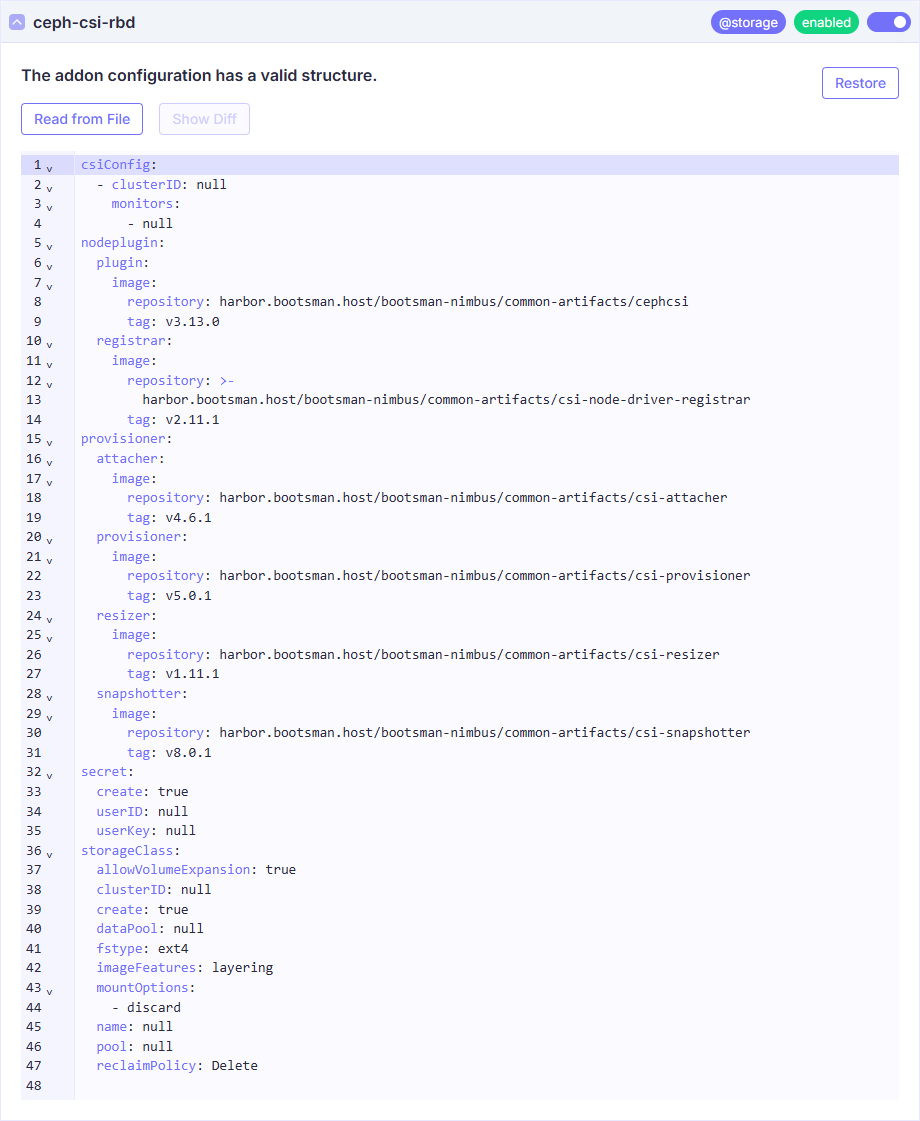
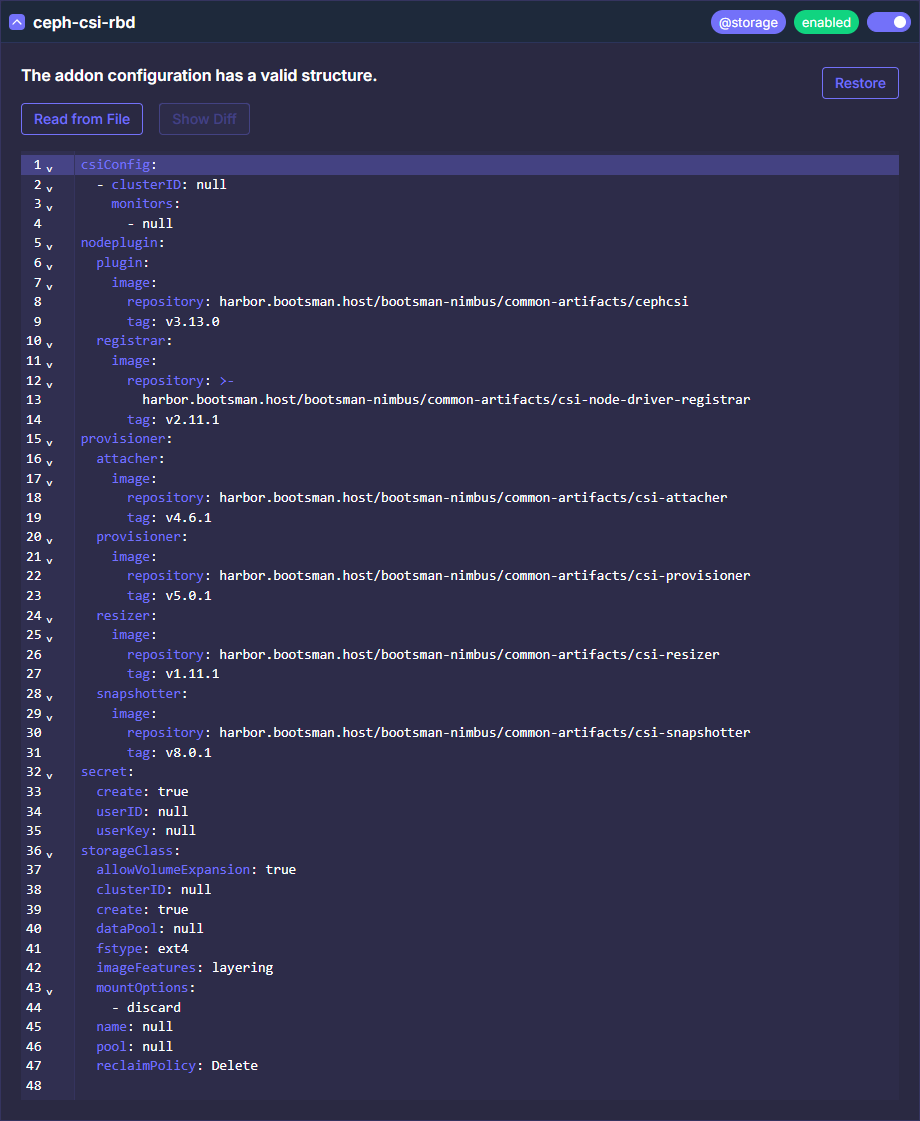
Все Values
Продвинутые настройки
Ниже представлены тонкие настройки модуля.
Используйте их для расширения конфигурации модуля, если потребуется.
Документация
Более полная документация по модулю:
Ceph CSI CephFS Docs
Ceph CSI CephFS Chart
Ceph CSI RBD Values
  values:
    rbac:
      # Specifies whether RBAC resources should be created
      create: true
      # When possible try and reduce the scope of permission to only give
      # access to resources defined in the config. See the README for more info
      leastPrivileges: true

    serviceAccounts:
      nodeplugin:
        # Specifies whether a ServiceAccount should be created
        create: true
        # The name of the ServiceAccount to use.
        # If not set and create is true, a name is generated using the fullname
        name:
      provisioner:
        # Specifies whether a ServiceAccount should be created
        create: true
        # The name of the ServiceAccount to use.
        # If not set and create is true, a name is generated using the fullname
        name:

    # Configuration for the CSI to connect to the cluster
    # Ref: https://github.com/ceph/ceph-csi/blob/devel/examples/README.md
    # Example:
    # csiConfig:
    #   - clusterID: "<cluster-id>"
    #     monitors:
    #       - "<MONValue1>"
    #       - "<MONValue2>"
    #     cephFS:
    #       subvolumeGroup: "csi"
    #       netNamespaceFilePath: "{{ .kubeletDir }}/plugins/{{ .driverName }}/net"
    #       radosNamespace: "csi"
    csiConfig: []

    # Configuration for the encryption KMS
    # yamllint disable-line rule:line-length
    # Ref: https://github.com/ceph/ceph-csi/blob/devel/docs/deploy-cephfs.md#cephfs-volume-encryption
    # Example:
    #   encryptionKMSConfig:
    #     encryptionKMSType: vault
    #     vaultAddress: https://vault.example.com
    #     vaultAuthPath: /v1/auth/kubernetes/login
    #     vaultRole: csi-kubernetes
    #     vaultPassphraseRoot: /v1/secret
    #     vaultPassphrasePath: ceph-csi/
    #     vaultCAVerify: "true"
    encryptionKMSConfig: {}

    # Labels to apply to all resources
    commonLabels: {}

    # Set logging level for csi containers.
    # Supported values from 0 to 5. 0 for general useful logs,
    # 5 for trace level verbosity.
    # logLevel is the variable for CSI driver containers's log level
    logLevel: 5
    # sidecarLogLevel is the variable for Kubernetes sidecar container's log level
    sidecarLogLevel: 1
    # Log slow operations at the specified rate.
    # Operation is considered slow if it outlives its deadline.
    logSlowOperationInterval: 30s

    # Set fsGroupPolicy for CSI Driver object spec
    # https://kubernetes-csi.github.io/docs/support-fsgroup.html
    # The following modes are supported:
    # - None: Indicates that volumes will be mounted with no modifications, as the
    #   CSI volume driver does not support these operations.
    # - File: Indicates that the CSI volume driver supports volume ownership and
    #   permission change via fsGroup, and Kubernetes may use fsGroup to change
    #   permissions and ownership of the volume to match user requested fsGroup in
    #   the pod's SecurityPolicy regardless of fstype or access mode.
    # - ReadWriteOnceWithFSType: Indicates that volumes will be examined to
    #   determine if volume ownership and permissions should be modified to match
    #   the pod's security policy.
    # Changes will only occur if the fsType is defined and the persistent volume's
    # accessModes contains ReadWriteOnce.
    CSIDriver:
      fsGroupPolicy: "File"
      seLinuxMount: true

    nodeplugin:
      name: nodeplugin
      # if you are using ceph-fuse client set this value to OnDelete
      updateStrategy: RollingUpdate

      # set user created priorityclassName for csi plugin pods. default is
      # system-node-critical which is highest priority
      priorityClassName: system-node-critical

      httpMetrics:
        # Metrics only available for cephcsi/cephcsi => 1.2.0
        # Specifies whether http metrics should be exposed
        enabled: true
        # The port of the container to expose the metrics
        containerPort: 8081

        service:
          # Specifies whether a service should be created for the metrics
          enabled: true
          # The port to use for the service
          servicePort: 8080
          type: ClusterIP

          # Annotations for the service
          # Example:
          # annotations:
          #   prometheus.io/scrape: "true"
          #   prometheus.io/port: "9080"
          annotations: {}

          clusterIP: ""

          ## List of IP addresses at which the stats-exporter service is available
          ## Ref: https://kubernetes.io/docs/user-guide/services/#external-ips
          ##
          externalIPs: []

          loadBalancerIP: ""
          loadBalancerSourceRanges: []

      ## Reference to one or more secrets to be used when pulling images
      ##
      imagePullSecrets: []
      # - name: "image-pull-secret"

      profiling:
        enabled: false

      registrar:
        image:
          repository: harbor.bootsman.host/bootsman-nimbus/common-artifacts/csi-node-driver-registrar
          tag: v2.11.1
          pullPolicy: IfNotPresent
        resources: {}

      plugin:
        image:
          repository: harbor.bootsman.host/bootsman-nimbus/common-artifacts/cephcsi
          tag: v3.13.0
          pullPolicy: IfNotPresent
        resources: {}

      nodeSelector: {}

      tolerations: []

      affinity: {}

      annotations: {}

      podSecurityContext: {}

      podAnnotations: {}

      # Set to true to enable Ceph Kernel clients
      # on kernel < 4.17 which support quotas
      # forcecephkernelclient: true

      # common mount options to apply all mounting
      # example: kernelmountoptions: "recover_session=clean"
      kernelmountoptions: ""
      fusemountoptions: ""

    provisioner:
      name: provisioner
      replicaCount: 3
      strategy:
        # RollingUpdate strategy replaces old pods with new ones gradually,
        # without incurring downtime.
        type: RollingUpdate
        rollingUpdate:
          # maxUnavailable is the maximum number of pods that can be
          # unavailable during the update process.
          maxUnavailable: 50%
      # Timeout for waiting for creation or deletion of a volume
      timeout: 60s
      # cluster name to set on the subvolume
      # clustername: "k8s-cluster-1"

      # set user created priorityclassName for csi provisioner pods. default is
      # system-cluster-critical which is less priority than system-node-critical
      priorityClassName: system-cluster-critical

      # enable hostnetwork for provisioner pod. default is false
      # useful for deployments where the podNetwork has no access to ceph
      enableHostNetwork: false

      httpMetrics:
        # Metrics only available for cephcsi/cephcsi => 1.2.0
        # Specifies whether http metrics should be exposed
        enabled: true
        # The port of the container to expose the metrics
        containerPort: 8081

        service:
          # Specifies whether a service should be created for the metrics
          enabled: true
          # The port to use for the service
          servicePort: 8080
          type: ClusterIP

          # Annotations for the service
          # Example:
          # annotations:
          #   prometheus.io/scrape: "true"
          #   prometheus.io/port: "9080"
          annotations: {}

          clusterIP: ""

          ## List of IP addresses at which the stats-exporter service is available
          ## Ref: https://kubernetes.io/docs/user-guide/services/#external-ips
          ##
          externalIPs: []

          loadBalancerIP: ""
          loadBalancerSourceRanges: []

      ## Reference to one or more secrets to be used when pulling images
      ##
      imagePullSecrets: []
      # - name: "image-pull-secret"

      profiling:
        enabled: false

      provisioner:
        image:
          repository: harbor.bootsman.host/bootsman-nimbus/common-artifacts/csi-provisioner
          tag: v5.0.1
          pullPolicy: IfNotPresent
        resources: {}
        args:
        #   # httpEndpointPort specifies the http server port for
        #   # diagnostics, health checks and metrics.
        #   # Uncomment below line to enable the `http-endpoint` arg for sidecar
        #   httpEndpointPort: 8090
        ## For further options, check
        ## https://github.com/kubernetes-csi/external-provisioner#command-line-options
        extraArgs: []

      # set metadata on volume
      setmetadata: true

      resizer:
        name: resizer
        enabled: true
        image:
          repository: harbor.bootsman.host/bootsman-nimbus/common-artifacts/csi-resizer
          tag: v1.11.1
          pullPolicy: IfNotPresent
        resources: {}
        args:
        #   # httpEndpointPort specifies the http server port for
        #   # diagnostics, health checks and metrics.
        #   # Uncomment below line to enable the `http-endpoint` arg for sidecar
        #   httpEndpointPort: 8091
        ## For further options, check
        ## https://github.com/kubernetes-csi/external-resizer#recommended-optional-arguments
        extraArgs: []

      snapshotter:
        image:
          repository: harbor.bootsman.host/bootsman-nimbus/common-artifacts/csi-snapshotter
          tag: v8.0.1
          pullPolicy: IfNotPresent
        resources: {}
        args:
          # enableVolumeGroupSnapshots enables support for volume group snapshots
          enableVolumeGroupSnapshots: false
          # httpEndpointPort specifies the http server port for
          # diagnostics, health checks and metrics.
          # Uncomment below line to enable the `http-endpoint` arg for sidecar
          # httpEndpointPort: 8092
        ## For further options, check
        ## https://github.com/kubernetes-csi/external-snapshotter#csi-external-snapshotter-sidecar-command-line-options
        extraArgs: []

      nodeSelector: {}

      tolerations: []

      affinity: {}

      annotations: {}

      podSecurityContext: {}

      podAnnotations: {}

    # readAffinity:
    # Enable read affinity for CephFS subvolumes. Recommended to
    # set to true if running kernel 5.8 or newer.
    # enabled: false
    # Define which node labels to use as CRUSH location.
    # This should correspond to the values set in the CRUSH map.
    # NOTE: the value here serves as an example
    # crushLocationLabels:
    #   - topology.kubernetes.io/region
    #   - topology.kubernetes.io/zone

    # Mount the host /etc/selinux inside pods to support
    # selinux-enabled filesystems
    selinuxMount: true

    storageClass:
      # Specifies whether the Storage class should be created
      create: false
      name: csi-cephfs-sc
      # Annotations for the storage class
      # Example:
      # annotations:
      #   storageclass.kubernetes.io/is-default-class: "true"
      annotations: {}

      # String representing a Ceph cluster to provision storage from.
      # Should be unique across all Ceph clusters in use for provisioning,
      # cannot be greater than 36 bytes in length, and should remain immutable for
      # the lifetime of the StorageClass in use.
      clusterID: <cluster-ID>
      # (required) CephFS filesystem name into which the volume shall be created
      # eg: fsName: myfs
      fsName: myfs
      # (optional) Ceph pool into which volume data shall be stored
      # pool: <cephfs-data-pool>
      # For eg:
      # pool: "replicapool"
      pool: ""
      # (optional) Comma separated string of Ceph-fuse mount options.
      # For eg:
      # fuseMountOptions: debug
      fuseMountOptions: ""
      # (optional) Comma separated string of Cephfs kernel mount options.
      # Check man mount.ceph for mount options. For eg:
      # kernelMountOptions: readdir_max_bytes=1048576,norbytes
      kernelMountOptions: ""
      # (optional) The driver can use either ceph-fuse (fuse) or
      # ceph kernelclient (kernel).
      # If omitted, default volume mounter will be used - this is
      # determined by probing for ceph-fuse and mount.ceph
      # mounter: kernel
      mounter: ""
      # (optional) Prefix to use for naming subvolumes.
      # If omitted, defaults to "csi-vol-".
      # volumeNamePrefix: "foo-bar-"
      volumeNamePrefix: ""

      # (optional) Instruct the plugin it has to encrypt the volume
      # By default it is disabled. Valid values are "true" or "false".
      # A string is expected here, i.e. "true", not true.
      # encrypted: "true"
      encrypted: ""

      # (optional) Use external key management system for encryption passphrases by
      # specifying a unique ID matching KMS ConfigMap. The ID is only used for
      # correlation to configmap entry.
      encryptionKMSID: ""

      # The secrets have to contain user and/or Ceph admin credentials.
      provisionerSecret: csi-cephfs-secret
      # If the Namespaces are not specified, the secrets are assumed to
      # be in the Release namespace.
      provisionerSecretNamespace: ""
      controllerExpandSecret: csi-cephfs-secret
      controllerExpandSecretNamespace: ""
      nodeStageSecret: csi-cephfs-secret
      nodeStageSecretNamespace: ""
      reclaimPolicy: Delete
      allowVolumeExpansion: true
      mountOptions: []
      # Mount Options
      # Example:
      # mountOptions:
      #   - discard

    secret:
      # Specifies whether the secret should be created
      create: false
      name: csi-cephfs-secret
      annotations: {}
      # Key values correspond to a user name and its key, as defined in the
      # ceph cluster. User ID should have required access to the 'pool'
      # specified in the storage class
      adminID: <plaintext ID>
      adminKey: <Ceph auth key corresponding to ID above>
      # User credentials are required for the static provisioned PVC.
      userID: ""
      userKey: ""

    # This is a sample configmap that helps define a Ceph configuration as required
    # by the CSI plugins.
    # Sample ceph.conf available at
    # https://github.com/ceph/ceph/blob/master/src/sample.ceph.conf Detailed
    # documentation is available at
    # https://docs.ceph.com/en/latest/rados/configuration/ceph-conf/
    cephconf: |
      [global]
        auth_cluster_required = cephx
        auth_service_required = cephx
        auth_client_required = cephx

        # ceph-fuse which uses libfuse2 by default has write buffer size of 2KiB
        # adding 'fuse_big_writes = true' option by default to override this limit
        # see https://github.com/ceph/ceph-csi/issues/1928
        fuse_big_writes = true

    # Array of extra objects to deploy with the release
    extraDeploy: []

    #########################################################
    # Variables for 'internal' use please use with caution! #
    #########################################################

    # The filename of the provisioner socket
    provisionerSocketFile: csi-provisioner.sock
    # The filename of the plugin socket
    pluginSocketFile: csi.sock
    # kubelet working directory,can be set using `--root-dir` when starting kubelet.
    kubeletDir: /var/lib/kubelet
    # Name of the csi-driver
    driverName: cephfs.csi.ceph.com
    # Name of the configmap used for state
    configMapName: ceph-csi-config
    # Key to use in the Configmap if not config.json
    # configMapKey:
    # Use an externally provided configmap
    externallyManagedConfigmap: false
    # Name of the configmap used for ceph.conf
    cephConfConfigMapName: ceph-config
    # Name of the configmap used for encryption kms configuration
    kmsConfigMapName: ceph-csi-encryption-kms-config
    # CephFS RadosNamespace used to store CSI specific objects and keys.
    # radosNamespaceCephFS: csi
    # Unique ID distinguishing this instance of Ceph CSI among other instances,
    # when sharing Ceph clusters across CSI instances for provisioning
    # instanceID: default