Velero
Описание
Velero — это модуль, предназначенный для резервного копирования и восстановления данных в кластерах Kubernetes. Он поддерживает как локальные, так и облачные хранилища для хранения резервных копий, обеспечивая гибкость и надежность работы.
Данные для резервной копии:
- Резервная копия всех манифестов кластера
- Создание бекапов Longhorn
Состав модулей для работы:
- snapshot-controller (1)
- velero (2)
- velero-config(3)
- Используется как webhook для взаимодействия velero с longhorn
- Само приложение
- Дополнительные настройки Longhorn
Зависимые модули
Для работы Velero, помимо модулей на данной странице, потребуется включить модуль хранения данных longhorn
Модуль Longhorn
Подключение модуля snapshot-controller
Описание Yaml
Внимание!
- Описание
apiVersion: addon.bootsman.tech/v1alpha1
kind: Config
metadata:
  name: CLUSTER_NAME-snapshot-controller
  namespace: CLUSTER_NAMESPACE
spec:
  enabled: true (1)
  values:
    controller:
      image:
        repository: >-
          harbor.bootsman.host/bootsman-nimbus/common-artifacts/snapshot-controller
        tag: v8.1.0
      volumeSnapshotClasses:
        - annotations: (2)
            snapshot.storage.kubernetes.io/is-default-class: 'true'
          deletionPolicy: Delete
          driver: driver.longhorn.io
          labels:
            velero.io/csi-volumesnapshot-class: 'true'
          name: longhorn
          parameters:
            type: bak
    webhook:
      image:
        repository: >-
          harbor.bootsman.host/bootsman-nimbus/common-artifacts/snapshot-validation-webhook
        tag: v8.1.0
      webhook:
        failurePolicy: Ignore
- True - включено.
False - выключено
- Подготовленные настройки для резервной копии Longhorn
Настройка в UI
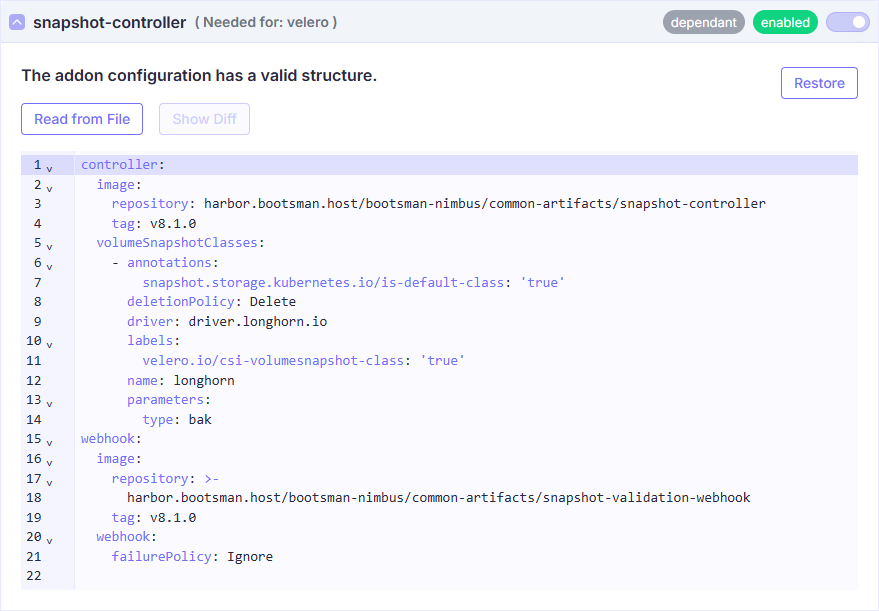
Все Values
Продвинутые настройки
Ниже представлены тонкие настройки модуля.
Используйте их для расширения конфигурации модуля, если потребуется.
Документация
Более полная документация по модулю:
Snapshot Controller Github
Snapshot Controller Chart
Snapshot Controller Values
  values:
    controller:
      enabled: true

      replicaCount: 1

      revisionHistoryLimit: 10

      args:
        leaderElection: true
        leaderElectionNamespace: "$(NAMESPACE)"
        httpEndpoint: ":8080"

      image:
        repository: harbor.bootsman.host/bootsman-nimbus/common-artifacts/snapshot-controller
        pullPolicy: IfNotPresent
        # Overrides the image tag whose default is the chart appVersion.
        tag: v8.1.0

      imagePullSecrets: []

      podAnnotations: {}

      podLabels: {}

      podSecurityContext: {}
        # fsGroup: 2000

      securityContext:
        capabilities:
          drop:
          - ALL
        readOnlyRootFilesystem: true
        runAsNonRoot: true
        runAsUser: 1000

      resources: {}

      nodeSelector: {}

      tolerations: []

      affinity: {}

      ## Ref: https://kubernetes.io/docs/tasks/run-application/configure-pdb/
      ##
      pdb: {}

      topologySpreadConstraints: []

      rbac:
        # Specifies whether RBAC resources should be created
        create: true

      serviceAccount:
        # Specifies whether a ServiceAccount should be created
        create: true
        name: ""

      serviceMonitor:
        # Specifies whether a ServiceMonitor should be created
        create: false

      volumeSnapshotClasses:
        - annotations:
            snapshot.storage.kubernetes.io/is-default-class: 'true'
          deletionPolicy: Delete
          driver: driver.longhorn.io
          labels:
            velero.io/csi-volumesnapshot-class: 'true'
          name: longhorn
          parameters:
            type: bak
    #    - name: linstor-csi-delete
    #      annotations:
    #        snapshot.storage.kubernetes.io/is-default-class: "true"
    #      labels:
    #        velero.io/csi-volumesnapshot-class: "true"
    #      driver: linstor.csi.linbit.com
    #      deletionPolicy: Delete

      priorityClassName: ""
        # Specifies wether a Priority Class should be attached to deployment pods

      # Change `hostNetwork` to `true` when you want the pod to share its host's network namespace.
      hostNetwork: false

      # DNS settings for the controller pod. https://kubernetes.io/docs/concepts/services-networking/dns-pod-service/#pod-dns-config
      dnsConfig: {}
      # DNS Policy for controller pod. For Pods running with hostNetwork, set to `ClusterFirstWithHostNet`
      # For further reference: https://kubernetes.io/docs/concepts/services-networking/dns-pod-service/#pod-s-dns-policy.
      dnsPolicy: ClusterFirst

    webhook:
      enabled: true

      replicaCount: 1

      revisionHistoryLimit: 10

      args:
        tlsPrivateKeyFile: /etc/snapshot-validation/tls.key
        tlsCertFile: /etc/snapshot-validation/tls.crt
        port: 8443
        # enableVolumeGroupSnapshotWebhook: true

      image:
        repository: harbor.bootsman.host/bootsman-nimbus/common-artifacts/snapshot-validation-webhook
        pullPolicy: IfNotPresent
        # Overrides the image tag whose default is the chart appVersion.
        tag: v8.1.0

      webhook:
        timeoutSeconds: 2
        failurePolicy: Ignore

      tls:
        certificateSecret: ""
        autogenerate: true
        renew: false
        certManagerIssuerRef: {}

      imagePullSecrets: []
      podAnnotations: {}
      podLabels: {}

      networkPolicy:
        enabled: false
        ingress: {}
          # - from:
          #   - ipBlock:
        #       cidr: 0.0.0.0/0

      ## Ref: https://kubernetes.io/docs/tasks/run-application/configure-pdb/
      ##
      pdb: {}

      priorityClassName:

      ## Ref: https://kubernetes.io/docs/concepts/scheduling-eviction/topology-spread-constraints/
      ##
      topologySpreadConstraints: []
        # - maxSkew: 1
        #   topologyKey: topology.kubernetes.io/zone
        #   whenUnsatisfiable: ScheduleAnyway
        #   labelSelector:
        #     matchLabels:
      #       app.kubernetes.io/instance: snapshot-validation-webhook

      podSecurityContext: {}
      # fsGroup: 2000

      securityContext:
        capabilities:
          drop:
            - ALL
        readOnlyRootFilesystem: true
        runAsNonRoot: true
        runAsUser: 1000

      resources: {}

      nodeSelector: {}

      tolerations: []

      affinity: {}

      serviceAccount:
        create: true
        name: ""

      rbac:
        create: true

      # Change `hostNetwork` to `true` when you want the pod to share its host's network namespace.
      hostNetwork: false

      # DNS settings for the webhook pod. https://kubernetes.io/docs/concepts/services-networking/dns-pod-service/#pod-dns-config
      dnsConfig: {}
      # DNS Policy for webhook pod. For Pods running with hostNetwork, set to `ClusterFirstWithHostNet`
      # For further reference: https://kubernetes.io/docs/concepts/services-networking/dns-pod-service/#pod-s-dns-policy.
      dnsPolicy: ClusterFirst

      tests:
        nodeSelector: { }

        tolerations: [ ]

        affinity: { }
Подключение модуля velero
Описание Yaml
Внимание!
- Описание
apiVersion: addon.bootsman.tech/v1alpha1
kind: Config
metadata:
  name: CLUSTER_NAME-velero
  namespace: CLUSTER_NAMESPACE
spec:
  enabled: true (1)
  values:
    configuration:
      backupStorageLocation:
        - bucket: velero-bucket (2)
          config:
            checksumAlgorithm: '' (3)
            region: ru-central1 (4)
            s3Url: https://storage.yandexcloud.net (5)
          name: default (6)
          prefix: velero-backup (7)
          provider: aws
      features: EnableCSI
      volumeSnapshotLocation:
        - config:
            region: ru-central1 (4)
          name: volume-snapshot-provider-name (8)
          provider: aws
    credentials:
      secretContents:
        cloud: | (9)
          [default]
          aws_access_key_id=awsaccesskeyid
          aws_secret_access_key=awssecretaccesskey
    image:
      repository: harbor.bootsman.host/bootsman-nimbus/common-artifacts/velero
    initContainers:
      - image: >-
          harbor.bootsman.host/bootsman-nimbus/common-artifacts/velero-plugin-for-aws:v1.10.0
        imagePullPolicy: IfNotPresent
        name: velero-plugin-for-aws
        volumeMounts:
          - mountPath: /target
            name: plugins
    kubectl:
      image:
        repository: harbor.bootsman.host/bootsman-nimbus/common-artifacts/bitnami-kubectl
        tag: 1.28.4
- True - включено.
False - выключено
- Имя Bucket в S3 хранилище
- Поддержка проверки контрольных сумм.
Зависит от типа используемого S3
- Регион
- URL для подключения к API S3 хранилища.
- Имя "профиля" Velero для хранения манифестов
- Дополнительная директория внутри Bucket, куда будет помещена резервная копия.
- Имя "профиля" Velero для хранения бекапов Longhorn
- Secret для авторизации в S3 хранилище
Настройка в UI
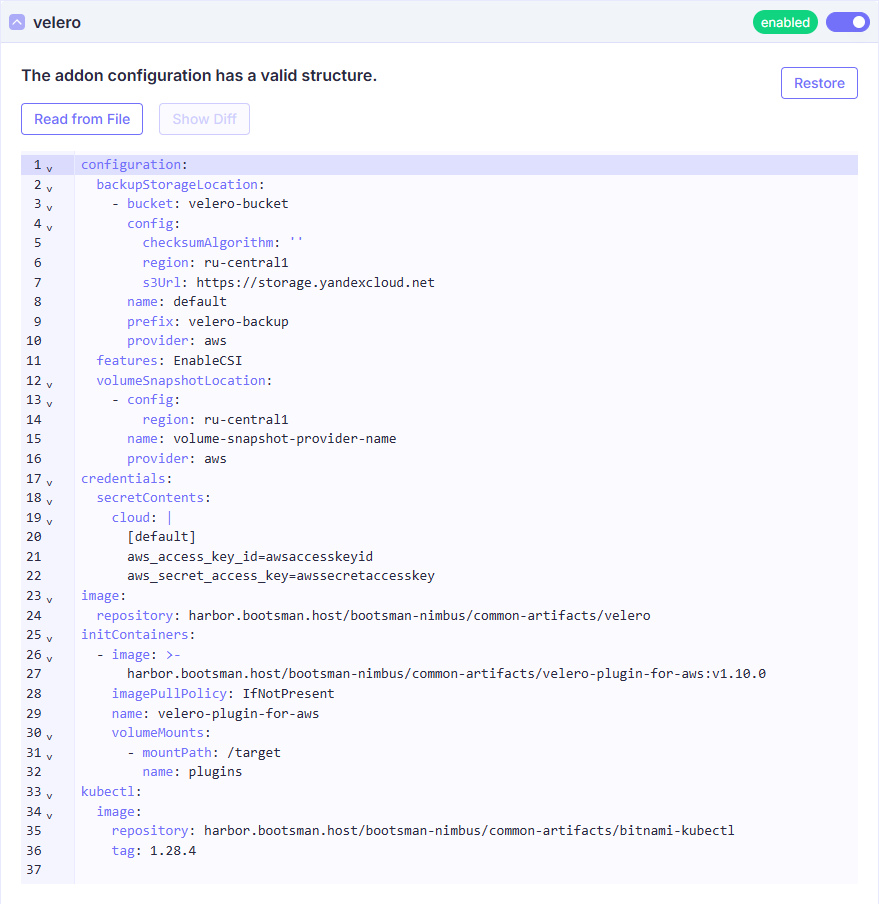
Все Values
Продвинутые настройки
Ниже представлены тонкие настройки модуля.
Используйте их для расширения конфигурации модуля, если потребуется.
Документация
Более полная документация по модулю:
Velero Docs
Velero Chart
Velero Values
  values:
    # Labels settings in namespace
    namespace:
      labels: {}
        # Enforce Pod Security Standards with Namespace Labels
        # https://kubernetes.io/docs/tasks/configure-pod-container/enforce-standards-namespace-labels/
        # - key: pod-security.kubernetes.io/enforce
        #   value: privileged
        # - key: pod-security.kubernetes.io/enforce-version
        #   value: latest
        # - key: pod-security.kubernetes.io/audit
        #   value: privileged
        # - key: pod-security.kubernetes.io/audit-version
        #   value: latest
        # - key: pod-security.kubernetes.io/warn
        #   value: privileged
        # - key: pod-security.kubernetes.io/warn-version
        #   value: latest

    ##
    ## End of namespace-related settings.
    ##


    ##
    ## Configuration settings that directly affect the Velero deployment YAML.
    ##

    # Details of the container image to use in the Velero deployment & daemonset (if
    # enabling node-agent). Required.
    image:
      repository: harbor.bootsman.host/bootsman-nimbus/common-artifacts/velero
      tag: v1.14.1
      # Digest value example: sha256:d238835e151cec91c6a811fe3a89a66d3231d9f64d09e5f3c49552672d271f38.
      # If used, it will take precedence over the image.tag.
      # digest:
      pullPolicy: IfNotPresent
      # One or more secrets to be used when pulling images
      imagePullSecrets: []
      # - registrySecretName

    nameOverride: ""
    fullnameOverride: ""

    # Annotations to add to the Velero deployment's. Optional.
    #
    # If you are using reloader use the following annotation with your VELERO_SECRET_NAME
    annotations: {}
    # secret.reloader.stakater.com/reload: "<VELERO_SECRET_NAME>"

    # Annotations to add to secret
    secretAnnotations: {}

    # Labels to add to the Velero deployment's. Optional.
    labels: {}

    # Annotations to add to the Velero deployment's pod template. Optional.
    #
    # If using kube2iam or kiam, use the following annotation with your AWS_ACCOUNT_ID
    # and VELERO_ROLE_NAME filled in:
    podAnnotations: {}
      #  iam.amazonaws.com/role: "arn:aws:iam::<AWS_ACCOUNT_ID>:role/<VELERO_ROLE_NAME>"

    # Additional pod labels for Velero deployment's template. Optional
    # ref: https://kubernetes.io/docs/concepts/overview/working-with-objects/labels/
    podLabels: {}

    # Number of old history to retain to allow rollback (If not set, default Kubernetes value is set to 10)
    # revisionHistoryLimit: 1

    # Resource requests/limits to specify for the Velero deployment.
    # https://velero.io/docs/v1.6/customize-installation/#customize-resource-requests-and-limits
    resources: {}
      # requests:
      #   cpu: 500m
      #   memory: 128Mi
      # limits:
      #   cpu: 1000m
      #   memory: 512Mi

    # Resource requests/limits to specify for the upgradeCRDs job pod. Need to be adjusted by user accordingly.
    upgradeJobResources: {}
    # requests:
    #     cpu: 50m
    #     memory: 128Mi
    #   limits:
    #     cpu: 100m
    #     memory: 256Mi
    upgradeCRDsJob:
      # Extra volumes for the Upgrade CRDs Job. Optional.
      extraVolumes: []
      # Extra volumeMounts for the Upgrade CRDs Job. Optional.
      extraVolumeMounts: []
      # Extra key/value pairs to be used as environment variables. Optional.
      extraEnvVars: {}


    # Configure the dnsPolicy of the Velero deployment
    # See: https://kubernetes.io/docs/concepts/services-networking/dns-pod-service/#pod-s-dns-policy
    dnsPolicy: ClusterFirst

    # Init containers to add to the Velero deployment's pod spec. At least one plugin provider image is required.
    # If the value is a string then it is evaluated as a template.
    initContainers:
      - image: >-
          harbor.bootsman.host/bootsman-nimbus/common-artifacts/velero-plugin-for-aws:v1.10.0
        imagePullPolicy: IfNotPresent
        name: velero-plugin-for-aws
        volumeMounts:
          - mountPath: /target
            name: plugins
      # - name: velero-plugin-for-aws
      #   image: velero/velero-plugin-for-aws:v1.10.0
      #   imagePullPolicy: IfNotPresent
      #   volumeMounts:
      #     - mountPath: /target
      #       name: plugins

    # SecurityContext to use for the Velero deployment. Optional.
    # Set fsGroup for `AWS IAM Roles for Service Accounts`
    # see more informations at: https://docs.aws.amazon.com/eks/latest/userguide/iam-roles-for-service-accounts.html
    podSecurityContext: {}
      # fsGroup: 1337

    # Container Level Security Context for the 'velero' container of the Velero deployment. Optional.
    # See: https://kubernetes.io/docs/tasks/configure-pod-container/security-context/#set-the-security-context-for-a-container
    containerSecurityContext: {}
      # allowPrivilegeEscalation: false
      # capabilities:
      #   drop: ["ALL"]
      #   add: []
      # readOnlyRootFilesystem: true

    # Container Lifecycle Hooks to use for the Velero deployment. Optional.
    lifecycle: {}

    # Pod priority class name to use for the Velero deployment. Optional.
    priorityClassName: ""

    # The number of seconds to allow for graceful termination of the pod. Optional.
    terminationGracePeriodSeconds: 3600

    # Liveness probe of the pod
    livenessProbe:
      httpGet:
        path: /metrics
        port: http-monitoring
        scheme: HTTP
      initialDelaySeconds: 10
      periodSeconds: 30
      timeoutSeconds: 5
      successThreshold: 1
      failureThreshold: 5

    # Readiness probe of the pod
    readinessProbe:
      httpGet:
        path: /metrics
        port: http-monitoring
        scheme: HTTP
      initialDelaySeconds: 10
      periodSeconds: 30
      timeoutSeconds: 5
      successThreshold: 1
      failureThreshold: 5

    # Tolerations to use for the Velero deployment. Optional.
    tolerations: []

    # Affinity to use for the Velero deployment. Optional.
    affinity: {}

    # Node selector to use for the Velero deployment. Optional.
    nodeSelector: {}

    # DNS configuration to use for the Velero deployment. Optional.
    dnsConfig: {}

    # Extra volumes for the Velero deployment. Optional.
    extraVolumes: []

    # Extra volumeMounts for the Velero deployment. Optional.
    extraVolumeMounts: []

    # Extra K8s manifests to deploy
    extraObjects: []
      # - apiVersion: secrets-store.csi.x-k8s.io/v1
      #   kind: SecretProviderClass
      #   metadata:
      #     name: velero-secrets-store
      #   spec:
      #     provider: aws
      #     parameters:
      #       objects: |
      #         - objectName: "velero"
      #           objectType: "secretsmanager"
      #           jmesPath:
      #               - path: "access_key"
      #                 objectAlias: "access_key"
      #               - path: "secret_key"
      #                 objectAlias: "secret_key"
      #     secretObjects:
      #       - data:
      #         - key: access_key
      #           objectName: client-id
      #         - key: client-secret
      #           objectName: client-secret
      #         secretName: velero-secrets-store
      #         type: Opaque

    # Settings for Velero's prometheus metrics. Enabled by default.
    metrics:
      enabled: true
      scrapeInterval: 30s
      scrapeTimeout: 10s

      # service metdata if metrics are enabled
      service:
        annotations: {}
        labels: {}

      # Pod annotations for Prometheus
      podAnnotations:
        prometheus.io/scrape: "true"
        prometheus.io/port: "8085"
        prometheus.io/path: "/metrics"

      serviceMonitor:
        autodetect: true
        enabled: false
        annotations: {}
        additionalLabels: {}

        # metrics.serviceMonitor.metricRelabelings Specify Metric Relabelings to add to the scrape endpoint
        # ref: https://github.com/coreos/prometheus-operator/blob/master/Documentation/api.md#relabelconfig
        # metricRelabelings: []
        # metrics.serviceMonitor.relabelings [array] Prometheus relabeling rules
        # relabelings: []
        # ServiceMonitor namespace. Default to Velero namespace.
        # namespace:
        # ServiceMonitor connection scheme. Defaults to HTTP.
        # scheme: ""
        # ServiceMonitor connection tlsConfig. Defaults to {}.
        # tlsConfig: {}
      nodeAgentPodMonitor:
        autodetect: true
        enabled: false
        annotations: {}
        additionalLabels: {}
        # ServiceMonitor namespace. Default to Velero namespace.
        # namespace:
        # ServiceMonitor connection scheme. Defaults to HTTP.
        # scheme: ""
        # ServiceMonitor connection tlsConfig. Defaults to {}.
        # tlsConfig: {}

      prometheusRule:
        autodetect: true
        enabled: false
        # Additional labels to add to deployed PrometheusRule
        additionalLabels: {}
        # PrometheusRule namespace. Defaults to Velero namespace.
        # namespace: ""
        # Rules to be deployed
        spec: []
        # - alert: VeleroBackupPartialFailures
        #   annotations:
        #     message: Velero backup {{ $labels.schedule }} has {{ $value | humanizePercentage }} partialy failed backups.
        #   expr: |-
        #     velero_backup_partial_failure_total{schedule!=""} / velero_backup_attempt_total{schedule!=""} > 0.25
        #   for: 15m
        #   labels:
        #     severity: warning
        # - alert: VeleroBackupFailures
        #   annotations:
        #     message: Velero backup {{ $labels.schedule }} has {{ $value | humanizePercentage }} failed backups.
        #   expr: |-
        #     velero_backup_failure_total{schedule!=""} / velero_backup_attempt_total{schedule!=""} > 0.25
        #   for: 15m
        #   labels:
        #     severity: warning

    kubectl:
      image:
        repository: harbor.bootsman.host/bootsman-nimbus/common-artifacts/bitnami-kubectl
        # Digest value example: sha256:d238835e151cec91c6a811fe3a89a66d3231d9f64d09e5f3c49552672d271f38.
        # If used, it will take precedence over the kubectl.image.tag.
        # digest:
        # kubectl image tag. If used, it will take precedence over the cluster Kubernetes version.
        tag: 1.28.4
      # Container Level Security Context for the 'kubectl' container of the crd jobs. Optional.
      # See: https://kubernetes.io/docs/tasks/configure-pod-container/security-context/#set-the-security-context-for-a-container
      containerSecurityContext: {}
      # Resource requests/limits to specify for the upgrade/cleanup job. Optional
      resources: {}
      # Annotations to set for the upgrade/cleanup job. Optional.
      annotations: {}
      # Labels to set for the upgrade/cleanup job. Optional.
      labels: {}

    # This job upgrades the CRDs.
    upgradeCRDs: true

    # This job is meant primarily for cleaning up CRDs on CI systems.
    # Using this on production systems, especially those that have multiple releases of Velero, will be destructive.
    cleanUpCRDs: false

    ##
    ## End of deployment-related settings.
    ##


    ##
    ## Parameters for the `default` BackupStorageLocation and VolumeSnapshotLocation,
    ## and additional server settings.
    ##
    configuration:
      volumeSnapshotLocation:
        - config:
            region: ru-central1
          name: volume-snapshot-provider-name
      # Parameters for the BackupStorageLocation(s). Configure multiple by adding other element(s) to the backupStorageLocation slice.
      # See https://velero.io/docs/v1.6/api-types/backupstoragelocation/
      backupStorageLocation:
        # name is the name of the backup storage location where backups should be stored. If a name is not provided,
        # a backup storage location will be created with the name "default". Optional.
      - name: default
        # provider is the name for the backup storage location provider.
        provider: aws
        # bucket is the name of the bucket to store backups in. Required.
        bucket: velero-bucket
        # caCert defines a base64 encoded CA bundle to use when verifying TLS connections to the provider. Optional.
        caCert:
        # prefix is the directory under which all Velero data should be stored within the bucket. Optional.
        prefix: velero-backup
        # default indicates this location is the default backup storage location. Optional.
        default:
        # validationFrequency defines how frequently Velero should validate the object storage. Optional.
        validationFrequency:
        # accessMode determines if velero can write to this backup storage location. Optional.
        # default to ReadWrite, ReadOnly is used during migrations and restores.
        accessMode: ReadWrite
        credential:
          # name of the secret used by this backupStorageLocation.
          name:
          # name of key that contains the secret data to be used.
          key:
        # Additional provider-specific configuration. See link above
        # for details of required/optional fields for your provider.
        config:
          checksumAlgorithm: ''
          region: ru-central1
          s3Url: https://storage.yandexcloud.net
        #  region:
        #  s3ForcePathStyle:
        #  s3Url:
        #  kmsKeyId:
        #  resourceGroup:
        #  The ID of the subscription containing the storage account, if different from the cluster’s subscription. (Azure only)
        #  subscriptionId:
        #  storageAccount:
        #  publicUrl:
        #  Name of the GCP service account to use for this backup storage location. Specify the
        #  service account here if you want to use workload identity instead of providing the key file.(GCP only)
        #  serviceAccount:
        #  Option to skip certificate validation or not if insecureSkipTLSVerify is set to be true, the client side should set the
        #  flag. For Velero client Command like velero backup describe, velero backup logs needs to add the flag --insecure-skip-tls-verify
        #  insecureSkipTLSVerify:

        # annotations allows adding arbitrary annotations to this BackupStorageLocation resource. Optional.
        annotations: {}

      # Parameters for the VolumeSnapshotLocation(s). Configure multiple by adding other element(s) to the volumeSnapshotLocation slice.
      # See https://velero.io/docs/v1.6/api-types/volumesnapshotlocation/
      volumeSnapshotLocation:
        # name is the name of the volume snapshot location where snapshots are being taken. Required.
      - name:
        # provider is the name for the volume snapshot provider.
        provider:
        credential:
          # name of the secret used by this volumeSnapshotLocation.
          name:
          # name of key that contains the secret data to be used.
          key:
        # Additional provider-specific configuration. See link above
        # for details of required/optional fields for your provider.
        config: {}
      #    region:
      #    apiTimeout:
      #    resourceGroup:
      #    The ID of the subscription where volume snapshots should be stored, if different from the cluster’s subscription. If specified, also requires `configuration.volumeSnapshotLocation.config.resourceGroup`to be set. (Azure only)
      #    subscriptionId:
      #    incremental:
      #    snapshotLocation:
      #    project:

        # annotations allows adding arbitrary annotations to this VolumeSnapshotLocation resource. Optional.
        annotations: {}

      # These are server-level settings passed as CLI flags to the `velero server` command. Velero
      # uses default values if they're not passed in, so they only need to be explicitly specified
      # here if using a non-default value. The `velero server` default values are shown in the
      # comments below.
      # --------------------
      # `velero server` default: kopia
      uploaderType:
      # `velero server` default: 1m
      backupSyncPeriod:
      # `velero server` default: 4h
      fsBackupTimeout:
      # `velero server` default: 30
      clientBurst:
      # `velero server` default: 500
      clientPageSize:
      # `velero server` default: 20.0
      clientQPS:
      # Name of the default backup storage location. Default: default
      defaultBackupStorageLocation:
      # The default duration any single item operation can take before timing out, especially important for large volume schedules. Default 4h
      defaultItemOperationTimeout:
      # How long to wait by default before backups can be garbage collected. Default: 72h
      defaultBackupTTL:
      # Name of the default volume snapshot location.
      defaultVolumeSnapshotLocations:
      # `velero server` default: empty
      disableControllers:
      # `velero server` default: false
      disableInformerCache: false
      # `velero server` default: 1h
      garbageCollectionFrequency:
      # Set log-format for Velero pod. Default: text. Other option: json.
      logFormat:
      # Set log-level for Velero pod. Default: info. Other options: debug, warning, error, fatal, panic.
      logLevel:
      # The address to expose prometheus metrics. Default: :8085
      metricsAddress:
      # Directory containing Velero plugins. Default: /plugins
      pluginDir:
      # The address to expose the pprof profiler. Default: localhost:6060
      profilerAddress:
      # `velero server` default: false
      restoreOnlyMode:
      # `velero server` default: customresourcedefinitions,namespaces,storageclasses,volumesnapshotclass.snapshot.storage.k8s.io,volumesnapshotcontents.snapshot.storage.k8s.io,volumesnapshots.snapshot.storage.k8s.io,persistentvolumes,persistentvolumeclaims,secrets,configmaps,serviceaccounts,limitranges,pods,replicasets.apps,clusterclasses.cluster.x-k8s.io,clusters.cluster.x-k8s.io,clusterresourcesets.addons.cluster.x-k8s.io
      restoreResourcePriorities:
      # `velero server` default: 1m
      storeValidationFrequency:
      # How long to wait on persistent volumes and namespaces to terminate during a restore before timing out. Default: 10m
      terminatingResourceTimeout:
      # Bool flag to configure Velero server to move data by default for all snapshots supporting data movement. Default: false
      defaultSnapshotMoveData:
      # Comma separated list of velero feature flags. default: empty
      features: EnableCSI
      features:
      # Resource requests/limits to specify for the repository-maintenance job. Optional.
      # https://velero.io/docs/v1.14/repository-maintenance/#resource-limitation
      repositoryMaintenanceJob:
        requests:
        #   cpu: 500m
        #   memory: 512Mi
        limits:
        #   cpu: 1000m
        #   memory: 1024Mi
        # Number of latest maintenance jobs to keep for each repository
        latestJobsCount: 3
      # `velero server` default: velero
      namespace:
      # additional command-line arguments that will be passed to the `velero server`
      # e.g.: extraArgs: ["--foo=bar"]
      extraArgs: []

      # additional key/value pairs to be used as environment variables such as "AWS_CLUSTER_NAME: 'yourcluster.domain.tld'"
      extraEnvVars: {}

      # Set true for backup all pod volumes without having to apply annotation on the pod when used file system backup Default: false.
      defaultVolumesToFsBackup:

      # How often repository maintain is run for repositories by default.
      defaultRepoMaintainFrequency:

    ##
    ## End of backup/snapshot location settings.
    ##


    ##
    ## Settings for additional Velero resources.
    ##

    rbac:
      # Whether to create the Velero role and role binding to give all permissions to the namespace to Velero.
      create: true
      # Whether to create the cluster role binding to give administrator permissions to Velero
      clusterAdministrator: true
      # Name of the ClusterRole.
      clusterAdministratorName: cluster-admin

    # Information about the Kubernetes service account Velero uses.
    serviceAccount:
      server:
        create: true
        name:
        annotations:
        labels:
        imagePullSecrets: []
        # - registrySecretName

    # Info about the secret to be used by the Velero deployment, which
    # should contain credentials for the cloud provider IAM account you've
    # set up for Velero.
    credentials:
      # Whether a secret should be used. Set to false if, for examples:
      # - using kube2iam or kiam to provide AWS IAM credentials instead of providing the key file. (AWS only)
      # - using workload identity instead of providing the key file. (Azure/GCP only)
      useSecret: true
      # Name of the secret to create if `useSecret` is true and `existingSecret` is empty
      name:
      # Name of a pre-existing secret (if any) in the Velero namespace
      # that should be used to get IAM account credentials. Optional.
      existingSecret:
      # Data to be stored in the Velero secret, if `useSecret` is true and `existingSecret` is empty.
      # As of the current Velero release, Velero only uses one secret key/value at a time.
      # The key must be named `cloud`, and the value corresponds to the entire content of your IAM credentials file.
      # Note that the format will be different for different providers, please check their documentation.
      # Here is a list of documentation for plugins maintained by the Velero team:
      # [AWS] https://github.com/vmware-tanzu/velero-plugin-for-aws/blob/main/README.md
      # [GCP] https://github.com/vmware-tanzu/velero-plugin-for-gcp/blob/main/README.md
      # [Azure] https://github.com/vmware-tanzu/velero-plugin-for-microsoft-azure/blob/main/README.md
      secretContents:
        cloud: |
          [default]
          aws_access_key_id=awsaccesskeyid
          aws_secret_access_key=awssecretaccesskey
      #  cloud: |
      #    [default]
      #    aws_access_key_id=<REDACTED>
      #    aws_secret_access_key=<REDACTED>
      # additional key/value pairs to be used as environment variables such as "DIGITALOCEAN_TOKEN: <your-key>". Values will be stored in the secret.
      extraEnvVars: {}
      # Name of a pre-existing secret (if any) in the Velero namespace
      # that will be used to load environment variables into velero and node-agent.
      # Secret should be in format - https://kubernetes.io/docs/concepts/configuration/secret/#use-case-as-container-environment-variables
      extraSecretRef: ""

    # Whether to create backupstoragelocation crd, if false => do not create a default backup location
    backupsEnabled: true
    # Whether to create volumesnapshotlocation crd, if false => disable snapshot feature
    snapshotsEnabled: true

    # Whether to deploy the node-agent daemonset.
    deployNodeAgent: false

    nodeAgent:
      podVolumePath: /var/lib/kubelet/pods
      # Pod priority class name to use for the node-agent daemonset. Optional.
      priorityClassName: ""
      # Resource requests/limits to specify for the node-agent daemonset deployment. Optional.
      # https://velero.io/docs/v1.6/customize-installation/#customize-resource-requests-and-limits
      resources: {}
        # requests:
        #   cpu: 500m
        #   memory: 512Mi
        # limits:
        #   cpu: 1000m
        #   memory: 1024Mi

      # Tolerations to use for the node-agent daemonset. Optional.
      tolerations: []

      # Annotations to set for the node-agent daemonset. Optional.
      annotations: {}

      # labels to set for the node-agent daemonset. Optional.
      labels: {}

      # will map /scratch to emptyDir. Set to false and specify your own volume
      # via extraVolumes and extraVolumeMounts that maps to /scratch
      # if you don't want to use emptyDir.
      useScratchEmptyDir: true

      # Extra volumes for the node-agent daemonset. Optional.
      extraVolumes: []

      # Extra volumeMounts for the node-agent daemonset. Optional.
      extraVolumeMounts: []

      # Key/value pairs to be used as environment variables for the node-agent daemonset. Optional.
      extraEnvVars: {}

      # Additional command-line arguments that will be passed to the node-agent. Optional.
      # e.g.: extraArgs: ["--foo=bar"]
      extraArgs: []

      # Configure the dnsPolicy of the node-agent daemonset
      # See: https://kubernetes.io/docs/concepts/services-networking/dns-pod-service/#pod-s-dns-policy
      dnsPolicy: ClusterFirst

      # SecurityContext to use for the Velero deployment. Optional.
      # Set fsGroup for `AWS IAM Roles for Service Accounts`
      # see more informations at: https://docs.aws.amazon.com/eks/latest/userguide/iam-roles-for-service-accounts.html
      podSecurityContext:
        runAsUser: 0
        # fsGroup: 1337

      # Container Level Security Context for the 'node-agent' container of the node-agent daemonset. Optional.
      # See: https://kubernetes.io/docs/tasks/configure-pod-container/security-context/#set-the-security-context-for-a-container
      containerSecurityContext: {}

      # Container Lifecycle Hooks to use for the node-agent daemonset. Optional.
      lifecycle: {}

      # Node selector to use for the node-agent daemonset. Optional.
      nodeSelector: {}

      # Affinity to use with node-agent daemonset. Optional.
      affinity: {}

      # DNS configuration to use for the node-agent daemonset. Optional.
      dnsConfig: {}

    # Backup schedules to create.
    # Eg:
    # schedules:
    #   mybackup:
    #     disabled: false
    #     labels:
    #       myenv: foo
    #     annotations:
    #       myenv: foo
    #     schedule: "0 0 * * *"
    #     useOwnerReferencesInBackup: false
    #     paused: false
    #     template:
    #       ttl: "240h"
    #       storageLocation: default
    #       includedNamespaces:
    #       - foo
    #       # See: https://velero.io/docs/v1.14/resource-filtering/#excludes
    #       excludedNamespaceScopedResources:
    #       - persistentVolumeClaims
    #       excludedClusterScopedResources:
    #       - persistentVolumes
    schedules: {}

    # Velero ConfigMaps.
    # Eg:
    # configMaps:
        # See: https://velero.io/docs/v1.11/file-system-backup/
    #   fs-restore-action-config:
    #     labels:
    #       velero.io/plugin-config: ""
    #       velero.io/pod-volume-restore: RestoreItemAction
    #     data:
    #       image: velero/velero-restore-helper:v1.10.2
    #       cpuRequest: 200m
    #       memRequest: 128Mi
    #       cpuLimit: 200m
    #       memLimit: 128Mi
    #       secCtx: |
    #         capabilities:
    #           drop:
    #           - ALL
    #           add: []
    #         allowPrivilegeEscalation: false
    #         readOnlyRootFilesystem: true
    #         runAsUser: 1001
    #         runAsGroup: 999
    configMaps: {}
Подключение модуля velero-config
Описание Yaml
Внимание!
- Описание
apiVersion: addon.bootsman.tech/v1alpha1
kind: Config
metadata:
  name: CLUSTER_NAME-velero-config
  namespace: CLUSTER_NAMESPACE
spec:
  enabled: true (1)
  values:
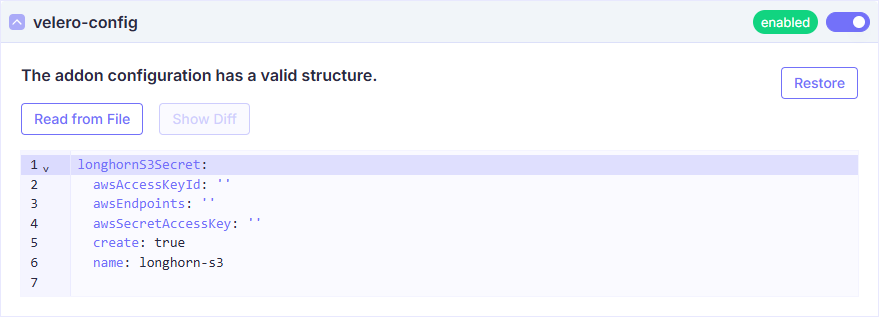
    longhornS3Secret:
      create: true (2)
      name: longhorn-s3 (3)
      awsEndpoints: '' (4)
      awsAccessKeyId: '' (5)
      awsSecretAccessKey: '' (6)
- True - включено.
False - выключено
- true - для создания нововго Secret.
false - при использовании существующего
- Имя Secret. Существующего или созданного.
- S3 key для авторизации
- URL для подключения к API S3 хранилища
- S3 пароль для авторизации
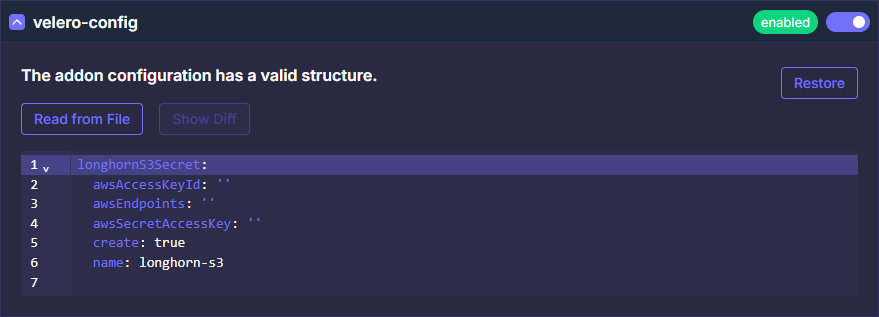
Настройка в UI
Внимание!
Не забудьте добавить информацию а бекапах в конфигурацию Longhorn
Примеры использования
Документация
Более полная документация по модулю:
Velero Docs
Для дальнейшей работы вам понадобится настроить объекты:
- Schedule (1)
- Backup (2)
- Restore (3)
- Основной объект настройки. Создает расписание по которому будут создаваться объекты Backup
- Объект, который запускает процедуру создания резервной копии. Для создания расписания используйте объект Schedule
- Объект восстановления. Требуется для восстановления данных из резервной копии
Описание полей объекта Schedule
Schedule.yaml
apiVersion: velero.io/v1
kind: Schedule
metadata:
  name: SCHEDULE_NAME (1)
  namespace: velero
spec:
  schedule: SCHEDULE (2)
  template:
    storageLocation: STORAGE_LOCATION_NAME (3)
    csiSnapshotTimeout: SNAPSHOT_TIMEOUT (4)
    includedNamespaces:
    - '*' (5)
    itemOperationTimeout: OPERATION_TIMEOUT (6)
    ttl: TTL (7)
    volumeSnapshotLocations:
      - SNAPSHOT_LOCATION_NAME (8)
  useOwnerReferencesInBackup: USE_OWNER (9)
- Имя объекта Schedule
- Расписание резервного копирования в формате cron.
Значение указывается в ' '.
Пример: '0 0 * * *' - Запускать в полночь
- Имя "профиля" Velero для хранения манифестов
- Период ожидания создания резервных копий через CSI.
По умолчанию: 10m0s
- Объекты каких Namespace будут затронуты процедурой
- Период ожидания операции над отдельными ресурсами
- Время существования резервной копии.
По умолчанию: 720h0m0s
- Имя "профиля" Velero для хранения бекапов Longhorn 10 Указывает, использовать ли ссылки на владельца ресурсов (Owner References) в резервных копиях
Описание полей объекта Backup
Backup.yaml
apiVersion: velero.io/v1
kind: Backup
metadata:
  labels:
    velero.io/storage-location: STORAGE_LOCATION_NAME (1)
  name: BACKUP_NAME (2)
  namespace: velero
spec:
  csiSnapshotTimeout: SNAPSHOT_TIMEOUT (3)
  defaultVolumesToFsBackup: TO_FS_BACKUP (4)
  includedNamespaces:
  - '*' (5)
  itemOperationTimeout: OPERATION_TIMEOUT (6)
  snapshotMoveData: MOVE_DATA (7)
  storageLocation: STORAGE_LOCATION_NAME (1)
  ttl: TTL (8)
  volumeSnapshotLocations:
  - SNAPSHOT_LOCATION_NAME (9)
- Имя "профиля" Velero для хранения манифестов
- Имя объекта Backup
- Период ожидания создания резервных копий через CSI.
По умолчанию: 10m0s
- Создавать ли файловые резервные копии.
По умолчанию: false
- Объекты каких Namespace будут затронуты процедурой
- Период ожидания операции над отдельными ресурсами
- true - перемещать данные на S3.
false - оставить в системе
- Время существования резервной копии.
По умолчанию: 720h0m0s
- Имя "профиля" Velero для хранения бекапов Longhorn
Описание полей объекта Restore
Backup.yaml
apiVersion: velero.io/v1
kind: Restore
metadata:
  name: RESTORE_NAME (1)
  namespace: velero
spec:
  backupName: BACKUP_STORAGE_LOCATION_NAME (2)
  includedNamespaces:
  - '*' (3)
  itemOperationTimeout: OPERATION_TIMEOUT (4)
- Имя "профиля" Velero для хранения манифестов
- Имя объекта Backup
- Объекты каких Namespace будут затронуты процедурой
- Период ожидания операции над отдельными ресурсами
Установка и использование velero client
Использовать velero удобнее всего с помощью официального клиента \ Установить его можно следующими способами:
MacOS
brew install velero
GitHub release
- Скачать со страницы релиза
- Распаковать
tar -xvf velero-v1.14.1-<OS>-<ARCH>.tar.gz - Переместить бинарный файл velero в $PATH (н.п.
/usr/local/bin)
velero будет использовать текущий контекст для kubectl
Основные команды
Создание резервной копии:
velero backup create <имя_резервной_копии> \
  --storage-location bootsman \
  --csi-snapshot-timeout=20m \
  --include-namespaces <namespace1>,<namespace2>
Если не указывать include-namespaces, то будет сделана резервная копия всех namespace \
Если необходимо копировать тома большого объема, рекомендуется выставить csi-snapshot-timeout (Значение по-умолчанию 10m)
Просмотр бекапов:
velero backup get
Восстановление резервной копии:
velero restore create --from-backup <имя_резервной_копии>
Просмотр лога резервного копирования/восстановления:
velero backup logs <имя_резервной_копии>
velero restore logs <имя_восстановления>
Создание расписания резервного копирования:
velero schedule create <имя_расписания> \
  --schedule "0 */6 * * *" \
  --include-namespaces <namespace>