Kyverno
Описание
Kyverno добавляет возможность создания политик для управления кластером.
Дополнительные модули
Для подключения UI потребуется модуль policy-reporter
Подключение модуля Kyverno
Описание Yaml
Внимание!
Values без описания (1) являются продвинутыми настройками и редактировать их не рекомендовано
- Описание
apiVersion: addon.bootsman.tech/v1alpha1
kind: Config
metadata:
  name: CLUSTER_NAME-kyverno
  namespace: CLUSTER_NAMESPACE
spec:
  enabled: true (1)
  values:
    admissionController:
      container:
        image:
          registry: harbor.bootsman.host/bootsman-nimbus/common-artifacts
          repository: kyverno
      initContainer:
        image:
          registry: harbor.bootsman.host/bootsman-nimbus/common-artifacts
          repository: kyvernopre
    backgroundController:
      image:
        registry: harbor.bootsman.host/bootsman-nimbus/common-artifacts
        repository: background-controller
    cleanupController:
      image:
        registry: harbor.bootsman.host/bootsman-nimbus/common-artifacts
        repository: cleanup-controller
    cleanupJobs:
      admissionReports:
        image:
          registry: harbor.bootsman.host/bootsman-nimbus/common-artifacts
          repository: bitnami-kubectl
          tag: 1.28.4
      clusterAdmissionReports:
        image:
          registry: harbor.bootsman.host/bootsman-nimbus/common-artifacts
          repository: bitnami-kubectl
          tag: 1.28.4
    reportsController:
      image:
        registry: harbor.bootsman.host/bootsman-nimbus/common-artifacts
        repository: reports-controller
    test:
      image:
        registry: harbor.bootsman.host/bootsman-nimbus/common-artifacts
        repository: busybox
    webhooksCleanup:
      image: >-
        harbor.bootsman.host/bootsman-nimbus/common-artifacts/bitnami-kubectl:1.28.4
- True - включено.
False - выключено
Настройка в UI
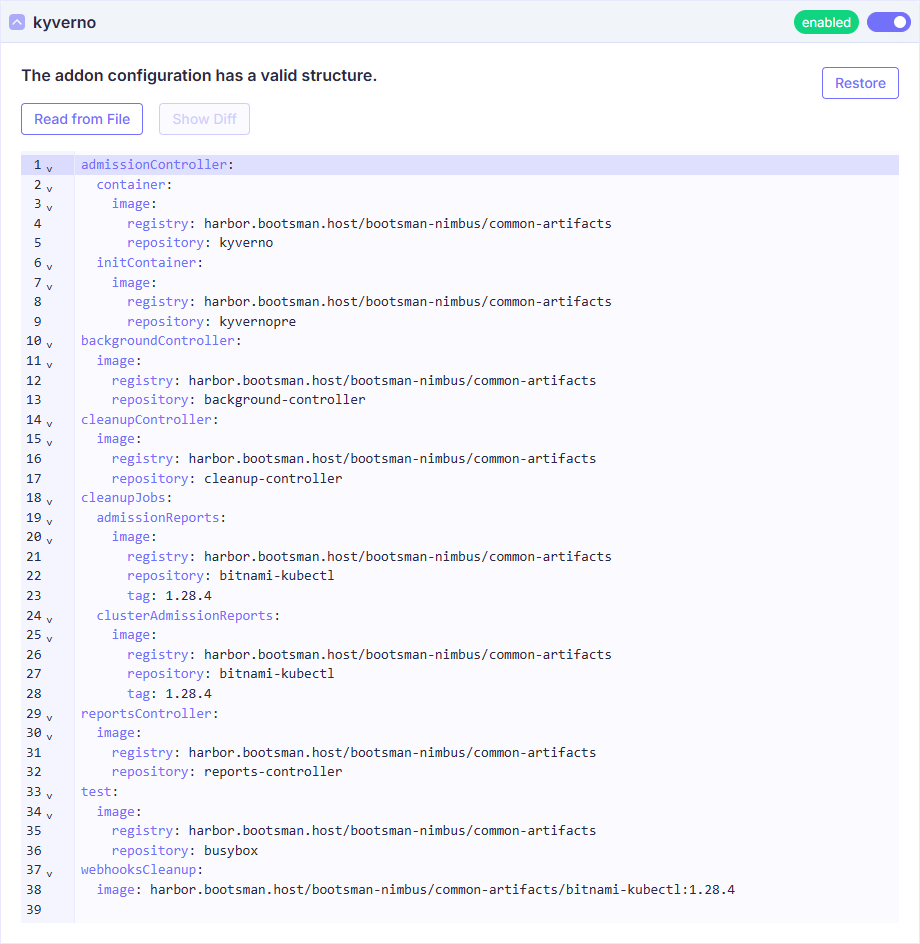
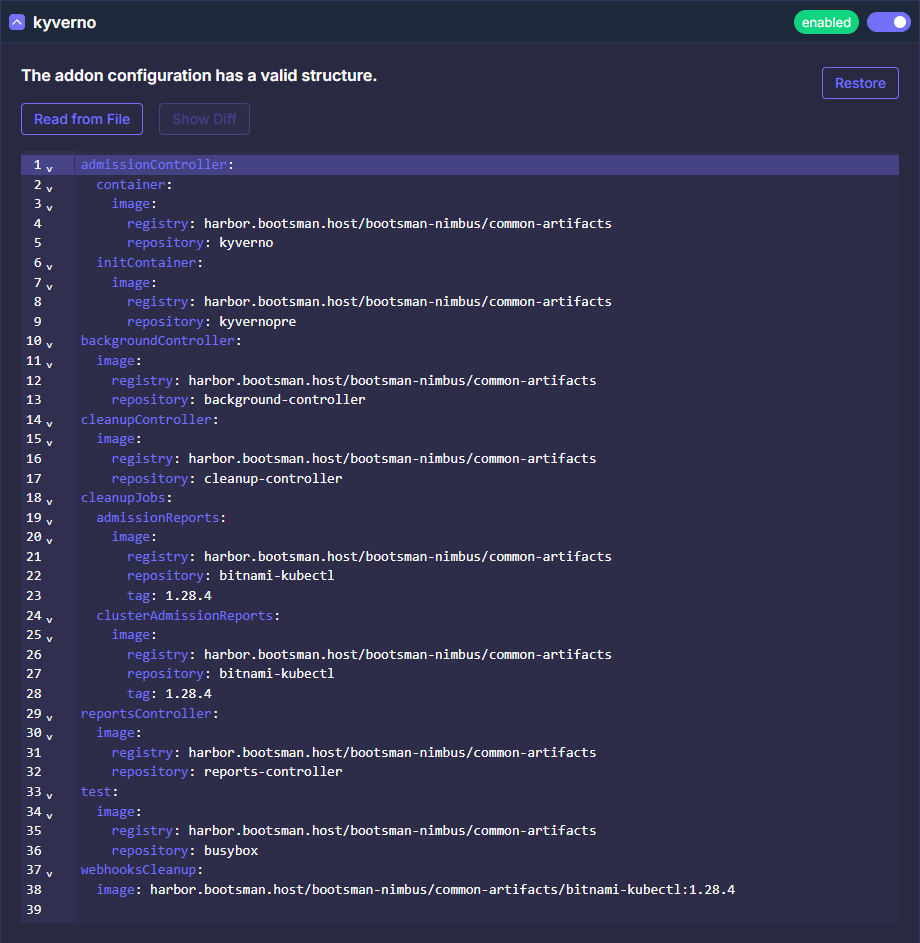
Все Values
Продвинутые настройки
Ниже представлены тонкие настройки модуля.
Используйте их для расширения конфигурации модуля, если потребуется.
Документация
Более полная документация по модулю:
Kyverno Cloud
Kyverno Chart
Kyverno Values
values:
# -- Internal settings used with `helm template` to generate install manifest
# @ignored
templating:
enabled: false
debug: false
version: ~
# -- (string) Override the name of the chart
nameOverride: ~
# -- (string) Override the expanded name of the chart
fullnameOverride: ~
# -- (string) Override the namespace the chart deploys to
namespaceOverride: ~
upgrade:
# -- Upgrading from v2 to v3 is not allowed by default, set this to true once changes have been reviewed.
fromV2: false
apiVersionOverride:
# -- (string) Override api version used to create `PodDisruptionBudget`` resources.
# When not specified the chart will check if `policy/v1/PodDisruptionBudget` is available to
# determine the api version automatically.
podDisruptionBudget: ~
# CRDs configuration
crds:
# -- Whether to have Helm install the Kyverno CRDs, if the CRDs are not installed by Helm, they must be added before policies can be created
install: true
# -- Additional CRDs annotations
annotations: {}
# argocd.argoproj.io/sync-options: Replace=true
# strategy.spinnaker.io/replace: 'true'
# Configuration
config:
# -- Create the configmap.
create: true
# -- (string) The configmap name (required if `create` is `false`).
name: ~
# -- Additional annotations to add to the configmap.
annotations: {}
# -- Enable registry mutation for container images. Enabled by default.
enableDefaultRegistryMutation: true
# -- The registry hostname used for the image mutation.
defaultRegistry: docker.io
# -- Exclude groups
excludeGroups:
- system:nodes
# -- Exclude usernames
excludeUsernames: []
# - '!system:kube-scheduler'
# -- Exclude roles
excludeRoles: []
# -- Exclude roles
excludeClusterRoles: []
# -- Generate success events.
generateSuccessEvents: false
# -- Resource types to be skipped by the Kyverno policy engine.
# Make sure to surround each entry in quotes so that it doesn't get parsed as a nested YAML list.
# These are joined together without spaces, run through `tpl`, and the result is set in the config map.
# @default -- See [values.yaml](values.yaml)
resourceFilters:
- '[Event,*,*]'
- '[*/*,kube-system,*]'
- '[*/*,kube-public,*]'
- '[*/*,kube-node-lease,*]'
- '[Node,*,*]'
- '[Node/*,*,*]'
- '[APIService,*,*]'
- '[APIService/*,*,*]'
- '[TokenReview,*,*]'
- '[SubjectAccessReview,*,*]'
- '[SelfSubjectAccessReview,*,*]'
- '[Binding,*,*]'
- '[Pod/binding,*,*]'
- '[ReplicaSet,*,*]'
- '[ReplicaSet/*,*,*]'
- '[AdmissionReport,*,*]'
- '[AdmissionReport/*,*,*]'
- '[ClusterAdmissionReport,*,*]'
- '[ClusterAdmissionReport/*,*,*]'
- '[BackgroundScanReport,*,*]'
- '[BackgroundScanReport/*,*,*]'
- '[ClusterBackgroundScanReport,*,*]'
- '[ClusterBackgroundScanReport/*,*,*]'
# exclude resources from the chart
- '[ClusterRole,*,{{ template "kyverno.admission-controller.roleName" . }}]'
- '[ClusterRole,*,{{ template "kyverno.admission-controller.roleName" . }}:core]'
- '[ClusterRole,*,{{ template "kyverno.admission-controller.roleName" . }}:additional]'
- '[ClusterRole,*,{{ template "kyverno.background-controller.roleName" . }}]'
- '[ClusterRole,*,{{ template "kyverno.background-controller.roleName" . }}:core]'
- '[ClusterRole,*,{{ template "kyverno.background-controller.roleName" . }}:additional]'
- '[ClusterRole,*,{{ template "kyverno.cleanup-controller.roleName" . }}]'
- '[ClusterRole,*,{{ template "kyverno.cleanup-controller.roleName" . }}:core]'
- '[ClusterRole,*,{{ template "kyverno.cleanup-controller.roleName" . }}:additional]'
- '[ClusterRole,*,{{ template "kyverno.reports-controller.roleName" . }}]'
- '[ClusterRole,*,{{ template "kyverno.reports-controller.roleName" . }}:core]'
- '[ClusterRole,*,{{ template "kyverno.reports-controller.roleName" . }}:additional]'
- '[ClusterRoleBinding,*,{{ template "kyverno.admission-controller.roleName" . }}]'
- '[ClusterRoleBinding,*,{{ template "kyverno.background-controller.roleName" . }}]'
- '[ClusterRoleBinding,*,{{ template "kyverno.cleanup-controller.roleName" . }}]'
- '[ClusterRoleBinding,*,{{ template "kyverno.reports-controller.roleName" . }}]'
- '[ServiceAccount,{{ include "kyverno.namespace" . }},{{ template "kyverno.admission-controller.serviceAccountName" . }}]'
- '[ServiceAccount/*,{{ include "kyverno.namespace" . }},{{ template "kyverno.admission-controller.serviceAccountName" . }}]'
- '[ServiceAccount,{{ include "kyverno.namespace" . }},{{ template "kyverno.background-controller.serviceAccountName" . }}]'
- '[ServiceAccount/*,{{ include "kyverno.namespace" . }},{{ template "kyverno.background-controller.serviceAccountName" . }}]'
- '[ServiceAccount,{{ include "kyverno.namespace" . }},{{ template "kyverno.cleanup-controller.serviceAccountName" . }}]'
- '[ServiceAccount/*,{{ include "kyverno.namespace" . }},{{ template "kyverno.cleanup-controller.serviceAccountName" . }}]'
- '[ServiceAccount,{{ include "kyverno.namespace" . }},{{ template "kyverno.reports-controller.serviceAccountName" . }}]'
- '[ServiceAccount/*,{{ include "kyverno.namespace" . }},{{ template "kyverno.reports-controller.serviceAccountName" . }}]'
- '[Role,{{ include "kyverno.namespace" . }},{{ template "kyverno.admission-controller.roleName" . }}]'
- '[Role,{{ include "kyverno.namespace" . }},{{ template "kyverno.background-controller.roleName" . }}]'
- '[Role,{{ include "kyverno.namespace" . }},{{ template "kyverno.cleanup-controller.roleName" . }}]'
- '[Role,{{ include "kyverno.namespace" . }},{{ template "kyverno.reports-controller.roleName" . }}]'
- '[RoleBinding,{{ include "kyverno.namespace" . }},{{ template "kyverno.admission-controller.roleName" . }}]'
- '[RoleBinding,{{ include "kyverno.namespace" . }},{{ template "kyverno.background-controller.roleName" . }}]'
- '[RoleBinding,{{ include "kyverno.namespace" . }},{{ template "kyverno.cleanup-controller.roleName" . }}]'
- '[RoleBinding,{{ include "kyverno.namespace" . }},{{ template "kyverno.reports-controller.roleName" . }}]'
- '[ConfigMap,{{ include "kyverno.namespace" . }},{{ template "kyverno.config.configMapName" . }}]'
- '[ConfigMap,{{ include "kyverno.namespace" . }},{{ template "kyverno.config.metricsConfigMapName" . }}]'
- '[Deployment,{{ include "kyverno.namespace" . }},{{ template "kyverno.admission-controller.name" . }}]'
- '[Deployment/*,{{ include "kyverno.namespace" . }},{{ template "kyverno.admission-controller.name" . }}]'
- '[Deployment,{{ include "kyverno.namespace" . }},{{ template "kyverno.background-controller.name" . }}]'
- '[Deployment/*,{{ include "kyverno.namespace" . }},{{ template "kyverno.background-controller.name" . }}]'
- '[Deployment,{{ include "kyverno.namespace" . }},{{ template "kyverno.cleanup-controller.name" . }}]'
- '[Deployment/*,{{ include "kyverno.namespace" . }},{{ template "kyverno.cleanup-controller.name" . }}]'
- '[Deployment,{{ include "kyverno.namespace" . }},{{ template "kyverno.reports-controller.name" . }}]'
- '[Deployment/*,{{ include "kyverno.namespace" . }},{{ template "kyverno.reports-controller.name" . }}]'
- '[Pod,{{ include "kyverno.namespace" . }},{{ template "kyverno.admission-controller.name" . }}-*]'
- '[Pod/*,{{ include "kyverno.namespace" . }},{{ template "kyverno.admission-controller.name" . }}-*]'
- '[Pod,{{ include "kyverno.namespace" . }},{{ template "kyverno.background-controller.name" . }}-*]'
- '[Pod/*,{{ include "kyverno.namespace" . }},{{ template "kyverno.background-controller.name" . }}-*]'
- '[Pod,{{ include "kyverno.namespace" . }},{{ template "kyverno.cleanup-controller.name" . }}-*]'
- '[Pod/*,{{ include "kyverno.namespace" . }},{{ template "kyverno.cleanup-controller.name" . }}-*]'
- '[Pod,{{ include "kyverno.namespace" . }},{{ template "kyverno.reports-controller.name" . }}-*]'
- '[Pod/*,{{ include "kyverno.namespace" . }},{{ template "kyverno.reports-controller.name" . }}-*]'
- '[Job,{{ include "kyverno.namespace" . }},{{ template "kyverno.fullname" . }}-hook-pre-delete]'
- '[Job/*,{{ include "kyverno.namespace" . }},{{ template "kyverno.fullname" . }}-hook-pre-delete]'
- '[NetworkPolicy,{{ include "kyverno.namespace" . }},{{ template "kyverno.admission-controller.name" . }}]'
- '[NetworkPolicy/*,{{ include "kyverno.namespace" . }},{{ template "kyverno.admission-controller.name" . }}]'
- '[NetworkPolicy,{{ include "kyverno.namespace" . }},{{ template "kyverno.background-controller.name" . }}]'
- '[NetworkPolicy/*,{{ include "kyverno.namespace" . }},{{ template "kyverno.background-controller.name" . }}]'
- '[NetworkPolicy,{{ include "kyverno.namespace" . }},{{ template "kyverno.cleanup-controller.name" . }}]'
- '[NetworkPolicy/*,{{ include "kyverno.namespace" . }},{{ template "kyverno.cleanup-controller.name" . }}]'
- '[NetworkPolicy,{{ include "kyverno.namespace" . }},{{ template "kyverno.reports-controller.name" . }}]'
- '[NetworkPolicy/*,{{ include "kyverno.namespace" . }},{{ template "kyverno.reports-controller.name" . }}]'
- '[PodDisruptionBudget,{{ include "kyverno.namespace" . }},{{ template "kyverno.admission-controller.name" . }}]'
- '[PodDisruptionBudget/*,{{ include "kyverno.namespace" . }},{{ template "kyverno.admission-controller.name" . }}]'
- '[PodDisruptionBudget,{{ include "kyverno.namespace" . }},{{ template "kyverno.background-controller.name" . }}]'
- '[PodDisruptionBudget/*,{{ include "kyverno.namespace" . }},{{ template "kyverno.background-controller.name" . }}]'
- '[PodDisruptionBudget,{{ include "kyverno.namespace" . }},{{ template "kyverno.cleanup-controller.name" . }}]'
- '[PodDisruptionBudget/*,{{ include "kyverno.namespace" . }},{{ template "kyverno.cleanup-controller.name" . }}]'
- '[PodDisruptionBudget,{{ include "kyverno.namespace" . }},{{ template "kyverno.reports-controller.name" . }}]'
- '[PodDisruptionBudget/*,{{ include "kyverno.namespace" . }},{{ template "kyverno.reports-controller.name" . }}]'
- '[Service,{{ include "kyverno.namespace" . }},{{ template "kyverno.admission-controller.serviceName" . }}]'
- '[Service/*,{{ include "kyverno.namespace" . }},{{ template "kyverno.admission-controller.serviceName" . }}]'
- '[Service,{{ include "kyverno.namespace" . }},{{ template "kyverno.admission-controller.serviceName" . }}-metrics]'
- '[Service/*,{{ include "kyverno.namespace" . }},{{ template "kyverno.admission-controller.serviceName" . }}-metrics]'
- '[Service,{{ include "kyverno.namespace" . }},{{ template "kyverno.background-controller.name" . }}-metrics]'
- '[Service/*,{{ include "kyverno.namespace" . }},{{ template "kyverno.background-controller.name" . }}-metrics]'
- '[Service,{{ include "kyverno.namespace" . }},{{ template "kyverno.cleanup-controller.name" . }}]'
- '[Service/*,{{ include "kyverno.namespace" . }},{{ template "kyverno.cleanup-controller.name" . }}]'
- '[Service,{{ include "kyverno.namespace" . }},{{ template "kyverno.cleanup-controller.name" . }}-metrics]'
- '[Service/*,{{ include "kyverno.namespace" . }},{{ template "kyverno.cleanup-controller.name" . }}-metrics]'
- '[Service,{{ include "kyverno.namespace" . }},{{ template "kyverno.reports-controller.name" . }}-metrics]'
- '[Service/*,{{ include "kyverno.namespace" . }},{{ template "kyverno.reports-controller.name" . }}-metrics]'
- '[ServiceMonitor,{{ if .Values.admissionController.serviceMonitor.namespace }}{{ .Values.admissionController.serviceMonitor.namespace }}{{ else }}{{ template "kyverno.namespace" . }}{{ end }},{{ template "kyverno.admission-controller.name" . }}]'
- '[ServiceMonitor,{{ if .Values.admissionController.serviceMonitor.namespace }}{{ .Values.admissionController.serviceMonitor.namespace }}{{ else }}{{ template "kyverno.namespace" . }}{{ end }},{{ template "kyverno.background-controller.name" . }}]'
- '[ServiceMonitor,{{ if .Values.admissionController.serviceMonitor.namespace }}{{ .Values.admissionController.serviceMonitor.namespace }}{{ else }}{{ template "kyverno.namespace" . }}{{ end }},{{ template "kyverno.cleanup-controller.name" . }}]'
- '[ServiceMonitor,{{ if .Values.admissionController.serviceMonitor.namespace }}{{ .Values.admissionController.serviceMonitor.namespace }}{{ else }}{{ template "kyverno.namespace" . }}{{ end }},{{ template "kyverno.reports-controller.name" . }}]'
- '[Secret,{{ include "kyverno.namespace" . }},{{ template "kyverno.admission-controller.serviceName" . }}.{{ template "kyverno.namespace" . }}.svc.*]'
- '[Secret,{{ include "kyverno.namespace" . }},{{ template "kyverno.cleanup-controller.name" . }}.{{ template "kyverno.namespace" . }}.svc.*]'
# -- Defines the `namespaceSelector` in the webhook configurations.
# Note that it takes a list of `namespaceSelector` and/or `objectSelector` in the JSON format, and only the first element
# will be forwarded to the webhook configurations.
# The Kyverno namespace is excluded if `excludeKyvernoNamespace` is `true` (default)
webhooks: []
# Exclude namespaces
# - namespaceSelector:
# matchExpressions:
# - key: kubernetes.io/metadata.name
# operator: NotIn
# values:
# - kube-system
# - kyverno
# Exclude objects
# - objectSelector:
# matchExpressions:
# - key: webhooks.kyverno.io/exclude
# operator: DoesNotExist
# -- Defines annotations to set on webhook configurations.
webhookAnnotations: {}
# Example to disable admission enforcer on AKS:
# 'admissions.enforcer/disabled': 'true'
# -- Exclude Kyverno namespace
# Determines if default Kyverno namespace exclusion is enabled for webhooks and resourceFilters
excludeKyvernoNamespace: true
# -- resourceFilter namespace exclude
# Namespaces to exclude from the default resourceFilters
resourceFiltersExcludeNamespaces: []
# Metrics configuration
metricsConfig:
# -- Create the configmap.
create: true
# -- (string) The configmap name (required if `create` is `false`).
name: ~
# -- Additional annotations to add to the configmap.
annotations: {}
namespaces:
# -- List of namespaces to capture metrics for.
include: []
# -- list of namespaces to NOT capture metrics for.
exclude: []
# -- (string) Rate at which metrics should reset so as to clean up the memory footprint of kyverno metrics, if you might be expecting high memory footprint of Kyverno's metrics. Default: 0, no refresh of metrics
metricsRefreshInterval: ~
# metricsRefreshInterval: 24h
# -- Image pull secrets for image verification policies, this will define the `--imagePullSecrets` argument
imagePullSecrets: {}
# regcred:
# registry: foo.example.com
# username: foobar
# password: secret
# regcred2:
# registry: bar.example.com
# username: barbaz
# password: secret2
# -- Existing Image pull secrets for image verification policies, this will define the `--imagePullSecrets` argument
existingImagePullSecrets: []
# - test-registry
# - other-test-registry
# Tests configuration
test:
image:
# -- (string) Image registry
registry: ~
# -- Image repository
repository: busybox
# -- Image tag
# Defaults to `latest` if omitted
tag: '1.35'
# -- (string) Image pull policy
# Defaults to image.pullPolicy if omitted
pullPolicy: ~
resources:
# -- Pod resource limits
limits:
cpu: 100m
memory: 256Mi
# -- Pod resource requests
requests:
cpu: 10m
memory: 64Mi
# -- Security context for the test containers
securityContext:
runAsUser: 65534
runAsGroup: 65534
runAsNonRoot: true
privileged: false
allowPrivilegeEscalation: false
readOnlyRootFilesystem: true
capabilities:
drop:
- ALL
seccompProfile:
type: RuntimeDefault
# -- Additional labels
customLabels: {}
webhooksCleanup:
# -- Create a helm pre-delete hook to cleanup webhooks.
enabled: true
# -- `kubectl` image to run commands for deleting webhooks.
image: bitnami/kubectl:latest
# -- Image pull secrets
imagePullSecrets: []
# -- Node labels for pod assignment
nodeSelector: {}
# -- List of node taints to tolerate
tolerations: []
# -- Pod anti affinity constraints.
podAntiAffinity: {}
# -- Pod affinity constraints.
podAffinity: {}
# -- Node affinity constraints.
nodeAffinity: {}
grafana:
# -- Enable grafana dashboard creation.
enabled: false
# -- Configmap name template.
configMapName: '{{ include "kyverno.fullname" . }}-grafana'
# -- (string) Namespace to create the grafana dashboard configmap.
# If not set, it will be created in the same namespace where the chart is deployed.
namespace: ~
# -- Grafana dashboard configmap annotations.
annotations: {}
# -- Grafana dashboard configmap labels
labels:
grafana_dashboard: "1"
# Features configuration
features:
admissionReports:
# -- Enables the feature
enabled: true
policyReports:
# -- Enables the feature
enabled: true
autoUpdateWebhooks:
# -- Enables the feature
enabled: true
backgroundScan:
# -- Enables the feature
enabled: true
# -- Number of background scan workers
backgroundScanWorkers: 2
# -- Background scan interval
backgroundScanInterval: 1h
# -- Skips resource filters in background scan
skipResourceFilters: true
configMapCaching:
# -- Enables the feature
enabled: true
deferredLoading:
# -- Enables the feature
enabled: true
dumpPayload:
# -- Enables the feature
enabled: false
forceFailurePolicyIgnore:
# -- Enables the feature
enabled: false
logging:
# -- Logging format
format: text
# -- Logging verbosity
verbosity: 2
omitEvents:
# -- Events which should not be emitted (possible values `PolicyViolation`, `PolicyApplied`, `PolicyError`, and `PolicySkipped`)
eventTypes: []
# - PolicyViolation
# - PolicyApplied
# - PolicyError
# - PolicySkipped
policyExceptions:
# -- Enables the feature
enabled: false
# -- Restrict policy exceptions to a single namespace
namespace: ''
protectManagedResources:
# -- Enables the feature
enabled: false
registryClient:
# -- Allow insecure registry
allowInsecure: false
# -- Enable registry client helpers
credentialHelpers:
- default
- google
- amazon
- azure
- github
reports:
# -- Reports chunk size
chunkSize: 1000
# Cleanup cronjobs to prevent internal resources from stacking up in the cluster
cleanupJobs:
admissionReports:
# -- Enable cleanup cronjob
enabled: true
image:
# -- (string) Image registry
registry: ~
# -- Image repository
repository: bitnami/kubectl
# -- Image tag
# Defaults to `latest` if omitted
tag: '1.26.4'
# -- (string) Image pull policy
# Defaults to image.pullPolicy if omitted
pullPolicy: ~
# -- Image pull secrets
imagePullSecrets: []
# - name: secretName
# -- Cronjob schedule
schedule: '*/10 * * * *'
# -- Reports threshold, if number of reports are above this value the cronjob will start deleting them
threshold: 10000
# -- Cronjob history
history:
success: 1
failure: 1
# -- Security context for the pod
podSecurityContext: {}
# -- Security context for the containers
securityContext:
runAsNonRoot: true
privileged: false
allowPrivilegeEscalation: false
readOnlyRootFilesystem: true
capabilities:
drop:
- ALL
seccompProfile:
type: RuntimeDefault
# -- Job resources
resources: {}
# -- List of node taints to tolerate
tolerations: []
# -- Node labels for pod assignment
nodeSelector: {}
# -- Pod Annotations
podAnnotations: {}
# -- Pod labels
podLabels: {}
# -- Pod anti affinity constraints.
podAntiAffinity: {}
# -- Pod affinity constraints.
podAffinity: {}
# -- Node affinity constraints.
nodeAffinity: {}
clusterAdmissionReports:
# -- Enable cleanup cronjob
enabled: true
image:
# -- (string) Image registry
registry: ~
# -- Image repository
repository: bitnami/kubectl
# -- Image tag
# Defaults to `latest` if omitted
tag: '1.26.4'
# -- (string) Image pull policy
# Defaults to image.pullPolicy if omitted
pullPolicy: ~
# -- Image pull secrets
imagePullSecrets: []
# - name: secretName
# -- Cronjob schedule
schedule: '*/10 * * * *'
# -- Reports threshold, if number of reports are above this value the cronjob will start deleting them
threshold: 10000
# -- Cronjob history
history:
success: 1
failure: 1
# -- Security context for the pod
podSecurityContext: {}
# -- Security context for the containers
securityContext:
runAsNonRoot: true
privileged: false
allowPrivilegeEscalation: false
readOnlyRootFilesystem: true
capabilities:
drop:
- ALL
seccompProfile:
type: RuntimeDefault
# -- Job resources
resources: {}
# -- List of node taints to tolerate
tolerations: []
# -- Node labels for pod assignment
nodeSelector: {}
# -- Pod Annotations
podAnnotations: {}
# -- Pod Labels
podLabels: {}
# -- Pod anti affinity constraints.
podAntiAffinity: {}
# -- Pod affinity constraints.
podAffinity: {}
# -- Node affinity constraints.
nodeAffinity: {}
# Admission controller configuration
admissionController:
# -- Overrides features defined at the root level
featuresOverride: {}
rbac:
# -- Create RBAC resources
create: true
serviceAccount:
# -- The ServiceAccount name
name:
# -- Annotations for the ServiceAccount
annotations: {}
# example.com/annotation: value
clusterRole:
# -- Extra resource permissions to add in the cluster role
extraResources: []
# - apiGroups:
# - ''
# resources:
# - pods
# verbs:
# - create
# - update
# - delete
# -- Create self-signed certificates at deployment time.
# The certificates won't be automatically renewed if this is set to `true`.
createSelfSignedCert: false
# -- (int) Desired number of pods
replicas: ~
# -- Additional labels to add to each pod
podLabels: {}
# example.com/label: foo
# -- Additional annotations to add to each pod
podAnnotations: {}
# example.com/annotation: foo
# -- Deployment update strategy.
# Ref: https://kubernetes.io/docs/concepts/workloads/controllers/deployment/#strategy
# @default -- See [values.yaml](values.yaml)
updateStrategy:
rollingUpdate:
maxSurge: 1
maxUnavailable: 40%
type: RollingUpdate
# -- Optional priority class
priorityClassName: ''
# -- Change `hostNetwork` to `true` when you want the pod to share its host's network namespace.
# Useful for situations like when you end up dealing with a custom CNI over Amazon EKS.
# Update the `dnsPolicy` accordingly as well to suit the host network mode.
hostNetwork: false
# -- `dnsPolicy` determines the manner in which DNS resolution happens in the cluster.
# In case of `hostNetwork: true`, usually, the `dnsPolicy` is suitable to be `ClusterFirstWithHostNet`.
# For further reference: https://kubernetes.io/docs/concepts/services-networking/dns-pod-service/#pod-s-dns-policy.
dnsPolicy: ClusterFirst
# -- Startup probe.
# The block is directly forwarded into the deployment, so you can use whatever startupProbes configuration you want.
# ref: https://kubernetes.io/docs/tasks/configure-pod-container/configure-liveness-readiness-probes/
# @default -- See [values.yaml](values.yaml)
startupProbe:
httpGet:
path: /health/liveness
port: 9443
scheme: HTTPS
failureThreshold: 20
initialDelaySeconds: 2
periodSeconds: 6
# -- Liveness probe.
# The block is directly forwarded into the deployment, so you can use whatever livenessProbe configuration you want.
# ref: https://kubernetes.io/docs/tasks/configure-pod-container/configure-liveness-readiness-probes/
# @default -- See [values.yaml](values.yaml)
livenessProbe:
httpGet:
path: /health/liveness
port: 9443
scheme: HTTPS
initialDelaySeconds: 15
periodSeconds: 30
timeoutSeconds: 5
failureThreshold: 2
successThreshold: 1
# -- Readiness Probe.
# The block is directly forwarded into the deployment, so you can use whatever readinessProbe configuration you want.
# ref: https://kubernetes.io/docs/tasks/configure-pod-container/configure-liveness-readiness-probes/
# @default -- See [values.yaml](values.yaml)
readinessProbe:
httpGet:
path: /health/readiness
port: 9443
scheme: HTTPS
initialDelaySeconds: 5
periodSeconds: 10
timeoutSeconds: 5
failureThreshold: 6
successThreshold: 1
# -- Node labels for pod assignment
nodeSelector: {}
# -- List of node taints to tolerate
tolerations: []
antiAffinity:
# -- Pod antiAffinities toggle.
# Enabled by default but can be disabled if you want to schedule pods to the same node.
enabled: true
# -- Pod anti affinity constraints.
# @default -- See [values.yaml](values.yaml)
podAntiAffinity:
preferredDuringSchedulingIgnoredDuringExecution:
- weight: 1
podAffinityTerm:
labelSelector:
matchExpressions:
- key: app.kubernetes.io/component
operator: In
values:
- admission-controller
topologyKey: kubernetes.io/hostname
# -- Pod affinity constraints.
podAffinity: {}
# -- Node affinity constraints.
nodeAffinity: {}
# -- Topology spread constraints.
topologySpreadConstraints: []
# -- Security context for the pod
podSecurityContext: {}
podDisruptionBudget:
# -- Configures the minimum available pods for disruptions.
# Cannot be used if `maxUnavailable` is set.
minAvailable: 1
# -- Configures the maximum unavailable pods for disruptions.
# Cannot be used if `minAvailable` is set.
maxUnavailable:
# -- A writable volume to use for the TUF root initialization.
tufRootMountPath: /.sigstore
# -- Volume to be mounted in pods for TUF/cosign work.
sigstoreVolume:
emptyDir: {}
# -- Image pull secrets
imagePullSecrets: []
# - secretName
initContainer:
image:
# -- Image registry
registry: ghcr.io
# -- Image repository
repository: kyverno/kyvernopre
# -- (string) Image tag
# If missing, defaults to image.tag
tag: ~
# -- (string) Image pull policy
# If missing, defaults to image.pullPolicy
pullPolicy: ~
resources:
# -- Pod resource limits
limits:
cpu: 100m
memory: 256Mi
# -- Pod resource requests
requests:
cpu: 10m
memory: 64Mi
# -- Container security context
securityContext:
runAsNonRoot: true
privileged: false
allowPrivilegeEscalation: false
readOnlyRootFilesystem: true
capabilities:
drop:
- ALL
seccompProfile:
type: RuntimeDefault
# -- Additional container args.
extraArgs: {}
# -- Additional container environment variables.
extraEnvVars: []
container:
image:
# -- Image registry
registry: ghcr.io
# -- Image repository
repository: kyverno/kyverno
# -- (string) Image tag
# Defaults to appVersion in Chart.yaml if omitted
tag: ~
# -- Image pull policy
pullPolicy: IfNotPresent
resources:
# -- Pod resource limits
limits:
memory: 384Mi
# -- Pod resource requests
requests:
cpu: 100m
memory: 128Mi
# -- Container security context
securityContext:
runAsNonRoot: true
privileged: false
allowPrivilegeEscalation: false
readOnlyRootFilesystem: true
capabilities:
drop:
- ALL
seccompProfile:
type: RuntimeDefault
# -- Additional container args.
extraArgs: {}
# -- Additional container environment variables.
extraEnvVars: []
# -- Array of extra init containers
extraInitContainers: []
# - name: init-container
# image: busybox
# command: ['sh', '-c', 'echo Hello']
# -- Array of extra containers to run alongside kyverno
extraContainers: []
# - name: myapp-container
# image: busybox
# command: ['sh', '-c', 'echo Hello && sleep 3600']
service:
# -- Service port.
port: 443
# -- Service type.
type: ClusterIP
# -- Service node port.
# Only used if `type` is `NodePort`.
nodePort:
# -- Service annotations.
annotations: {}
metricsService:
# -- Create service.
create: true
# -- Service port.
# Kyverno's metrics server will be exposed at this port.
port: 8000
# -- Service type.
type: ClusterIP
# -- Service node port.
# Only used if `type` is `NodePort`.
nodePort:
# -- Service annotations.
annotations: {}
networkPolicy:
# -- When true, use a NetworkPolicy to allow ingress to the webhook
# This is useful on clusters using Calico and/or native k8s network policies in a default-deny setup.
enabled: false
# -- A list of valid from selectors according to https://kubernetes.io/docs/concepts/services-networking/network-policies.
ingressFrom: []
serviceMonitor:
# -- Create a `ServiceMonitor` to collect Prometheus metrics.
enabled: false
# -- Additional labels
additionalLabels: {}
# -- (string) Override namespace
namespace: ~
# -- Interval to scrape metrics
interval: 30s
# -- Timeout if metrics can't be retrieved in given time interval
scrapeTimeout: 25s
# -- Is TLS required for endpoint
secure: false
# -- TLS Configuration for endpoint
tlsConfig: {}
# -- RelabelConfigs to apply to samples before scraping
relabelings: []
# -- MetricRelabelConfigs to apply to samples before ingestion.
metricRelabelings: []
tracing:
# -- Enable tracing
enabled: false
# -- Traces receiver address
address:
# -- Traces receiver port
port:
# -- Traces receiver credentials
creds: ''
metering:
# -- Disable metrics export
disabled: false
# -- Otel configuration, can be `prometheus` or `grpc`
config: prometheus
# -- Prometheus endpoint port
port: 8000
# -- Otel collector endpoint
collector: ''
# -- Otel collector credentials
creds: ''
# Background controller configuration
backgroundController:
# -- Overrides features defined at the root level
featuresOverride: {}
# -- Enable background controller.
enabled: true
rbac:
# -- Create RBAC resources
create: true
serviceAccount:
# -- Service account name
name:
# -- Annotations for the ServiceAccount
annotations: {}
# example.com/annotation: value
clusterRole:
# -- Extra resource permissions to add in the cluster role
extraResources: []
# - apiGroups:
# - ''
# resources:
# - pods
# verbs:
# - create
# - update
# - delete
# - patch
image:
# -- Image registry
registry: ghcr.io
# -- Image repository
repository: kyverno/background-controller
# -- Image tag
# Defaults to appVersion in Chart.yaml if omitted
tag: # replaced in e2e tests
# -- Image pull policy
pullPolicy: IfNotPresent
# -- Image pull secrets
imagePullSecrets: []
# - secretName
# -- (int) Desired number of pods
replicas: ~
# -- Additional labels to add to each pod
podLabels: {}
# example.com/label: foo
# -- Additional annotations to add to each pod
podAnnotations: {}
# example.com/annotation: foo
# -- Deployment update strategy.
# Ref: https://kubernetes.io/docs/concepts/workloads/controllers/deployment/#strategy
# @default -- See [values.yaml](values.yaml)
updateStrategy:
rollingUpdate:
maxSurge: 1
maxUnavailable: 40%
type: RollingUpdate
# -- Optional priority class
priorityClassName: ''
# -- Change `hostNetwork` to `true` when you want the pod to share its host's network namespace.
# Useful for situations like when you end up dealing with a custom CNI over Amazon EKS.
# Update the `dnsPolicy` accordingly as well to suit the host network mode.
hostNetwork: false
# -- `dnsPolicy` determines the manner in which DNS resolution happens in the cluster.
# In case of `hostNetwork: true`, usually, the `dnsPolicy` is suitable to be `ClusterFirstWithHostNet`.
# For further reference: https://kubernetes.io/docs/concepts/services-networking/dns-pod-service/#pod-s-dns-policy.
dnsPolicy: ClusterFirst
# -- Extra arguments passed to the container on the command line
extraArgs: {}
# -- Additional container environment variables.
extraEnvVars: []
resources:
# -- Pod resource limits
limits:
memory: 128Mi
# -- Pod resource requests
requests:
cpu: 100m
memory: 64Mi
# -- Node labels for pod assignment
nodeSelector: {}
# -- List of node taints to tolerate
tolerations: []
antiAffinity:
# -- Pod antiAffinities toggle.
# Enabled by default but can be disabled if you want to schedule pods to the same node.
enabled: true
# -- Pod anti affinity constraints.
# @default -- See [values.yaml](values.yaml)
podAntiAffinity:
preferredDuringSchedulingIgnoredDuringExecution:
- weight: 1
podAffinityTerm:
labelSelector:
matchExpressions:
- key: app.kubernetes.io/component
operator: In
values:
- background-controller
topologyKey: kubernetes.io/hostname
# -- Pod affinity constraints.
podAffinity: {}
# -- Node affinity constraints.
nodeAffinity: {}
# -- Topology spread constraints.
topologySpreadConstraints: []
# -- Security context for the pod
podSecurityContext: {}
# -- Security context for the containers
securityContext:
runAsNonRoot: true
privileged: false
allowPrivilegeEscalation: false
readOnlyRootFilesystem: true
capabilities:
drop:
- ALL
seccompProfile:
type: RuntimeDefault
podDisruptionBudget:
# -- Configures the minimum available pods for disruptions.
# Cannot be used if `maxUnavailable` is set.
minAvailable: 1
# -- Configures the maximum unavailable pods for disruptions.
# Cannot be used if `minAvailable` is set.
maxUnavailable:
metricsService:
# -- Create service.
create: true
# -- Service port.
# Metrics server will be exposed at this port.
port: 8000
# -- Service type.
type: ClusterIP
# -- Service node port.
# Only used if `metricsService.type` is `NodePort`.
nodePort:
# -- Service annotations.
annotations: {}
networkPolicy:
# -- When true, use a NetworkPolicy to allow ingress to the webhook
# This is useful on clusters using Calico and/or native k8s network policies in a default-deny setup.
enabled: false
# -- A list of valid from selectors according to https://kubernetes.io/docs/concepts/services-networking/network-policies.
ingressFrom: []
serviceMonitor:
# -- Create a `ServiceMonitor` to collect Prometheus metrics.
enabled: false
# -- Additional labels
additionalLabels: {}
# -- (string) Override namespace
namespace: ~
# -- Interval to scrape metrics
interval: 30s
# -- Timeout if metrics can't be retrieved in given time interval
scrapeTimeout: 25s
# -- Is TLS required for endpoint
secure: false
# -- TLS Configuration for endpoint
tlsConfig: {}
# -- RelabelConfigs to apply to samples before scraping
relabelings: []
# -- MetricRelabelConfigs to apply to samples before ingestion.
metricRelabelings: []
tracing:
# -- Enable tracing
enabled: false
# -- Traces receiver address
address:
# -- Traces receiver port
port:
# -- Traces receiver credentials
creds: ''
metering:
# -- Disable metrics export
disabled: false
# -- Otel configuration, can be `prometheus` or `grpc`
config: prometheus
# -- Prometheus endpoint port
port: 8000
# -- Otel collector endpoint
collector: ''
# -- Otel collector credentials
creds: ''
# Cleanup controller configuration
cleanupController:
# -- Overrides features defined at the root level
featuresOverride: {}
# -- Enable cleanup controller.
enabled: true
rbac:
# -- Create RBAC resources
create: true
serviceAccount:
# -- Service account name
name:
# -- Annotations for the ServiceAccount
annotations: {}
# example.com/annotation: value
clusterRole:
# -- Extra resource permissions to add in the cluster role
extraResources: []
# - apiGroups:
# - ''
# resources:
# - pods
# -- Create self-signed certificates at deployment time.
# The certificates won't be automatically renewed if this is set to `true`.
createSelfSignedCert: false
image:
# -- Image registry
registry: ghcr.io
# -- Image repository
repository: kyverno/cleanup-controller
# -- (string) Image tag
# Defaults to appVersion in Chart.yaml if omitted
tag: ~
# -- Image pull policy
pullPolicy: IfNotPresent
# -- Image pull secrets
imagePullSecrets: []
# - secretName
# -- (int) Desired number of pods
replicas: ~
# -- Additional labels to add to each pod
podLabels: {}
# example.com/label: foo
# -- Additional annotations to add to each pod
podAnnotations: {}
# example.com/annotation: foo
# -- Deployment update strategy.
# Ref: https://kubernetes.io/docs/concepts/workloads/controllers/deployment/#strategy
# @default -- See [values.yaml](values.yaml)
updateStrategy:
rollingUpdate:
maxSurge: 1
maxUnavailable: 40%
type: RollingUpdate
# -- Optional priority class
priorityClassName: ''
# -- Change `hostNetwork` to `true` when you want the pod to share its host's network namespace.
# Useful for situations like when you end up dealing with a custom CNI over Amazon EKS.
# Update the `dnsPolicy` accordingly as well to suit the host network mode.
hostNetwork: false
# -- `dnsPolicy` determines the manner in which DNS resolution happens in the cluster.
# In case of `hostNetwork: true`, usually, the `dnsPolicy` is suitable to be `ClusterFirstWithHostNet`.
# For further reference: https://kubernetes.io/docs/concepts/services-networking/dns-pod-service/#pod-s-dns-policy.
dnsPolicy: ClusterFirst
# -- Extra arguments passed to the container on the command line
extraArgs: {}
# -- Additional container environment variables.
extraEnvVars: []
resources:
# -- Pod resource limits
limits:
memory: 128Mi
# -- Pod resource requests
requests:
cpu: 100m
memory: 64Mi
# -- Startup probe.
# The block is directly forwarded into the deployment, so you can use whatever startupProbes configuration you want.
# ref: https://kubernetes.io/docs/tasks/configure-pod-container/configure-liveness-readiness-probes/
# @default -- See [values.yaml](values.yaml)
startupProbe:
httpGet:
path: /health/liveness
port: 9443
scheme: HTTPS
failureThreshold: 20
initialDelaySeconds: 2
periodSeconds: 6
# -- Liveness probe.
# The block is directly forwarded into the deployment, so you can use whatever livenessProbe configuration you want.
# ref: https://kubernetes.io/docs/tasks/configure-pod-container/configure-liveness-readiness-probes/
# @default -- See [values.yaml](values.yaml)
livenessProbe:
httpGet:
path: /health/liveness
port: 9443
scheme: HTTPS
initialDelaySeconds: 15
periodSeconds: 30
timeoutSeconds: 5
failureThreshold: 2
successThreshold: 1
# -- Readiness Probe.
# The block is directly forwarded into the deployment, so you can use whatever readinessProbe configuration you want.
# ref: https://kubernetes.io/docs/tasks/configure-pod-container/configure-liveness-readiness-probes/
# @default -- See [values.yaml](values.yaml)
readinessProbe:
httpGet:
path: /health/readiness
port: 9443
scheme: HTTPS
initialDelaySeconds: 5
periodSeconds: 10
timeoutSeconds: 5
failureThreshold: 6
successThreshold: 1
# -- Node labels for pod assignment
nodeSelector: {}
# -- List of node taints to tolerate
tolerations: []
antiAffinity:
# -- Pod antiAffinities toggle.
# Enabled by default but can be disabled if you want to schedule pods to the same node.
enabled: true
# -- Pod anti affinity constraints.
# @default -- See [values.yaml](values.yaml)
podAntiAffinity:
preferredDuringSchedulingIgnoredDuringExecution:
- weight: 1
podAffinityTerm:
labelSelector:
matchExpressions:
- key: app.kubernetes.io/component
operator: In
values:
- cleanup-controller
topologyKey: kubernetes.io/hostname
# -- Pod affinity constraints.
podAffinity: {}
# -- Node affinity constraints.
nodeAffinity: {}
# -- Topology spread constraints.
topologySpreadConstraints: []
# -- Security context for the pod
podSecurityContext: {}
# -- Security context for the containers
securityContext:
runAsNonRoot: true
privileged: false
allowPrivilegeEscalation: false
readOnlyRootFilesystem: true
capabilities:
drop:
- ALL
seccompProfile:
type: RuntimeDefault
podDisruptionBudget:
# -- Configures the minimum available pods for disruptions.
# Cannot be used if `maxUnavailable` is set.
minAvailable: 1
# -- Configures the maximum unavailable pods for disruptions.
# Cannot be used if `minAvailable` is set.
maxUnavailable:
service:
# -- Service port.
port: 443
# -- Service type.
type: ClusterIP
# -- Service node port.
# Only used if `service.type` is `NodePort`.
nodePort:
# -- Service annotations.
annotations: {}
metricsService:
# -- Create service.
create: true
# -- Service port.
# Metrics server will be exposed at this port.
port: 8000
# -- Service type.
type: ClusterIP
# -- Service node port.
# Only used if `metricsService.type` is `NodePort`.
nodePort:
# -- Service annotations.
annotations: {}
networkPolicy:
# -- When true, use a NetworkPolicy to allow ingress to the webhook
# This is useful on clusters using Calico and/or native k8s network policies in a default-deny setup.
enabled: false
# -- A list of valid from selectors according to https://kubernetes.io/docs/concepts/services-networking/network-policies.
ingressFrom: []
serviceMonitor:
# -- Create a `ServiceMonitor` to collect Prometheus metrics.
enabled: false
# -- Additional labels
additionalLabels: {}
# -- (string) Override namespace
namespace: ~
# -- Interval to scrape metrics
interval: 30s
# -- Timeout if metrics can't be retrieved in given time interval
scrapeTimeout: 25s
# -- Is TLS required for endpoint
secure: false
# -- TLS Configuration for endpoint
tlsConfig: {}
# -- RelabelConfigs to apply to samples before scraping
relabelings: []
# -- MetricRelabelConfigs to apply to samples before ingestion.
metricRelabelings: []
tracing:
# -- Enable tracing
enabled: false
# -- Traces receiver address
address:
# -- Traces receiver port
port:
# -- Traces receiver credentials
creds: ''
metering:
# -- Disable metrics export
disabled: false
# -- Otel configuration, can be `prometheus` or `grpc`
config: prometheus
# -- Prometheus endpoint port
port: 8000
# -- Otel collector endpoint
collector: ''
# -- Otel collector credentials
creds: ''
# Reports controller configuration
reportsController:
# -- Overrides features defined at the root level
featuresOverride: {}
# -- Enable reports controller.
enabled: true
rbac:
# -- Create RBAC resources
create: true
serviceAccount:
# -- Service account name
name:
# -- Annotations for the ServiceAccount
annotations: {}
# example.com/annotation: value
clusterRole:
# -- Extra resource permissions to add in the cluster role
extraResources: []
# - apiGroups:
# - ''
# resources:
# - pods
image:
# -- Image registry
registry: ghcr.io
# -- Image repository
repository: kyverno/reports-controller
# -- (string) Image tag
# Defaults to appVersion in Chart.yaml if omitted
tag: ~
# -- Image pull policy
pullPolicy: IfNotPresent
# -- Image pull secrets
imagePullSecrets: []
# - secretName
# -- (int) Desired number of pods
replicas: ~
# -- Additional labels to add to each pod
podLabels: {}
# example.com/label: foo
# -- Additional annotations to add to each pod
podAnnotations: {}
# example.com/annotation: foo
# -- Deployment update strategy.
# Ref: https://kubernetes.io/docs/concepts/workloads/controllers/deployment/#strategy
# @default -- See [values.yaml](values.yaml)
updateStrategy:
rollingUpdate:
maxSurge: 1
maxUnavailable: 40%
type: RollingUpdate
# -- Optional priority class
priorityClassName: ''
# -- Change `hostNetwork` to `true` when you want the pod to share its host's network namespace.
# Useful for situations like when you end up dealing with a custom CNI over Amazon EKS.
# Update the `dnsPolicy` accordingly as well to suit the host network mode.
hostNetwork: false
# -- `dnsPolicy` determines the manner in which DNS resolution happens in the cluster.
# In case of `hostNetwork: true`, usually, the `dnsPolicy` is suitable to be `ClusterFirstWithHostNet`.
# For further reference: https://kubernetes.io/docs/concepts/services-networking/dns-pod-service/#pod-s-dns-policy.
dnsPolicy: ClusterFirst
# -- Extra arguments passed to the container on the command line
extraArgs: {}
# -- Additional container environment variables.
extraEnvVars: []
resources:
# -- Pod resource limits
limits:
memory: 128Mi
# -- Pod resource requests
requests:
cpu: 100m
memory: 64Mi
# -- Node labels for pod assignment
nodeSelector: {}
# -- List of node taints to tolerate
tolerations: []
antiAffinity:
# -- Pod antiAffinities toggle.
# Enabled by default but can be disabled if you want to schedule pods to the same node.
enabled: true
# -- Pod anti affinity constraints.
# @default -- See [values.yaml](values.yaml)
podAntiAffinity:
preferredDuringSchedulingIgnoredDuringExecution:
- weight: 1
podAffinityTerm:
labelSelector:
matchExpressions:
- key: app.kubernetes.io/component
operator: In
values:
- reports-controller
topologyKey: kubernetes.io/hostname
# -- Pod affinity constraints.
podAffinity: {}
# -- Node affinity constraints.
nodeAffinity: {}
# -- Topology spread constraints.
topologySpreadConstraints: []
# -- Security context for the pod
podSecurityContext: {}
# -- Security context for the containers
securityContext:
runAsNonRoot: true
privileged: false
allowPrivilegeEscalation: false
readOnlyRootFilesystem: true
capabilities:
drop:
- ALL
seccompProfile:
type: RuntimeDefault
podDisruptionBudget:
# -- Configures the minimum available pods for disruptions.
# Cannot be used if `maxUnavailable` is set.
minAvailable: 1
# -- Configures the maximum unavailable pods for disruptions.
# Cannot be used if `minAvailable` is set.
maxUnavailable:
# -- A writable volume to use for the TUF root initialization.
tufRootMountPath: /.sigstore
# -- Volume to be mounted in pods for TUF/cosign work.
sigstoreVolume:
emptyDir: {}
metricsService:
# -- Create service.
create: true
# -- Service port.
# Metrics server will be exposed at this port.
port: 8000
# -- Service type.
type: ClusterIP
# -- (string) Service node port.
# Only used if `type` is `NodePort`.
nodePort: ~
# -- Service annotations.
annotations: {}
networkPolicy:
# -- When true, use a NetworkPolicy to allow ingress to the webhook
# This is useful on clusters using Calico and/or native k8s network policies in a default-deny setup.
enabled: false
# -- A list of valid from selectors according to https://kubernetes.io/docs/concepts/services-networking/network-policies.
ingressFrom: []
serviceMonitor:
# -- Create a `ServiceMonitor` to collect Prometheus metrics.
enabled: false
# -- Additional labels
additionalLabels: {}
# -- (string) Override namespace
namespace: ~
# -- Interval to scrape metrics
interval: 30s
# -- Timeout if metrics can't be retrieved in given time interval
scrapeTimeout: 25s
# -- Is TLS required for endpoint
secure: false
# -- TLS Configuration for endpoint
tlsConfig: {}
# -- RelabelConfigs to apply to samples before scraping
relabelings: []
# -- MetricRelabelConfigs to apply to samples before ingestion.
metricRelabelings: []
tracing:
# -- Enable tracing
enabled: false
# -- (string) Traces receiver address
address: ~
# -- (string) Traces receiver port
port: ~
# -- (string) Traces receiver credentials
creds: ~
metering:
# -- Disable metrics export
disabled: false
# -- Otel configuration, can be `prometheus` or `grpc`
config: prometheus
# -- Prometheus endpoint port
port: 8000
# -- (string) Otel collector endpoint
collector: ~
# -- (string) Otel collector credentials
creds: ~
Подключение модуля Policy Reporter
Описание Yaml
Внимание!
Values без описания (1) являются продвинутыми настройками и редактировать их не рекомендовано
- Описание
apiVersion: addon.bootsman.tech/v1alpha1
kind: Config
metadata:
  name: CLUSTER_NAME-policy-reporter
  namespace: CLUSTER_NAMESPACE
spec:
  enabled: true (1)
  values:
    image:
      registry: harbor.bootsman.host/bootsman-nimbus/common-artifacts
      repository: policy-reporter
    kyvernoPlugin:
      enabled: true
      image:
        registry: harbor.bootsman.host/bootsman-nimbus/common-artifacts
        repository: policy-reporter-kyverno-plugin
    ui:
      enabled: true
      image:
        registry: harbor.bootsman.host/bootsman-nimbus/common-artifacts
        repository: policy-reporter-ui
      plugins:
        kyverno: true
- True - включено.
False - выключено
Настройка в UI
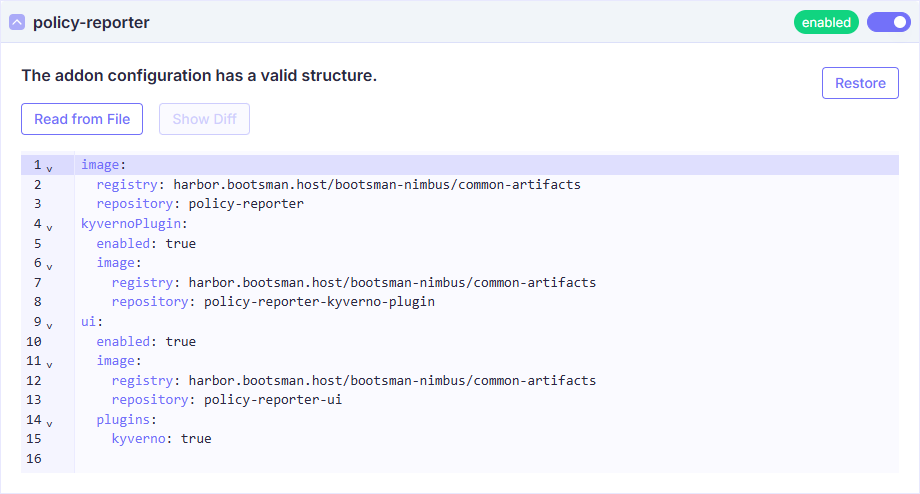
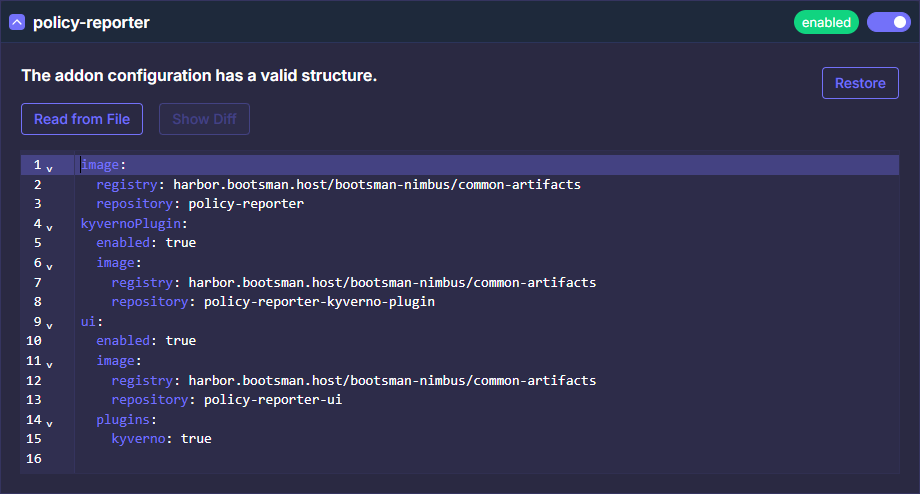
Все Values
Продвинутые настройки
Ниже представлены тонкие настройки модуля.
Используйте их для расширения конфигурации модуля, если потребуется.
Документация
Более полная документация по модулю:
Policy Reporter Cloud
Policy Reporter Chart
Policy reporter Values
  values:
    # Override the chart name used for all resources
    nameOverride: ""

    image:
      registry: harbor.bootsman.host/bootsman-nimbus/common-artifacts
      repository: policy-reporter
      pullPolicy: IfNotPresent
      tag: 2.15.2

    imagePullSecrets: []

    priorityClassName: ""

    replicaCount: 1

    deploymentStrategy: {}
      # rollingUpdate:
      #  maxSurge: 25%
      #  maxUnavailable: 25%
      # type: RollingUpdate

    # When using a custom port together with the PolicyReporter UI
    # the port has also to be changed in the UI subchart as well because it can't access the parent values.
    # You can change the port under `ui.policyReporter.port`
    port:
      name: http
      number: 8080

    # Key/value pairs that are attached to all resources.
    annotations: {}

    # Create cluster role policies
    rbac:
      enabled: true

    serviceAccount:
      # Specifies whether a service account should be created
      create: true
      # Annotations to add to the service account
      annotations: {}
      # The name of the service account to use.
      # If not set and create is true, a name is generated using the fullname template
      name: ""

    service:
      enabled: true
      ## configuration of service
      # key/value
      annotations: {}
      # key/value
      labels: {}
      type: ClusterIP
      # integer number. This is port for service
      port: 8080

    podSecurityContext:
      fsGroup: 1234

    securityContext:
      runAsUser: 1234
      runAsNonRoot: true
      privileged: false
      allowPrivilegeEscalation: false
      readOnlyRootFilesystem: true
      capabilities:
        drop:
          - ALL
      seccompProfile:
        type: RuntimeDefault

    # Key/value pairs that are attached to pods.
    podAnnotations: {}

    # Key/value pairs that are attached to pods.
    podLabels: {}

    resources: {}
      # We usually recommend not to specify default resources and to leave this as a conscious
      # choice for the user. This also increases chances charts run on environments with little
      # resources, such as Minikube. If you do want to specify resources, uncomment the following
      # lines, adjust them as necessary, and remove the curly braces after 'resources:'.
      # limits:
      #   memory: 100Mi
      #   cpu: 10m
      # requests:
      #   memory: 75Mi
      #   cpu: 5m

    # Enable a NetworkPolicy for this chart. Useful on clusters where Network Policies are
    # used and configured in a default-deny fashion.
    networkPolicy:
      enabled: false
      # Kubernetes API Server
      egress:
      - to:
        ports:
        - protocol: TCP
          port: 6443
      ingress: []

    ## Set to true to enable ingress record generation
    # ref to: https://kubernetes.io/docs/concepts/services-networking/ingress/
    ingress:
      enabled: false
      className: ""
      # key/value
      labels: {}
      # key/value
      annotations: {}
        # kubernetes.io/ingress.class: nginx
        # kubernetes.io/tls-acme: "true"
      hosts:
        - host: chart-example.local
          paths: []
      tls: []
      #  - secretName: chart-example-tls
      #    hosts:
      #      - chart-example.local

    logging:
      encoding: console # possible encodings are console and json
      logLevel: 0 # default info
      development: false # more human readable structure, enables stacktraces and removes log sampling

    api:
      logging: false # enable debug API access logging, sets logLevel to debug

    # REST API
    rest:
      enabled: false

    # Prometheus Metrics API
    metrics:
      enabled: false
      mode: detailed # available modes are detailed, simple and custom
      customLabels: [] # only used for custom mode. Supported fields are: ["namespace", "rule", "policy", "report" // PolicyReport name, "kind" // resource kind, "name" // resource name, "status", "severity", "category", "source"]
    #  filter:
    #    sources:
    #      exclude: ["Trivy CIS Kube Bench"]
    #    status:
    #      exclude: ["pass", "skip"]

    profiling:
      enabled: false

    # amount of queue workers for PolicyReport resource processing
    worker: 5

    # Filter PolicyReport resources to process
    reportFilter:
      namespaces:
        # Process only PolicyReport resources from an included namespace, wildcards are supported
        include: []
        # Ignore all PolicyReport resources from a excluded namespace, wildcards are supported
        # exclude will be ignored if an include filter exists
        exclude: []
      clusterReports:
        # Disable the processing of ClusterPolicyReports
        disabled: false

    # enable policy-report-ui
    ui:
      enabled: true
      image:
        registry: harbor.bootsman.host/bootsman-nimbus/common-artifacts
        repository: policy-reporter-ui
      plugins:
        kyverno: true

    kyvernoPlugin:
      enabled: false
      image:
        registry: harbor.bootsman.host/bootsman-nimbus/common-artifacts
        repository: policy-reporter-kyverno-plugin
    # Settings for the monitoring subchart
    monitoring:
      enabled: false

    database:
      # Database Type, supported: mysql, postgres, mariadb
      type: ""
      database: "" # Database Name
      username: ""
      password: ""
      host: ""
      enableSSL: false
      # instead of configure the individual values you can also provide an DSN string
      # example postgres: postgres://postgres:password@localhost:5432/postgres?sslmode=disable
      # example mysql: root:password@tcp(localhost:3306)/test?tls=false
      dsn: ""
      # configure an existing secret as source for your values
      # supported fields: username, password, host, dsn, database
      secretRef: ""
      # use an mounted secret as source for your values, required the information in JSON format
      # supported fields: username, password, host, dsn, database
      mountedSecret: ""

    global:
      # available plugins
      plugins:
        # enable kyverno for Policy Reporter UI and monitoring
        kyverno: false
      # The name of service policy-report. Defaults to ReleaseName.
      backend: ""
      # overwrite the fullname of all resources including subcharts
      fullnameOverride: ""
      # configure the namespace of all resources including subcharts
      namespace: ""
      # additional labels added on each resource
      labels: {}

    # configure mappings from policy to priority
    # you can use default to configure a default priority for fail results
    # example mapping
    #   default: warning
    #   require-ns-labels: error
    policyPriorities: {}

    emailReports:
      clusterName: "" # (optional) - displayed in the email report if configured
      smtp:
        secret: "" # (optional) secret name to provide the complete or partial SMTP configuration
        host: ""
        port: 465
        username: ""
        password: ""
        from: "" # displayed from email address
        encryption: "" # default is none, supports ssl/tls and starttls

      # basic summary report
      summary:
        enabled: false
        schedule: "0 8 * * *" # CronJob schedule defines when the report will be send
        activeDeadlineSeconds: 300 # timeout in seconds
        backoffLimit: 3 # retry counter
        ttlSecondsAfterFinished: 0
        restartPolicy: Never # pod restart policy

        to: [] # list of receiver email addresses
        filter: {} # optional filters
        #  disableClusterReports: false # remove ClusterPolicyResults from Reports
        #  namespaces:
        #    include: []
        #    exclude: []
        #  sources:
        #    include: []
        #    exclude: []
        channels: [] # (optional) channels can be used to to send only a subset of namespaces / sources to dedicated email addresses    channels: [] # (optional) channels can be used to to send only a subset of namespaces / sources to dedicated email addresses
        #  - to: ['team-a@company.org']
        #    filter:
        #      disableClusterReports: true
        #      namespaces:
        #        include: ['team-a-*']
        #      sources:
        #        include: ['Kyverno']
      # violation summary report
      violations:
        enabled: false
        schedule: "0 8 * * *" # CronJob schedule defines when the report will be send
        activeDeadlineSeconds: 300 # timeout in seconds
        backoffLimit: 3 # retry counter
        ttlSecondsAfterFinished: 0
        restartPolicy: Never # pod restart policy

        to: [] # list of receiver email addresses
        filter: {} # optional filters
        #  disableClusterReports: false # remove ClusterPolicyResults from Reports
        #  namespaces:
        #    include: []
        #    exclude: []
        #  sources:
        #    include: []
        #    exclude: []
        channels: [] # (optional) channels can be used to to send only a subset of namespaces / sources to dedicated email addresses    channels: [] # (optional) channels can be used to to send only a subset of namespaces / sources to dedicated email addresses
        #  - to: ['team-a@company.org']
        #    filter:
        #      disableClusterReports: true
        #      namespaces:
        #        include: ['team-a-*']
        #      sources:
        #        include: ['Kyverno']

    # Reference a configuration which already exists instead of creating one
    existingTargetConfig:
      enabled: false
      # Name of the secret with the config
      name: ""
      # subPath within the secret (defaults to config.yaml)
      subPath: ""

    # Supported targets for new PolicyReport Results
    target:
      loki:
        # loki host address
        host: ""
        # path to your custom certificate
        # can be added under extraVolumes
        certificate: ""
        # skip TLS verification if necessary
        skipTLS: false
        # receive the host from an existing secret instead
        secretRef: ""
        # Mounted secret path by Secrets Controller, secret should be in json format
        mountedSecret: ""
        # loki api path, defaults to "/api/prom/push" (deprecated)
        path: ""
        # minimum priority "" < info < warning < critical < error
        minimumPriority: ""
        # list of sources which should send to loki
        sources: []
        # Skip already existing PolicyReportResults on startup
        skipExistingOnStartup: true
        # Added as additional labels to each Loki event
        customLabels: {}
        # Filter Results which should send to this target by report labels, namespaces, priorities or policies
        # Wildcars for namespaces and policies are supported, you can either define exclude or include values
        # Filters are available for all targets except the UI
        filter: {}
    #      namespaces:
    #        include: ["develop"]
    #      priorities:
    #        exclude: ["debug", "info", "error"]
    #      labels:
    #        include: ["app", "owner:team-a", "monitoring:*"]
        channels: []
    #    - host: "http://loki.loki-stack:3100"
    #      sources: []
    #      customLabels: {}
    #      filter:
    #        namespaces:
    #          include: ["develop"]
    #        priorities:
    #          exclude: ["debug", "info", "error"]
    #        reportLabels:
    # .         include: ["app", "owner:team-b"]

      elasticsearch:
        # elasticsearch host address
        host: ""
        # path to your custom certificate
        # can be added under extraVolumes
        certificate: ""
        # skip TLS verification if necessary
        skipTLS: false
        # elasticsearch index (default: policy-reporter)
        index: ""
        # elasticsearch username für HTTP Basic Auth
        username: ""
        # elasticsearch password für HTTP Basic Auth
        password: ""
        # receive the host, username and/or password from an existing secret instead
        secretRef: ""
        # Mounted secret path by Secrets Controller, secret should be in json format
        mountedSecret: ""
        # elasticsearch index rotation and index suffix
        # possible values: daily, monthly, annually, none (default: daily)
        rotation: ""
        # minimum priority "" < info < warning < critical < error
        minimumPriority: ""
        # list of sources which should send to elasticsearch
        sources: []
        # Skip already existing PolicyReportResults on startup
        skipExistingOnStartup: true
        # Added as additional properties to each elasticsearch event
        customFields: {}
        # filter results send by namespaces, policies and priorities
        filter: {}
        # add additional elasticsearch channels with different configurations and filters
        channels: []

      slack:
        # slack app webhook address
        webhook: ""
        # slack channel
        channel: ""
        # receive the webhook from an existing secret instead
        secretRef: ""
        # Mounted secret path by Secrets Controller, secret should be in json format
        mountedSecret: ""
        # minimum priority "" < info < warning < critical < error
        minimumPriority: ""
        # list of sources which should send to slack
        sources: []
        # Skip already existing PolicyReportResults on startup
        skipExistingOnStartup: true
        # Added as additional fields to each Slack event
        customFields: {}
        # filter results send by namespaces, policies and priorities
        filter: {}
        # add additional slack channels with different configurations and filters
        channels: []
    #    - webhook: "https://slack.webhook1"
    #      channel: ""
    #      filter:
    #        namespaces:
    #          include: ["develop"]
    #        priorities:
    #          exclude: ["debug", "info", "error"]
    #        policies:
    #          include: ["require-run-as-nonroot"]
    #        reportLabels:
    # .         include: ["app", "owner:team-b"]
    #    - webhook: "https://slack.webhook2"
    #      minimumPriority: "warning"
    #      filter:
    #        namespaces:
    #          include: ["team-a-*"]

      discord:
        # discord app webhook address
        webhook: ""
        # receive the webhook from an existing secret instead
        secretRef: ""
        # Mounted secret path by Secrets Controller, secret should be in json format
        mountedSecret: ""
        # minimum priority "" < info < warning < critical < error
        minimumPriority: ""
        # list of sources which should send to discord
        sources: []
        # Skip already existing PolicyReportResults on startup
        skipExistingOnStartup: true
        # filter results send by namespaces, policies and priorities
        filter: {}
        # add additional discord channels with different configurations and filters
        channels: []

      teams:
        # teams webhook address
        webhook: ""
        # receive the webhook from an existing secret instead
        secretRef: ""
        # Mounted secret path by Secrets Controller, secret should be in json format
        mountedSecret: ""
        # path to your custom certificate
        # can be added under extraVolumes
        certificate: ""
        # skip TLS verification if necessary
        skipTLS: false
        # minimum priority "" < info < warning < critical < error
        minimumPriority: ""
        # list of sources which should send to teams
        sources: []
        # Skip already existing PolicyReportResults on startup
        skipExistingOnStartup: true
        # filter results send by namespaces, policies and priorities
        filter: {}
        # add additional teams channels with different configurations and filters
        channels: []

      ui:
        # ui host address
        host: ""
        # path to your custom certificate
        # can be added under extraVolumes
        certificate: ""
        # skip TLS verification if necessary
        skipTLS: false
        # minimum priority "" < info < warning < critical < error
        minimumPriority: "warning"
        # list of sources which should send to the UI Log
        sources: []
        # Skip already existing PolicyReportResults on startup
        skipExistingOnStartup: true

      webhook:
        # webhook host address
        host: ""
        # path to your custom certificate
        # can be added under extraVolumes
        certificate: ""
        # skip TLS verification if necessary
        skipTLS: false
        # receive the host and/or token from an existing secret, the token is added as Authorization header
        secretRef: ""
        # Mounted secret path by Secrets Controller, secret should be in json format
        mountedSecret: ""
        # additional http headers
        headers: {}
        # minimum priority "" < info < warning < critical < error
        minimumPriority: ""
        # list of sources which should send to the UI Log
        sources: []
        # Skip already existing PolicyReportResults on startup
        skipExistingOnStartup: true
        # Added as additional properties to each webhook event
        customFields: {}
        # filter results send by namespaces, policies and priorities
        filter: {}
        # add additional webhook channels with different configurations and filters
        channels: []

      s3:
        # S3 access key
        accessKeyID: ""
        # S3 secret access key
        secretAccessKey: ""
        # receive the accessKeyID and/or secretAccessKey from an existing secret instead
        secretRef: ""
        # Mounted secret path by Secrets Controller, secret should be in json format
        mountedSecret: ""
        # S3 storage region
        region: ""
        # S3 storage endpoint
        endpoint: ""
        # S3 storage, bucket name
        bucket: ""
        # S3 storage to use an S3 Bucket Key for object encryption with SSE-KMS
        bucketKeyEnabled: false
        # S3 storage KMS Key ID for object encryption with SSE-KMS
        kmsKeyId: ""
        # S3 storage server-side encryption algorithm used when storing this object in Amazon S3, AES256, aws:kms
        serverSideEncryption: ""
        # S3 storage, force path style configuration
        pathStyle: false
        # name of prefix, keys will have format: s3://<bucket>/<prefix>/YYYY-MM-DD/YYYY-MM-DDTHH:mm:ss.s+01:00.json
        prefix: ""
        # minimum priority "" < info < warning < critical < error
        minimumPriority: ""
        # list of sources which should send to S3
        sources: []
        # Skip already existing PolicyReportResults on startup
        skipExistingOnStartup: true
        # Added as additional properties to each s3 event
        customFields: {}
        # filter results send by namespaces, policies and priorities
        filter: {}
        # add additional s3 channels with different configurations and filters
        channels: []

      kinesis:
        # AWS access key
        accessKeyID: ""
        # AWS secret access key
        secretAccessKey: ""
        # receive the accessKeyID and/or secretAccessKey from an existing secret instead
        secretRef: ""
        # Mounted secret path by Secrets Controller, secret should be in json format
        mountedSecret: ""
        # AWS region
        region: ""
        # AWS Kinesis endpoint
        endpoint: ""
        # AWS Kinesis stream name
        streamName: ""
        # minimum priority "" < info < warning < critical < error
        minimumPriority: ""
        # list of sources which should send to S3
        sources: []
        # Skip already existing PolicyReportResults on startup
        skipExistingOnStartup: true
        # Added as additional properties to each kinesis event
        customFields: {}
        # filter results send by namespaces, policies and priorities
        filter: {}
        # add additional s3 channels with different configurations and filters
        channels: []

      securityHub:
        # AWS access key
        accessKeyID: ""
        # AWS secret access key
        secretAccessKey: ""
        # receive the accessKeyID and/or secretAccessKey from an existing secret instead
        secretRef: ""
        # Mounted secret path by Secrets Controller, secret should be in json format
        mountedSecret: ""
        # AWS region
        region: ""
        # AWS SecurityHub endpoint (optional)
        endpoint: ""
        # AWS accountID
        accountID: ""
        # minimum priority "" < info < warning < critical < error
        minimumPriority: ""
        # list of sources which should send to S3
        sources: []
        # Skip already existing PolicyReportResults on startup
        skipExistingOnStartup: true
        # Added as additional properties to each securityHub event
        customFields: {}
        # filter results send by namespaces, policies and priorities
        filter: {}
        # add additional s3 channels with different configurations and filters
        channels: []

      gcs:
        # GCS (Google Cloud Storage) Service Accout Credentials
        credentials: ""
        # receive the credentials from an existing secret instead
        secretRef: ""
        # Mounted secret path by Secrets Controller, secret should be in json format
        mountedSecret: ""
        # GCS Bucket
        bucket: ""
        # minimum priority "" < info < warning < critical < error
        minimumPriority: ""
        # list of sources which should send to GCS
        sources: []
        # Skip already existing PolicyReportResults on startup
        skipExistingOnStartup: true
        # Added as additional properties to each gcs event
        customFields: {}
        # filter results send by namespaces, policies and priorities
        filter: {}
        # add additional s3 channels with different configurations and filters
        channels: []

    # required when policy-reporter runs in HA mode and you have targets configured
    # if no targets are configured, leaderElection is disabled automatically
    # will be enabled when replicaCount > 1
    leaderElection:
      enabled: false
      releaseOnCancel: true
      leaseDuration: 15
      renewDeadline: 10
      retryPeriod: 2

    # use redis as external result cache instead of the in memory cache
    redis:
      enabled: false
      address: ""
      database: 0
      prefix: "policy-reporter"
      username: ""
      password: ""

    # enabled if replicaCount > 1
    podDisruptionBudget:
      # -- Configures the minimum available pods for policy-reporter disruptions.
      # Cannot be used if `maxUnavailable` is set.
      minAvailable: 1
      # -- Configures the maximum unavailable pods for policy-reporter disruptions.
      # Cannot be used if `minAvailable` is set.
      maxUnavailable:

    # Node labels for pod assignment
    # ref: https://kubernetes.io/docs/user-guide/node-selection/
    nodeSelector: {}

    # Tolerations for pod assignment
    # ref: https://kubernetes.io/docs/concepts/configuration/taint-and-toleration/
    tolerations: []

    # Anti-affinity to disallow deploying client and master nodes on the same worker node
    affinity: {}

    # Topology Spread Constraints to better spread pods
    topologySpreadConstraints: []

    # livenessProbe for policy-reporter
    livenessProbe:
      httpGet:
        path: /ready
        port: http

    # readinessProbe for policy-reporter
    readinessProbe:
      httpGet:
        path: /healthz
        port: http

    extraVolumes:
      volumeMounts: []

      volumes: []

    # If set the volume for sqlite is freely configurable below "- name: sqlite". If no value is set an emptyDir is used.
    sqliteVolume: {}
      # emptyDir:
      #   sizeLimit: 10Mi